NTA JEE Main 8th April 2019 Shift 1
For the following questions answer them individually
NTA JEE Main 8th April 2019 Shift 1 - Question 11
A thermally insulated vessel contains 150 g of water at 0°C. Then the air from the vessel is pumped out adiabatically. A fraction of water turns into ice and the rest evaporates at 0°C itself. The mass of evaporated water will be closest to: (Latent heat of vaporization of water = $$2.10 \times 10^{6}$$ J kg$$^{-1}$$ and Latent heat of Fusion of water = $$3.36 \times 10^{5}$$ J kg$$^{-1}$$)
NTA JEE Main 8th April 2019 Shift 1 - Question 12
Two identical beakers A and B contain equal volumes of two different liquids at 60°C each and left to cool down. Liquid in A has density of $$8 \times 10^{2}$$ kg m$$^{-3}$$ and specific heat of 2000 J kg$$^{-1}$$K$$^{-1}$$ while the liquid in B has density $$10^{3}$$ kg m$$^{-3}$$ and specific heat of 4000 J kg$$^{-1}$$K$$^{-1}$$. Which of the following best describes their temperature versus time graph schematically? (assume the emissivity of both the beakers to be the same)
NTA JEE Main 8th April 2019 Shift 1 - Question 13
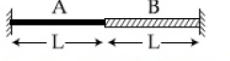
A wire of length 2L, is made by joining two wires A and B of same length but different radii r and 2r and made of the same material. It is vibrating at a frequency such that the joint of the two wires forms a node. If the number of antinodes in wire A is p and that in B is q then ratio p:q is:

NTA JEE Main 8th April 2019 Shift 1 - Question 14
The bob of a simple pendulum has mass 2 g and a charge of 5.0 $$\mu$$C. It is at rest in a uniform horizontal electric field of intensity 2000 V/m. At equilibrium, the angle that the pendulum makes with the vertical is: (take g = 10 m/s$$^{2}$$)
NTA JEE Main 8th April 2019 Shift 1 - Question 15
A solid conducting sphere, having a charge Q, is surrounded by an uncharged conducting hollow spherical shell. Let the potential difference between the surface of the solid sphere and that of the outer surface of the hollow shell be V. If the shell is now given a charge of -4Q, the new potential difference between the same two surfaces is:
NTA JEE Main 8th April 2019 Shift 1 - Question 16
Voltage rating of a parallel plate capacitor is 500 V. Its dielectric can withstand a maximum electric field of $$10^{6}$$ V/m. The plate area is $$10^{-4}$$ m$$^{2}$$. What is the dielectric constant if the capacitance is 15 pF? (given $$\varepsilon_0 = 8.86 \times 10^{-12}$$ C$$^{2}$$/Nm$$^{2}$$)
NTA JEE Main 8th April 2019 Shift 1 - Question 17
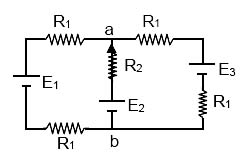
For the circuit shown, with $$R_1 = 1.0 \; \Omega$$, $$R_2 = 2.0 \; \Omega$$, $$E_1 = 2$$ V and $$E_2 = E_3 = 4$$ V, the potential difference between the points 'a' and 'b' is approximately (in V):
NTA JEE Main 8th April 2019 Shift 1 - Question 18
A 200 $$\Omega$$ resistor has certain colour code. If one replaced the red colour by green in the code, the new resistance will be:
NTA JEE Main 8th April 2019 Shift 1 - Question 19
A circular coil having N turns and radius r carries a current I. It is held in the XZ plane in a magnetic field $$B\hat{i}$$. The torque on the coil due to the magnetic field is:
NTA JEE Main 8th April 2019 Shift 1 - Question 20
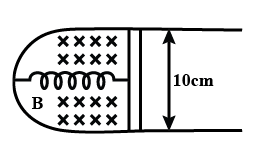
A thin strip 10 cm long is on a U shaped wire of negligible resistance and it is connected to a spring of spring constant 0.5 N m$$^{-1}$$ (see figure). The assembly is kept in a uniform magnetic field of 0.1 T. If the strip is pulled from its equilibrium position and released, the number of oscillations it performs before its amplitude decreases by a factor of e is N. If the mass of the strip is 50 grams, its resistance 10$$\Omega$$ and air drag negligible, N will be close to: