NTA JEE Main 8th April 2019 Shift 1
For the following questions answer them individually
NTA JEE Main 8th April 2019 Shift 1 - Question 21
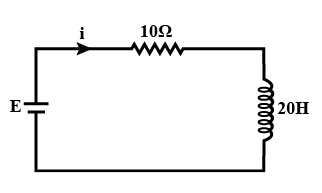
A 20 H inductor coil is connected to a 10 $$\Omega$$ resistance in series as shown in figure. The time at which rate of dissipation of energy (Joule's heat) across resistance is equal to the rate at which magnetic energy is stored in the inductor, is:
NTA JEE Main 8th April 2019 Shift 1 - Question 22
An alternating voltage $$V(t) = 220\sin(100\pi t)$$ volt is applied to a purely resistive load of 50 $$\Omega$$. The time taken for the current to rise from half of the peak value to the peak value is:
NTA JEE Main 8th April 2019 Shift 1 - Question 23
A plane electromagnetic wave travels in free space along the x-direction. The electric field component of the wave at a particular point of space and time is E = 6 V m$$^{-1}$$ along y-direction. Its corresponding magnetic field component, B would be:

NTA JEE Main 8th April 2019 Shift 1 - Question 24
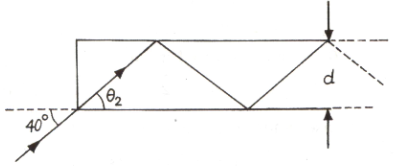
In figure, the optical fiber is $$l = 2$$ m long and has a diameter of $$d = 20 \; \mu$$m. If a ray of light is incident on one end of the fiber at angle $$\theta_1 = 40°$$, the number of reflections it makes before emerging from the other end is close to: (refractive index of fiber is 1.31, sin 40° = 0.64 and sin$$^{-1}$$(0.49) = 30°.)
NTA JEE Main 8th April 2019 Shift 1 - Question 25
An upright object is placed at a distance of 40 cm in front of a convergent lens of focal length 20 cm. A convergent mirror of focal length 10 cm is placed at a distance of 60 cm on the other side of the lens. The position and size of the final image will be:
NTA JEE Main 8th April 2019 Shift 1 - Question 26
In an interference experiment the ratio of amplitudes of coherent waves is $$\frac{a_1}{a_2} = \frac{1}{3}$$. The ratio of maximum and minimum intensities of fringes will be:
NTA JEE Main 8th April 2019 Shift 1 - Question 27
Two particles move at right angle to each other. Their de Broglie wavelengths are $$\lambda_1$$ and $$\lambda_2$$ respectively. The particles suffer perfectly inelastic collision. The de Broglie wavelength $$\lambda$$ of the final particle, is given by:
NTA JEE Main 8th April 2019 Shift 1 - Question 28
Radiation coming from transitions $$n = 2$$ to $$n = 1$$ of hydrogen atoms fall on He$$^{+}$$ ions in $$n = 1$$ and $$n = 2$$ states. The possible transition of helium ions as they absorb energy from the radiation is:
NTA JEE Main 8th April 2019 Shift 1 - Question 29
The reverse break down voltage of a Zener diode is 5.6 V in the given circuit.
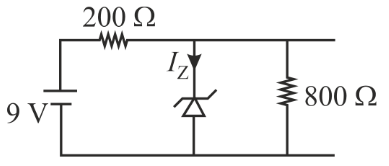
The current I$$_z$$ through the Zener is:
NTA JEE Main 8th April 2019 Shift 1 - Question 30
The wavelength of the carrier waves in a modern optical fiber communication network is close to: