For the following questions answer them individually
Ship A is sailing towards north-east with velocity $$\vec{v} = 30\hat{i} + 50\hat{j}$$ km h$$^{-1}$$ where $$\hat{i}$$ points east and $$\hat{j}$$, north. The ship B is at a distance of 80 km east and 150 km north of Ship A and is sailing towards the west at 10 km h$$^{-1}$$. A will be at the minimum distance from B in:
In SI units, the dimensions of $$\sqrt{\frac{\varepsilon_0}{\mu_0}}$$ is:
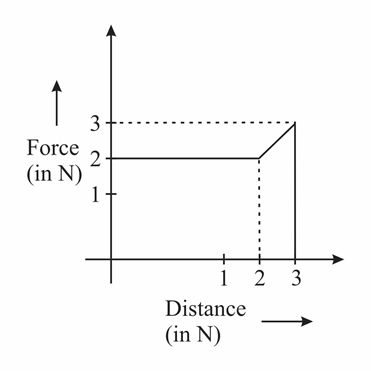
A particle moves in one dimension from rest under the influence of a force that varies with the distance traveled by the particle as shown in the figure. The kinetic energy of the particle after it has traveled 3 m is:
If $$10^{22}$$ gas molecules each of mass $$10^{-26}$$ kg collides with a surface (perpendicular to it) elastically per second over an area 1 m$$^{2}$$ with a speed $$10^{4}$$ m/s, the pressure exerted by the gas molecules will be of the order of:
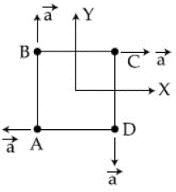
Four particles A, B, C and D with masses $$m_A = m$$, $$m_B = 2m$$, $$m_C = 3m$$ and $$m_D = 4m$$ are at the corners of a square. They have accelerations of equal magnitude with directions as shown. The acceleration of the centre of mass of the particles is:
A thin circular plate of mass $$M$$ and radius $$R$$ has its density varying as $$\rho(r) = \rho_0 r$$ with $$\rho_0$$ as constant and $$r$$ is the distance from its centre. The moment of Inertia of the circular plate about an axis perpendicular to the plate and passing through its edge is $$I = aMR^{2}$$. The value of the coefficient $$a$$ is:
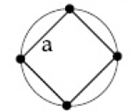
Four identical particles of mass M are located at the corners of a square of side 'a'. What should be their speed if each of them revolves under the influence of other's gravitational field in a circular orbit circumscribing the square?
A boy's catapult is made of rubber cord which is 42 cm long, with 6 mm diameter of cross-section and of negligible mass. The boy keeps a stone weighing 0.02 kg on it and stretches the cord by 20 cm by applying a constant force. When released, the stone flies off with a velocity of 20 ms$$^{-1}$$. Neglect the change in the area of cross-section of the cord while stretched. The Young's modulus of rubber is closest to:
A steel wire having a radius of 2.0 mm, carrying a load of 4 kg, is hanging from a ceiling. Given that g = 3.1$$\pi$$ m s$$^{-2}$$, what will be the tensile stress that would be developed in the wire?
Water from a pipe is coming at a rate of 100 liters per minute. If the radius of the pipe is 5 cm, the Reynolds number for the flow is of the order of: (density of water = 100 kg/m$$^{3}$$, coefficient of viscosity of water = 1 mPa s)
A thermally insulated vessel contains 150 g of water at 0°C. Then the air from the vessel is pumped out adiabatically. A fraction of water turns into ice and the rest evaporates at 0°C itself. The mass of evaporated water will be closest to: (Latent heat of vaporization of water = $$2.10 \times 10^{6}$$ J kg$$^{-1}$$ and Latent heat of Fusion of water = $$3.36 \times 10^{5}$$ J kg$$^{-1}$$)
Two identical beakers A and B contain equal volumes of two different liquids at 60°C each and left to cool down. Liquid in A has density of $$8 \times 10^{2}$$ kg m$$^{-3}$$ and specific heat of 2000 J kg$$^{-1}$$K$$^{-1}$$ while the liquid in B has density $$10^{3}$$ kg m$$^{-3}$$ and specific heat of 4000 J kg$$^{-1}$$K$$^{-1}$$. Which of the following best describes their temperature versus time graph schematically? (assume the emissivity of both the beakers to be the same)
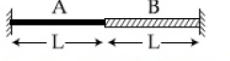
A wire of length 2L, is made by joining two wires A and B of same length but different radii r and 2r and made of the same material. It is vibrating at a frequency such that the joint of the two wires forms a node. If the number of antinodes in wire A is p and that in B is q then ratio p:q is:
The bob of a simple pendulum has mass 2 g and a charge of 5.0 $$\mu$$C. It is at rest in a uniform horizontal electric field of intensity 2000 V/m. At equilibrium, the angle that the pendulum makes with the vertical is: (take g = 10 m/s$$^{2}$$)
A solid conducting sphere, having a charge Q, is surrounded by an uncharged conducting hollow spherical shell. Let the potential difference between the surface of the solid sphere and that of the outer surface of the hollow shell be V. If the shell is now given a charge of -4Q, the new potential difference between the same two surfaces is:
Voltage rating of a parallel plate capacitor is 500 V. Its dielectric can withstand a maximum electric field of $$10^{6}$$ V/m. The plate area is $$10^{-4}$$ m$$^{2}$$. What is the dielectric constant if the capacitance is 15 pF? (given $$\varepsilon_0 = 8.86 \times 10^{-12}$$ C$$^{2}$$/Nm$$^{2}$$)
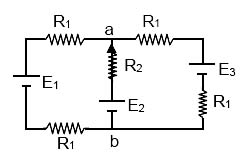
For the circuit shown, with $$R_1 = 1.0 \; \Omega$$, $$R_2 = 2.0 \; \Omega$$, $$E_1 = 2$$ V and $$E_2 = E_3 = 4$$ V, the potential difference between the points 'a' and 'b' is approximately (in V):
A 200 $$\Omega$$ resistor has certain colour code. If one replaced the red colour by green in the code, the new resistance will be:
A circular coil having N turns and radius r carries a current I. It is held in the XZ plane in a magnetic field $$B\hat{i}$$. The torque on the coil due to the magnetic field is:
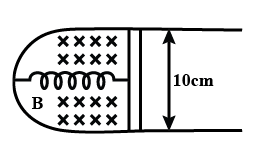
A thin strip 10 cm long is on a U shaped wire of negligible resistance and it is connected to a spring of spring constant 0.5 N m$$^{-1}$$ (see figure). The assembly is kept in a uniform magnetic field of 0.1 T. If the strip is pulled from its equilibrium position and released, the number of oscillations it performs before its amplitude decreases by a factor of e is N. If the mass of the strip is 50 grams, its resistance 10$$\Omega$$ and air drag negligible, N will be close to:
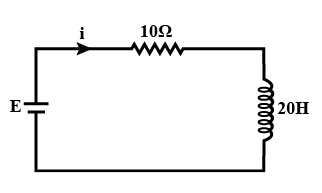
A 20 H inductor coil is connected to a 10 $$\Omega$$ resistance in series as shown in figure. The time at which rate of dissipation of energy (Joule's heat) across resistance is equal to the rate at which magnetic energy is stored in the inductor, is:
An alternating voltage $$V(t) = 220\sin(100\pi t)$$ volt is applied to a purely resistive load of 50 $$\Omega$$. The time taken for the current to rise from half of the peak value to the peak value is:
A plane electromagnetic wave travels in free space along the x-direction. The electric field component of the wave at a particular point of space and time is E = 6 V m$$^{-1}$$ along y-direction. Its corresponding magnetic field component, B would be:
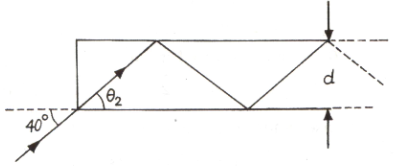
In figure, the optical fiber is $$l = 2$$ m long and has a diameter of $$d = 20 \; \mu$$m. If a ray of light is incident on one end of the fiber at angle $$\theta_1 = 40°$$, the number of reflections it makes before emerging from the other end is close to: (refractive index of fiber is 1.31, sin 40° = 0.64 and sin$$^{-1}$$(0.49) = 30°.)
An upright object is placed at a distance of 40 cm in front of a convergent lens of focal length 20 cm. A convergent mirror of focal length 10 cm is placed at a distance of 60 cm on the other side of the lens. The position and size of the final image will be:
In an interference experiment the ratio of amplitudes of coherent waves is $$\frac{a_1}{a_2} = \frac{1}{3}$$. The ratio of maximum and minimum intensities of fringes will be:
Two particles move at right angle to each other. Their de Broglie wavelengths are $$\lambda_1$$ and $$\lambda_2$$ respectively. The particles suffer perfectly inelastic collision. The de Broglie wavelength $$\lambda$$ of the final particle, is given by:
Radiation coming from transitions $$n = 2$$ to $$n = 1$$ of hydrogen atoms fall on He$$^{+}$$ ions in $$n = 1$$ and $$n = 2$$ states. The possible transition of helium ions as they absorb energy from the radiation is:
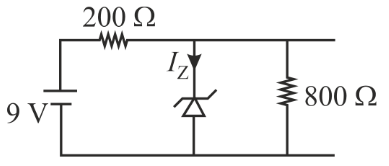
The reverse break down voltage of a Zener diode is 5.6 V in the given circuit.

The current I$$_z$$ through the Zener is:
The wavelength of the carrier waves in a modern optical fiber communication network is close to: