
Join Our JEE Preparation Group
Prep with like-minded aspirants; Get access to free daily tests and study material.
Sign in
Please select an account to continue using cracku.in
↓ →
Join Our JEE Preparation Group
Prep with like-minded aspirants; Get access to free daily tests and study material.
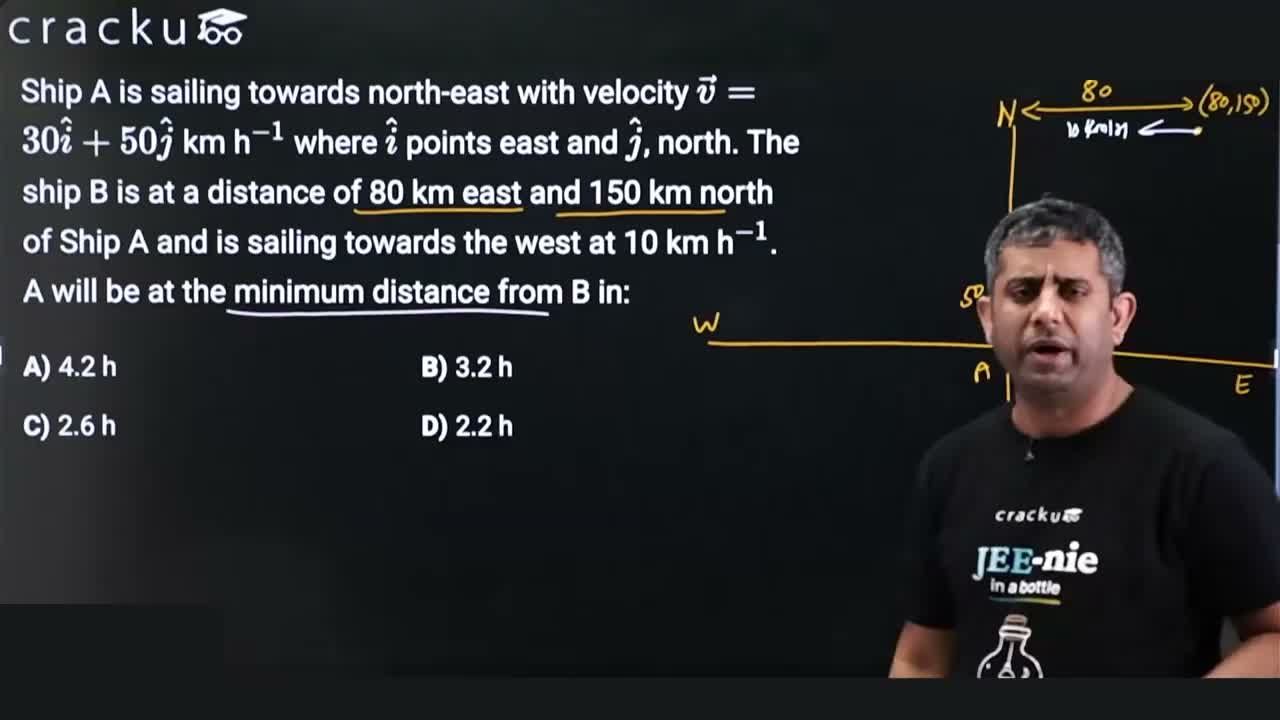
Ship A is sailing towards north-east with velocity $$\vec{v} = 30\hat{i} + 50\hat{j}$$ km h$$^{-1}$$ where $$\hat{i}$$ points east and $$\hat{j}$$, north. The ship B is at a distance of 80 km east and 150 km north of Ship A and is sailing towards the west at 10 km h$$^{-1}$$. A will be at the minimum distance from B in:
Let us first describe the data in vector language. We adopt east as the positive $$x$$-direction and north as the positive $$y$$-direction, so the unit vectors are $$\hat{i}$$ to the east and $$\hat{j}$$ to the north.
Ship A is moving with velocity
$$\vec v_A = 30\hat i + 50\hat j\ \text{km h}^{-1}.$$
Ship B is initially 80 km east and 150 km north of A. Measured from A, its initial position vector is therefore
$$\vec r_0 = 80\hat i + 150\hat j\ \text{km}.$$
Ship B is sailing due west at 10 km h$$^{-1}$$, hence
$$\vec v_B = -10\hat i\ \text{km h}^{-1}.$$
We are interested in the separation between the two ships, so we examine the relative motion of B with respect to A. The relative velocity is given by the formula
$$\vec v_{\text{rel}} = \vec v_B - \vec v_A.$$
Substituting the individual velocities, we have
$$\vec v_{\text{rel}} = (-10\hat i) - (30\hat i + 50\hat j)$$ $$= -10\hat i - 30\hat i - 50\hat j$$ $$= -40\hat i - 50\hat j\ \text{km h}^{-1}.$$
At any time $$t$$ hours after the instant chosen as $$t=0$$, the relative position vector of B with respect to A is
$$\vec r(t) = \vec r_0 + \vec v_{\text{rel}}\,t.$$
Substituting $$\vec r_0$$ and $$\vec v_{\text{rel}}$$, we obtain
$$\vec r(t) = (80\hat i + 150\hat j) + (-40\hat i - 50\hat j)t$$ $$= (80 - 40t)\hat i + (150 - 50t)\hat j.$$
The actual separation between the ships is the magnitude of $$\vec r(t)$$. To find the time of minimum distance we minimise the square of that magnitude, because the square is easier to differentiate and has its minimum at the same instant. Using the formula $$|\vec r|^2 = x^2 + y^2$$, we write
$$D^2(t) = (80 - 40t)^2 + (150 - 50t)^2.$$
Now we differentiate $$D^2(t)$$ with respect to $$t$$ and set the derivative equal to zero. This ensures the distance is extremal (and here it will be a minimum):
$$\frac{d}{dt}D^2(t) = 2(80 - 40t)(-40) + 2(150 - 50t)(-50) = 0.$$
We can cancel the factor 2 to simplify:
$$(80 - 40t)(-40) + (150 - 50t)(-50) = 0.$$
Expanding each product, we get
$$-40\cdot80 + 40\cdot40t - 50\cdot150 + 50\cdot50t = 0,$$ $$-3200 + 1600t - 7500 + 2500t = 0.$$
Collecting like terms,
$$(-3200 - 7500) + (1600 + 2500)t = 0,$$ $$-10700 + 4100t = 0.$$
Isolating $$t$$ yields
$$4100t = 10700,$$ $$t = \frac{10700}{4100}.$$
We divide numerator and denominator by 100 to simplify:
$$t = \frac{107}{41} \ \text{h}.$$
Performing the division,
$$t \approx 2.609756\ \text{h}.$$
Rounded to one decimal place this is 2.6 h, which matches Option C.
Hence, the correct answer is Option C.
Was this solution helpful?
Click on the Email ☝️ to Watch the Video Solution
Create a FREE account and get:
_1.webp)

Educational materials for JEE preparation

Ask our AI anything

AI can make mistakes. Please verify important information.
AI can make mistakes. Please verify important information.
