NTA JEE Main 6th September 2020 Shift 2
For the following questions answer them individually
NTA JEE Main 6th September 2020 Shift 2 - Question 1
A particle moving in the xy-plane experiences a velocity dependent force $$\vec{F} = k(v_y\hat{i} + v_x\hat{j})$$, where $$v_x$$ and $$v_y$$ are the x and y components of its velocity $$\vec{v}$$. If $$\vec{a}$$ is the acceleration of the particle, then which of the following statements is true for the particle?
NTA JEE Main 6th September 2020 Shift 2 - Question 2
When a car is at rest, its driver sees rain drops falling on it vertically. When driving the car with speed $$v$$, he sees that rain drops coming at an angle $$60^\circ$$ from the horizontal. On further increasing the speed of the car to $$(1+\beta)v$$, this angle changes to $$45^\circ$$. The value of $$\beta$$ is close to:
NTA JEE Main 6th September 2020 Shift 2 - Question 3
Particle A of mass $$m_1$$ moving with velocity $$(\sqrt{3}\hat{i} + \hat{j})\,\text{ms}^{-1}$$ collides with another particle B of mass $$m_2$$ which is at rest initially. Let $$\vec{v}_1$$ and $$\vec{v}_2$$ be the velocities of particles A and B after collision respectively. If $$m_1 = 2m_2$$ and after collision $$\vec{v}_1 - (\hat{i} + \sqrt{3}\hat{j})\,\text{ms}^{-1}$$, the angle between $$\vec{v}_1$$ and $$\vec{v}_2$$ is:

NTA JEE Main 6th September 2020 Shift 2 - Question 4
The linear mass density of a thin rod AB of length L varies from A to B as $$\lambda(x) = \lambda_0\left(1 + \frac{x}{L}\right)$$, where $$x$$ is the distance from A. If M is the mass of the rod then its moment of inertia about an axis passing through A and perpendicular to the rod is:
NTA JEE Main 6th September 2020 Shift 2 - Question 5
Two planets have masses M and 16M and their radii are $$a$$ and $$2a$$, respectively. The separation between the centres of the planets is $$10a$$. A body of mass $$m$$ is fired from the surface of the larger planet towards the smaller planet along the line joining their centres. For the body to be able to reach at the surface of smaller planet, the minimum firing speed needed is:
NTA JEE Main 6th September 2020 Shift 2 - Question 6
A fluid is flowing through a horizontal pipe of varying cross-section, with speed $$v\,\text{ms}^{-1}$$ at a point where the pressure is P Pascal. At another point where pressure is $$\frac{P}{2}$$ Pascal its speed is $$V\,\text{ms}^{-1}$$. If the density of the fluid is $$\rho\,\text{kg m}^{-3}$$ and the flow is streamline, then $$V$$ is equal to:
NTA JEE Main 6th September 2020 Shift 2 - Question 7
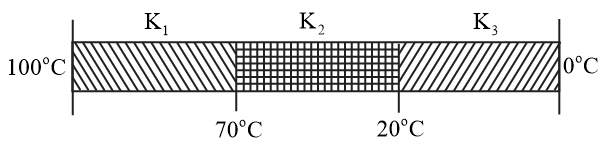
Three rods of identical cross-section and length are made of three different materials of thermal conductivity $$K_1$$, $$K_2$$ and $$K_3$$, respectively. They are joined together at their ends to make a long rod (see figure). One end of the long rod is maintained at $$100^\circ\text{C}$$ and the other at $$0^\circ\text{C}$$ (see figure). If the joints of the rod are at $$70^\circ\text{C}$$ and $$20^\circ\text{C}$$ in steady state and there is no loss of energy from the surface of the rod, the correct relationship between $$K_1$$, $$K_2$$ and $$K_3$$ is:
NTA JEE Main 6th September 2020 Shift 2 - Question 8
In a dilute gas at pressure P and temperature 't', the time between successive collision of a molecule varies with T as:
NTA JEE Main 6th September 2020 Shift 2 - Question 9
Assuming the nitrogen molecule is moving with r.m.s. velocity at 400 K, the de-Broglie wave length of nitrogen molecule is close to: (Given: nitrogen molecule weight: $$4.64 \times 10^{-26}\,\text{kg}$$, Boltzman constant: $$1.38 \times 10^{-23}\,\text{J K}^{-1}$$, Planck constant: $$6.63 \times 10^{-34}\,\text{J s}$$)
NTA JEE Main 6th September 2020 Shift 2 - Question 10
When a particle of mass $$m$$ is attached to a vertical spring of spring constant $$k$$ and released, its motion is described by $$y(t) = y_0\sin^2\omega t$$, where 'y' is measured from the lower end of unstretched spring. Then $$\omega$$ is: