NTA JEE Main 29th July 2022 Shift 2
For the following questions answer them individually
NTA JEE Main 29th July 2022 Shift 2 - Question 1
Match List I with List II.
| List I | List II |
|---|---|
| (A) Torque | (I) Nm s$$^{-1}$$ |
| (B) Stress | (II) J kg$$^{-1}$$ |
| (C) Latent Heat | (III) Nm |
| (D) Power | (IV) Nm$$^{-2}$$ |
Choose the correct answer from the options given below:
NTA JEE Main 29th July 2022 Shift 2 - Question 2
A juggler throws balls vertically upwards with same initial velocity in air. When the first ball reaches its highest position, he throws the next ball. Assuming the juggler throws $$n$$ balls per second, the maximum height the balls can reach is
NTA JEE Main 29th July 2022 Shift 2 - Question 3
A ball is released from a height $$h$$. If $$t_1$$ and $$t_2$$ be the time required to complete first half and second half of the distance respectively. Then, choose the correct relation between $$t_1$$ and $$t_2$$.

NTA JEE Main 29th July 2022 Shift 2 - Question 4
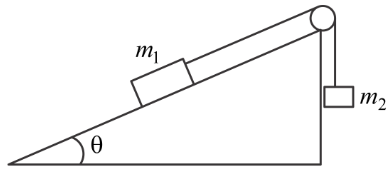
Two bodies of masses $$m_1 = 5$$ kg and $$m_2 = 3$$ kg are connected by a light string going over a smooth light pulley on a smooth inclined plane as shown in the figure. The system is at rest. The force exerted by the inclined plane on the body of mass $$m_1$$ will be: [Take $$g = 10$$ m s$$^{-2}$$]
NTA JEE Main 29th July 2022 Shift 2 - Question 5
If momentum of a body is increased by 20%, then its kinetic energy increases by:
NTA JEE Main 29th July 2022 Shift 2 - Question 6
The torque of a force $$5\hat{i} + 3\hat{j} - 7\hat{k}$$ about the origin is $$\vec{\tau}$$. If the force acts on a particle whose position vector is $$2\hat{i} + 2\hat{j} + \hat{k}$$, then the value of $$\vec{\tau}$$ will be
NTA JEE Main 29th July 2022 Shift 2 - Question 7
An object of mass 1 kg is taken to a height from the surface of earth which is equal to three times the radius of earth. The gain in potential energy of the object will be [If, $$g = 10$$ m s$$^{-2}$$ and radius of earth = 6400 km]
NTA JEE Main 29th July 2022 Shift 2 - Question 8
A thermodynamic system is taken from an original state D to an intermediate state E by the linear process shown in the figure. Its volume is then reduced to the original volume from E to F by an isobaric process. The total work done by the gas from D to E to F will be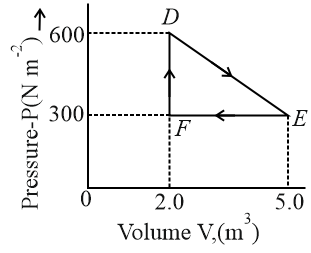
NTA JEE Main 29th July 2022 Shift 2 - Question 9
The root mean square speed of smoke particles of mass $$5 \times 10^{-17}$$ kg in their Brownian motion in air at NTP is approximately. [Given $$k = 1.38 \times 10^{-23}$$ J K$$^{-1}$$]
NTA JEE Main 29th July 2022 Shift 2 - Question 10
Two identical metallic spheres A and B when placed at certain distance in air repel each other with a force of F. Another identical uncharged sphere C is first placed in contact with A and then in contact with B and finally placed at midpoint between spheres A and B. The force experienced by sphere C will be: