NTA JEE Main 26th February 2021 Shift 2
For the following questions answer them individually
NTA JEE Main 26th February 2021 Shift 2 - Question 1
A wire of 1 $$\Omega$$ has a length of 1 m. It is stretched till its length increases by 25%. The percentage change in resistance to the nearest integer is:
NTA JEE Main 26th February 2021 Shift 2 - Question 2
If $$C$$ and $$V$$ represent capacity and voltage respectively then what are the dimensions of $$\lambda$$ where $$C/V = \lambda$$?
NTA JEE Main 26th February 2021 Shift 2 - Question 3
A scooter accelerates from rest for time $$t_1$$ at constant rate $$a_1$$ and then retards at constant rate $$a_2$$ for time $$t_2$$ and comes to rest. The correct value of $$\frac{t_1}{t_2}$$ will be:

NTA JEE Main 26th February 2021 Shift 2 - Question 4
The trajectory of a projectile in a vertical plane is $$y = \alpha x - \beta x^2$$, where $$\alpha$$ and $$\beta$$ are constants and $$x$$ & $$y$$ are respectively the horizontal and vertical distances of the projectile from the point of projection. The angle of projection $$\theta$$ and the maximum height attained $$H$$ are respectively given by
NTA JEE Main 26th February 2021 Shift 2 - Question 5
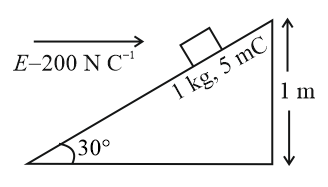
An inclined plane making an angle of 30° with the horizontal is placed in a uniform horizontal electric field 200 $$\frac{N}{C}$$ as shown in the figure. A body of mass 1 kg and charge 5 mC is allowed to slide down from rest at a height of 1 m. If the coefficient of friction is 0.2, find the time taken by the body to reach the bottom.
[g = 9.8 m $$s^{-2}$$; $$\sin 30^{\circ} =\frac{1}{2}$$; $$\cos 30^{\circ} = \frac{\sqrt{3}}{2}$$]
NTA JEE Main 26th February 2021 Shift 2 - Question 6
Two masses $$A$$ and $$B$$, each of mass $$M$$ are fixed together by a massless spring. A force acts on the mass $$B$$ as shown in figure. If the mass $$A$$ starts moving away from mass $$B$$ with acceleration $$a$$, then the acceleration of mass $$B$$ will be:
NTA JEE Main 26th February 2021 Shift 2 - Question 7
A cord is wound round the circumference of wheel of radius $$r$$. The axis of the wheel is horizontal and the moment of inertia about it is $$I$$. A weight $$mg$$ is attached to the cord at the end. The weight falls from rest. After falling through a distance h, the square of angular velocity of wheel will be
NTA JEE Main 26th February 2021 Shift 2 - Question 8
The length of metallic wire is $$l_1$$ when tension in it is $$T_1$$. It is $$l_2$$ when the tension is $$T_2$$. The original length of the wire will be:
NTA JEE Main 26th February 2021 Shift 2 - Question 9
The internal energy (U), pressure (P) and volume (V) of an ideal gas are related as $$U = 3PV + 4$$. The gas is
NTA JEE Main 26th February 2021 Shift 2 - Question 10
Given below are two statements:
Statement I: A second's pendulum has a time period of 1 second.
Statement II: It takes precisely one second to move between the two extreme positions.
In the light of the above statements, choose the correct answer from the options given below