NTA JEE Main 2025 April 7th Shift 1
For the following questions answer them individually
NTA JEE Main 2025 April 7th Shift 1 - Question 21
The number of points of discontinuity of the function $$f(x) = \left[\frac{x^2}{2}\right] - \left[\sqrt{x}\right], x \in [0, 4]$$, where $$[\cdot]$$ denotes the greatest integer function is ______.
789
456
123
0.-
Clear All
NTA JEE Main 2025 April 7th Shift 1 - Question 22
The number of relations on the set $$A = \{1, 2, 3\}$$ containing at most 6 elements including (1, 2), which are reflexive and transitive but not symmetric, is ______.
789
456
123
0.-
Clear All
NTA JEE Main 2025 April 7th Shift 1 - Question 23
Consider the hyperbola $$\frac{x^2}{a^2} - \frac{y^2}{b^2} = 1$$ having one of its focus at P(-3, 0). If the latus rectum through its other focus subtends a right angle at P and $$a^2b^2 = \alpha\sqrt{2} - \beta$$, $$\alpha, \beta \in \mathbb{N}$$.
789
456
123
0.-
Clear All
NTA JEE Main 2025 April 7th Shift 1 - Question 24
The number of singular matrices of order 2, whose elements are from the set $$\{2, 3, 6, 9\}$$ is
789
456
123
0.-
Clear All
NTA JEE Main 2025 April 7th Shift 1 - Question 25
For $$n \geq 2$$, let $$S_n$$ denote the set of all subsets of $$\{1, 2, \ldots, n\}$$ with no two consecutive numbers. For example $$\{1, 3, 5\} \in S_6$$, but $$\{1, 2, 4\} \notin S_6$$. Then $$n(S_5)$$ is equal to ______.
789
456
123
0.-
Clear All
NTA JEE Main 2025 April 7th Shift 1 - Question 26
Two harmonic waves moving in the same direction superimpose to form a wave $$x = a \cos(1.5t) \cos(50.5t)$$ where t is in seconds. Find the period with which they beat (close to nearest integer)
NTA JEE Main 2025 April 7th Shift 1 - Question 27
Two plane polarized light waves combine at a certain point whose electric field components are $$E_1 = E_0 \sin \omega t$$ and $$E_2 = E_0 \sin(\omega t + \frac{\pi}{3})$$. Find the amplitude of the resultant wave.
NTA JEE Main 2025 April 7th Shift 1 - Question 28
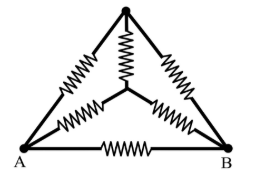
A wire of resistance R is bent into a triangular pyramid as shown in figure with each segment having same length. The resistance between points A and B is R/n. The value of n is :
NTA JEE Main 2025 April 7th Shift 1 - Question 29
Uniform magnetic fields of different strengths ($$B_1$$ and $$B_2$$), both normal to the plane of the paper exist as shown in the figure. A charged particle of mass m and charge q, at the interface at an instant, moves into the region 2 with velocity v and returns to the interface. What is the displacement of the particle during this movement along the interface?
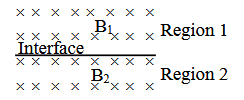
(Consider the velocity of the particle to be normal to the magnetic field and $$B_2 > B_1$$)
NTA JEE Main 2025 April 7th Shift 1 - Question 30
If $$\epsilon_0$$ denotes the permittivity of free space and $$\Phi_E$$ is the flux of the electric field through the area bounded by the closed surface, then dimension of $$\left(\epsilon_0 \frac{d\Phi_E}{dt}\right)$$ are that of :