NTA JEE Main 2nd September 2020 Shift 2
For the following questions answer them individually
NTA JEE Main 2nd September 2020 Shift 2 - Question 11
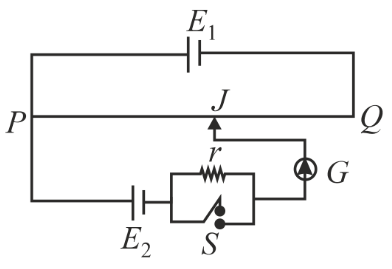
A potentiometer wire PQ of 1m length is connected to a standard cell $$E_1$$. Another cell $$E_2$$ of emf 1.02 V is connected with a resistance 'r' and switch S (as shown in figure). With switch S open, the null position is obtained at a distance of 49 cm from Q. The potential gradient in the potentiometer wire is:
NTA JEE Main 2nd September 2020 Shift 2 - Question 12
The figure shows a region of length 'l' with a uniform magnetic field of 0.3 T in it and a proton entering the region with velocity $$4 \times 10^5$$ m s$$^{-1}$$ making an angle 60$$°$$ with the field. If proton completes 10 revolution by the time it cross the region shown, 'l' is close to (mass of proton $$= 1.67 \times 10^{-27}$$ kg, charge of the proton $$= 1.6 \times 10^{-19}$$ C):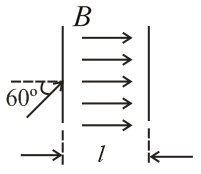
NTA JEE Main 2nd September 2020 Shift 2 - Question 13
A wire carrying current I is bent in the shape ABCDEFA as shown, where rectangle ABCDA and ADEFA are perpendicular to each other. If the sides of the rectangles are of lengths a and b, then the magnitude and direction of magnetic moment of the loop ABCDEFA is: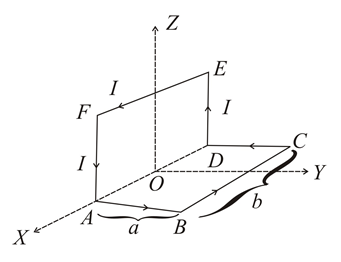

NTA JEE Main 2nd September 2020 Shift 2 - Question 14
A small point mass carrying some positive charge on it, is released from the edge of a table. There is a uniform electric field in this region in the horizontal direction. Which of the following options then correctly describe the trajectory of the mass? (Curves are drawn schematically and are not to scale)
NTA JEE Main 2nd September 2020 Shift 2 - Question 15
An inductance coil has a reactance of 100 $$\Omega$$. When an AC signal of frequency 1000 Hz is applied to the coil, the applied voltage leads the current by 45$$°$$. The self-inductance of the coil is:
NTA JEE Main 2nd September 2020 Shift 2 - Question 16
In a plane electromagnetic wave, the directions of electric field and magnetic field are represented by $$\hat{k}$$ and $$2\hat{i} - 2\hat{j}$$, respectively. What is the unit vector along direction of propagation of the wave.
NTA JEE Main 2nd September 2020 Shift 2 - Question 17
In a Young's double slit experiment, 16 fringes are observed in a certain segment of the screen when light of wavelength 700 nm is used. If the wavelength of light is changed to 400 nm, the number of fringes observed in the same segment of the screen would be:
NTA JEE Main 2nd September 2020 Shift 2 - Question 18
A particle is moving 5 times as fast as an electron. The ratio of the de-Broglie wavelength of the particle to that of the electron is $$1.878 \times 10^{-4}$$. The mass of the particle is close to:
NTA JEE Main 2nd September 2020 Shift 2 - Question 19
In a hydrogen atom the electron makes a transition from $$(n + 1)^{th}$$ level to the $$n^{th}$$ level. If $$n >> 1$$, the frequency of radiation emitted is proportional to:
NTA JEE Main 2nd September 2020 Shift 2 - Question 20
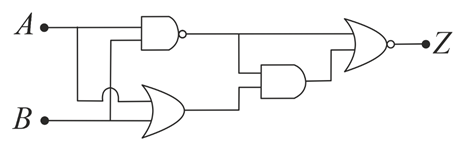
In the following digital circuit, what will be the output 'Z', when the input (A, B) are (1, 0), (0, 0), (1, 1), (0, 1):