NTA JEE Main 2nd September 2020 Shift 2
For the following questions answer them individually
NTA JEE Main 2nd September 2020 Shift 2 - Question 1
If momentum (P), area (A) and time (T) are taken to be the fundamental quantities then the dimensional formula for energy is:
NTA JEE Main 2nd September 2020 Shift 2 - Question 2
Two uniform circular discs are rotating independently in the same direction around their common axis passing through their centres. The moment of inertia and angular velocity of the first disc are 0.1 kg - m$$^2$$ and 10 rad s$$^{-1}$$ respectively while those for the second one are 0.2 kg - m$$^2$$ and 5 rad s$$^{-1}$$ respectively. At some instant they get stuck together and start rotating as a single system about their common axis with some angular speed. The kinetic energy of the combined system is:
NTA JEE Main 2nd September 2020 Shift 2 - Question 3
The height 'h' at which the weight of a body will be the same as that at the same depth 'h' from the surface of the earth is (Radius of the earth is R and effect of the rotation of the earth is neglected):

NTA JEE Main 2nd September 2020 Shift 2 - Question 4
A capillary tube made of glass of radius 0.15 mm is dipped vertically in a beaker filled with methylene iodide (surface tension = 0.05 N m$$^{-1}$$, density = 667 kg m$$^{-3}$$) which rises to height h in the tube. It is observed that the two tangents drawn from observed that the two tangents drawn from liquid-glass interfaces (from opp. sides of the capillary) make an angle of 60$$°$$ with one another. Then h is close to (g = 10 m s$$^{-2}$$):
NTA JEE Main 2nd September 2020 Shift 2 - Question 5
When the temperature of a metal wire is increased from 0$$°$$C to 10$$°$$C, its length increases by 0.02%. The percentage change in its mass density will be closed to:
NTA JEE Main 2nd September 2020 Shift 2 - Question 6
A heat engine is involved with exchange of heat of 1915 J, $$-40$$ J, $$+125$$ J and $$-Q$$ J, during one cycle achieving and efficiency of 50.0%. The value of Q is:
NTA JEE Main 2nd September 2020 Shift 2 - Question 7
An ideal gas in a closed container is slowly heated. As its temperature increases, which of the following statements are true?
(A) the mean free path of the molecules decreases
(B) the mean collision time between the molecules decreases.
(C) the mean free path remains unchanged.
(D) the mean collision time relations unchanged.
NTA JEE Main 2nd September 2020 Shift 2 - Question 8
The displacement time graph of a particle executing SHM is given in figure: (sketch is schematic and not to scale)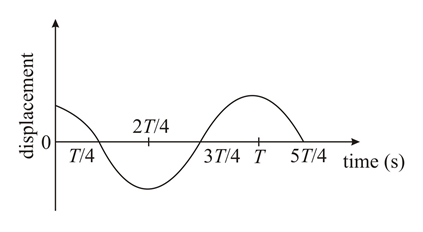
Which of the following statements is/are true for this motion?
(A) The force is zero at $$t = \frac{3T}{4}$$
(B) The magnitude of acceleration is maximum at $$t = T$$
(C) The speed is maximum at $$t = \frac{T}{4}$$
(D) The P.E. is equal to K.E. of the oscillation at $$t = \frac{T}{2}$$
NTA JEE Main 2nd September 2020 Shift 2 - Question 9
A charge Q is distributed over two concentric conducting thin spherical shells radii r and R (R > r). If the surface charge densities on the two shells are equal, the electric potential at the common centre is: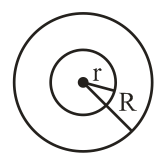
NTA JEE Main 2nd September 2020 Shift 2 - Question 10
A 10 $$\mu$$F capacitor is fully charged to a potential difference of 50 V. After removing the source voltage it is connected to an uncharged capacitor in parallel. Now the potential difference across them becomes 20 V. The capacitance of the second capacitor is: