NTA JEE Main 16th March 2021 Shift 1
For the following questions answer them individually
NTA JEE Main 16th March 2021 Shift 1 - Question 1
The velocity-displacement graph describing the motion of a bicycle is shown in the figure.
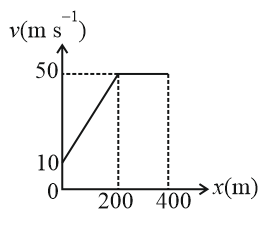
The acceleration-displacement graph of the bicycle's motion is best described by:
NTA JEE Main 16th March 2021 Shift 1 - Question 2
A block of 200 g mass moves with a uniform speed in a horizontal circular groove, with vertical side walls of radius 20 cm. If the block takes 40 s to complete one round, the normal force by the side walls of the groove is:
NTA JEE Main 16th March 2021 Shift 1 - Question 3
A block of mass $$m$$ slides along a floor while a force of magnitude $$F$$ is applied to it at an angle $$\theta$$ as shown in figure. The coefficient of kinetic friction is $$\mu_K$$. Then, the block's acceleration $$a$$ is given by: ($$g$$ is acceleration due to gravity)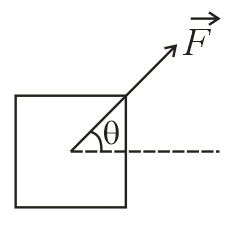

NTA JEE Main 16th March 2021 Shift 1 - Question 4
The maximum and minimum distances of a comet from the Sun are $$1.6 \times 10^{12}$$ m and $$8.0 \times 10^{10}$$ m respectively. If the speed of the comet at the nearest point is $$6 \times 10^{4}$$ m s$$^{-1}$$, the speed at the farthest point is:
NTA JEE Main 16th March 2021 Shift 1 - Question 5
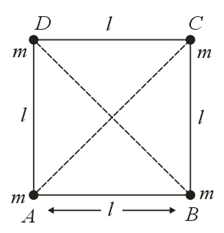
Four equal masses, $$m$$ each are placed at the corners of a square of length $$l$$ as shown in the figure. The moment of inertia of the system about an axis passing through $$A$$ and parallel to $$DB$$ would be:
NTA JEE Main 16th March 2021 Shift 1 - Question 6
The pressure acting on a submarine is $$3 \times 10^5$$ Pa at a certain depth. If the depth is doubled, the percentage increase in the pressure acting on the submarine would be: (Assume that atmospheric pressure is $$1 \times 10^5$$ Pa, density of water is $$10^3$$ kg m$$^{-3}$$, g = 10 ms$$^{-2}$$)
NTA JEE Main 16th March 2021 Shift 1 - Question 7
In thermodynamics, heat and work are:
NTA JEE Main 16th March 2021 Shift 1 - Question 8
The volume $$V$$ of an enclosure contains a mixture of three gases, 16 g of oxygen, 28 g of nitrogen and 44 g of carbon dioxide at absolute temperature $$T$$. Consider $$R$$ as universal gas constant. The pressure of the mixture of gases is:
NTA JEE Main 16th March 2021 Shift 1 - Question 9
Time period of a simple pendulum is $$T$$ inside a lift when the lift is stationary. If the lift moves upwards with an acceleration $$\frac{g}{2}$$, the time period of pendulum will be:
NTA JEE Main 16th March 2021 Shift 1 - Question 10
A 25 m long antenna is mounted on an antenna tower. The height of the antenna tower is 75 m. The wavelength (in meter) of the signal transmitted by this antenna would be: