NTA JEE Main 16th March 2021 Shift 1
For the following questions answer them individually
NTA JEE Main 16th March 2021 Shift 1 - Question 11
For changing the capacitance of a given parallel plate capacitor, a dielectric material of dielectric constant $$K$$ is used, which has the same area as the plates of the capacitor. The thickness of the dielectric slab is $$\frac{3}{4}d$$, where $$d$$ is the separation between the plates of parallel plate capacitor. The new capacitance $$C'$$ in terms of original capacitance $$C_0$$ is given by the following relation:
NTA JEE Main 16th March 2021 Shift 1 - Question 12
A conducting wire of length $$l$$, area of cross-section $$A$$ and electric resistivity $$\rho$$ is connected between the terminals of a battery. A potential difference $$V$$ is developed between its ends, causing an electric current. If the length of the wire of the same material is doubled and the area of cross-section is halved, the resultant current would be:
NTA JEE Main 16th March 2021 Shift 1 - Question 13
A bar magnet of length 14 cm is placed in the magnetic meridian with its north pole pointing towards the geographic north pole. A neutral point is obtained at a distance of 18 cm from the center of the magnet. If $$B_H = 0.4$$ G, the magnetic moment of the magnet is (1 G = $$10^{-4}$$ T):

NTA JEE Main 16th March 2021 Shift 1 - Question 14
A conducting bar of length $$L$$ is free to slide on two parallel conducting rails as shown in the figure.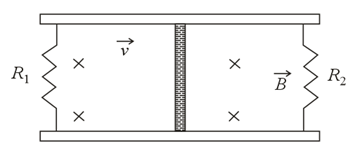
Two resistors $$R_1$$ and $$R_2$$ are connected across the ends of the rails. There is a uniform magnetic field $$\vec{B}$$ pointing into the page. An external agent pulls the bar to the left at a constant speed $$v$$. The correct statement about the directions of induced currents $$I_1$$ and $$I_2$$ flowing through $$R_1$$ and $$R_2$$ respectively is:
NTA JEE Main 16th March 2021 Shift 1 - Question 15
An $$RC$$ circuit as shown in the figure is driven by a $$AC$$ source generating a square wave. The output wave pattern monitored by $$CRO$$ would look close to: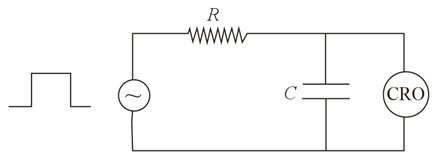
NTA JEE Main 16th March 2021 Shift 1 - Question 16
A plane electromagnetic wave of frequency 500 MHz is traveling in a vacuum along the $$y$$-direction. At a particular point in space and time, $$\vec{B} = 8.0 \times 10^{-8}\hat{z}$$ T. The value of the electric field at this point is: (speed of light = $$3 \times 10^{8}$$ ms$$^{-1}$$; $$\hat{x}, \hat{y}, \hat{z}$$ are unit vectors along $$x, y$$ and $$z$$ direction.)
NTA JEE Main 16th March 2021 Shift 1 - Question 17
For an electromagnetic wave travelling in free space, the relation between average energy densities due to electric ($$U_e$$) and magnetic ($$U_m$$) fields is:
NTA JEE Main 16th March 2021 Shift 1 - Question 18
The angle of deviation through a prism is minimum when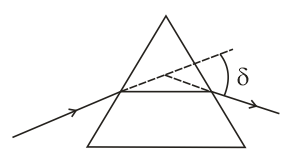
(A) Incident ray and emergent ray are symmetric to the prism
(B) The refracted ray inside the prism becomes parallel to its base
(C) Angle of incidence is equal to that of the angle of emergence
(D) When angle of emergence is double the angle of incidence
Choose the correct answer from the options given below:
NTA JEE Main 16th March 2021 Shift 1 - Question 19
The stopping potential in the context of photoelectric effect depends on the following property of incident electromagnetic radiation:
NTA JEE Main 16th March 2021 Shift 1 - Question 20
One main scale division of a vernier callipers is $$a$$ cm and $$n^{th}$$ division of the vernier scale coincide with $$(n-1)^{th}$$ division of the main scale. The least count of the callipers in mm is: