JEE Main 12th January 2019 Shift 1
For the following questions answer them individually
JEE Main 12th January 2019 Shift 1 - Question 1
A person standing on an open ground hears the sound of a jet aeroplane, coming from north at an angle $$60°$$ with ground level, but he finds the aeroplane right vertically above his position. If $$v$$ is the speed of sound, speed of the plane is:
JEE Main 12th January 2019 Shift 1 - Question 2
A passenger train of length 60 m travels at a speed of 80 km/hr. Another freight train of length 120 m travels at a speed of 30 km/hr. The ratio of times taken by the passenger train to completely cross the freight train when: (i) they are moving in the same direction, and (ii) in the opposite directions is:
JEE Main 12th January 2019 Shift 1 - Question 3
A simple pendulum, made of a string of length $$l$$ and a bob of mass $$m$$, is released from a small angle $$\theta_0$$. It strikes a block of mass $$M$$, kept on horizontal surface at its lowest point of oscillations, elastically. It bounces back and goes up to an angle $$\theta_1$$. Then M is given by:

JEE Main 12th January 2019 Shift 1 - Question 4
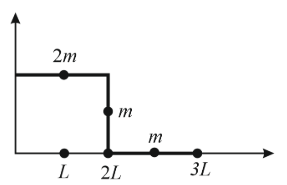
The position vector of the center of mass $$\vec{r_{cm}}$$ of an asymmetric uniform bar of negligible area of cross-section as shown in figure is:
JEE Main 12th January 2019 Shift 1 - Question 5
Let the moment of inertia of a hollow cylinder of length 30 cm (inner radius 10 cm and outer radius 20 cm), about its axis be I. The radius of a thin cylinder of the same mass such that its moment of inertia about its axis is also I, is:
JEE Main 12th January 2019 Shift 1 - Question 6
A satellite of mass M is in a circular orbit of radius R about the center of the earth. A meteorite of the same mass, falling towards the earth, collides with the satellite completely inelastic. The speeds of the satellite and the meteorite are the same, just before the collision. The subsequent motion of the combined body will be:
JEE Main 12th January 2019 Shift 1 - Question 7
A straight rod of length L extends from $$x = a$$ to $$x = L + a$$. The gravitational force it exerts on a point mass 'm' at $$x = 0$$, if the mass per unit length of the rod is $$A + Bx^2$$, is given by:
JEE Main 12th January 2019 Shift 1 - Question 8
A cylinder of radius R is surrounded by a cylindrical shell of inner radius R and outer radius 2R. The thermal conductivity of the material of the inner cylinder is $$K_1$$ and that of the outer cylinder is $$K_2$$. Assuming no loss of heat, the effective thermal conductivity of the system for heat flowing along the length of the cylinder is:
JEE Main 12th January 2019 Shift 1 - Question 9
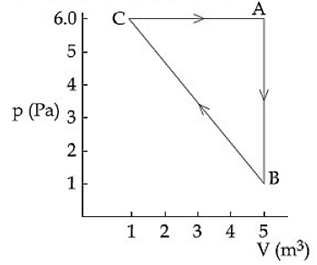
For the given cyclic process CAB as shown for a gas, the work done is:
JEE Main 12th January 2019 Shift 1 - Question 10
An ideal gas occupies a volume of $$2 m^3$$ at a pressure of $$3 \times 10^6 Pa$$. The energy of the gas is: