JEE Main 12th January 2019 Shift 1
For the following questions answer them individually
JEE Main 12th January 2019 Shift 1 - Question 11
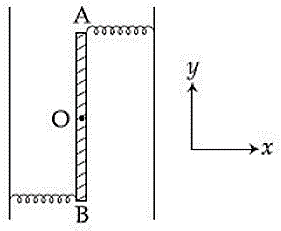
Two light identical springs of spring constant k are attached horizontally at the two ends of a uniform horizontal rod AB of length l and mass m. The rod is pivoted at its center 'O' and can rotate freely in horizontal plane. The other ends of the two springs are fixed to rigid supports as shown in figure. The rod is gently pushed through a small angle and released. The frequency of resulting oscillation is:
JEE Main 12th January 2019 Shift 1 - Question 12
A travelling harmonic wave is represented by the equation $$y(x, t) = 10^{-3} \sin(50t + 2x)$$, where x and y are in meter and t is in seconds. Which of the following is a correct statement about the wave?
JEE Main 12th January 2019 Shift 1 - Question 13
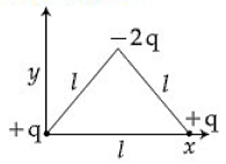
Determine the electric dipole moment of the system of three charges, placed on the vertices of an equilateral triangle, as shown in the figure:

JEE Main 12th January 2019 Shift 1 - Question 14
There is a uniform spherically symmetric surface charge density at a distance $$R_0$$ from the origin. The charge distribution is initially at rest and starts expanding because of mutual repulsion. The figure that represents best the speed $$V(R(t))$$ of the distribution as a function of its instantaneous radius $$R(t)$$ is:
JEE Main 12th January 2019 Shift 1 - Question 15
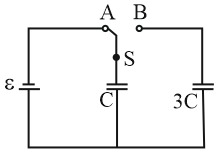
The figure shows a capacitor of capacitance C connected to a battery via a switch, having a total charge Q on it, in steady-state. When the switch S is turned from position A to position B, the energy dissipated in the circuit is
JEE Main 12th January 2019 Shift 1 - Question 16
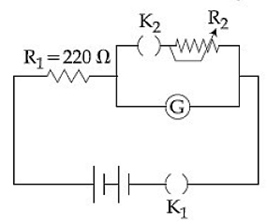
The galvanometer deflection, when key $$K_1$$ is closed but $$K_2$$ is open, equals $$\theta_0$$ (see figure). On closing $$K_2$$ also and adjusting $$R_2$$ to $$5\Omega$$, the deflection in galvanometer becomes $$\frac{\theta_0}{5}$$. The resistance of the galvanometer is, then, given by [Neglect the internal resistance of battery]:
JEE Main 12th January 2019 Shift 1 - Question 17
An ideal battery of emf 4V and resistance R are connected in series in the primary circuit of a potentiometer of length 1 m and resistance $$5\Omega$$. The value of R, to give a potential difference of 5 mV across 10 cm of potentiometer wire, is:
JEE Main 12th January 2019 Shift 1 - Question 18
Two electric bulbs, rated at (25 W, 220 V) and (100 W, 220 V), are connected in series across a 220 V voltage source. If the 25 W and 100 W bulbs draw powers $$P_1$$ and $$P_2$$ respectively, then:
JEE Main 12th January 2019 Shift 1 - Question 19
A proton and an $$\alpha$$-particle (with their masses in the ratio of 1 : 4 and charges in the ratio of 1 : 2) are accelerated from rest through a potential difference V. If a uniform magnetic field (B) is set up perpendicular to their velocities, the ratio of the radii $$r_p : r_{\alpha}$$ of the circular paths described by them will be:
JEE Main 12th January 2019 Shift 1 - Question 20
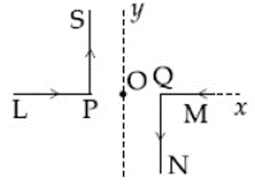
As shown in the figure, two infinitely long, identical wires are bent by 90° and placed in such a way that the segments LP and QM are along the x-axis, while segments PS and QN are parallel to the y-axis. If $$OP = OQ = 4$$ cm, and the magnitude of the magnetic field at O is $$10^{-4}$$ T, and the two wires carry equal currents (see figure), the magnitude of the current in each wire and the direction of the magnetic field at O will be $$\left(\mu_0 = 4\pi \times 10^{-7} NA^{-2}\right)$$: