NTA JEE Main 12th April 2019 Shift 1
For the following questions answer them individually
NTA JEE Main 12th April 2019 Shift 1 - Question 21
A thin ring of 10 cm radius carries a uniformly distributed charge. The ring rotates at a constant angular speed of $$40\pi$$ rad s$$^{-1}$$ about its axis, perpendicular to its plane. If the magnetic field at its centre is $$3.8 \times 10^{-9}$$ T, then the charge carried by the ring is close to $$\mu_0 = 4\pi \times 10^{-7}$$ N/A$$^2$$.
NTA JEE Main 12th April 2019 Shift 1 - Question 22
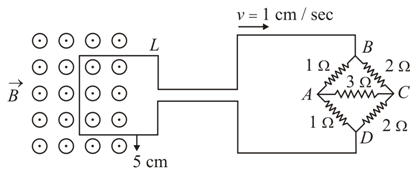
The figure shows a square loop L of side 5 cm which is connected to a network of resistances. The whole setup is moving towards the right with a constant speed of 1 cm s$$^{-1}$$. At some instant, a part of L is in a uniform magnetic field of 1T perpendicular to the plane of the loop. If the resistance of L is 1.7 Ω, the current in the loop at that instant will be close to:
NTA JEE Main 12th April 2019 Shift 1 - Question 23
An electromagnetic wave is represented by the electric field $$\vec{E} = E_0\hat{n}\sin(\omega t + 6y - 8z)$$. Taking unit vectors in x, y and z directions to be $$\hat{i}, \hat{j}, \hat{k}$$, the direction of propagation $$\hat{s}$$, is:

NTA JEE Main 12th April 2019 Shift 1 - Question 24
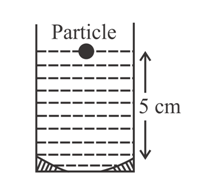
A concave mirror has radius of curvature of 40 cm. It is at the bottom of a glass that has water filled up to 5 cm (see figure). If a small particle is floating on the surface of water, its image as seen, from directly above the glass, is at a distance d from the surface of water. The value of d is close to: (Refractive index of water = 1.33)
NTA JEE Main 12th April 2019 Shift 1 - Question 25
The value of numerical aperture of the objective lens of a microscope is 1.25. If light of wavelength 5000 Å is used, the minimum separation between two points, to be seen as distinct, will be:
NTA JEE Main 12th April 2019 Shift 1 - Question 26
In a double slit experiment, when a thin film of thickness t having refractive index μ is introduced in front of one of the slits, the maximum at the centre of the fringe pattern shifts by one fringe width. The value of t is ($$\lambda$$ is the wavelength of the light used):
NTA JEE Main 12th April 2019 Shift 1 - Question 27
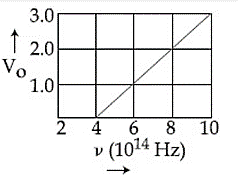
The stopping potential V$$_0$$ (in volt) as a function of frequency ($$\nu$$) for a sodium emitter, is shown in the figure. The work function of sodium, from the data plotted in the figure, will be:
(Given: Planck's constant h = $$6.63 \times 10^{-34}$$ J s, electron charge (e) = $$1.6 \times 10^{-19}$$ C)
NTA JEE Main 12th April 2019 Shift 1 - Question 28
An excited He$$^+$$ ion emits two photons in succession, with wavelengths 108.5 nm and 30.4 nm in making a transition to the ground state. The quantum number n, corresponding to its initial excited state is
(for a photon of wavelength $$\lambda$$, energy E = $$\frac{1240 \text{ eV}}{\lambda(\text{in nm})}$$)
NTA JEE Main 12th April 2019 Shift 1 - Question 29
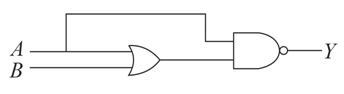
The truth table for the circuit given in the figure is:
NTA JEE Main 12th April 2019 Shift 1 - Question 30
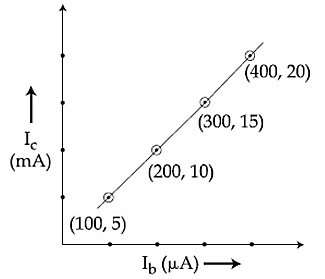
The transfer characteristic curve of a transistor, having input and output resistance 100 Ω and 100 kΩ respectively, is shown in the figure. The voltage and power gain, are respectively: