For the following questions answer them individually
An ideal gas is in thermodynamic equilibrium. The number of degrees of freedom of a molecule of the gas is $$n$$. The internal energy of one mole of the gas is $$U_n$$ and the speed of sound in the gas is $$v_n$$. At a fixed temperature and pressure, which of the following is the correct option?
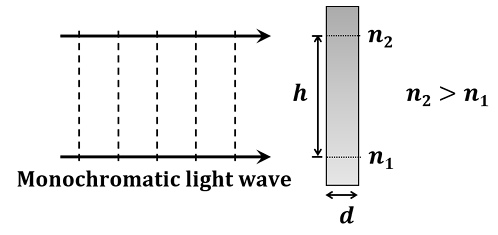
A monochromatic light wave is incident normally on a glass slab of thickness d, as shown in the figure. The refractive index of the slab increases linearly from $$n_1$$ to $$n_2$$ over the height h. Which of the following statement(s) is (are) true about the light wave emerging out of the slab?
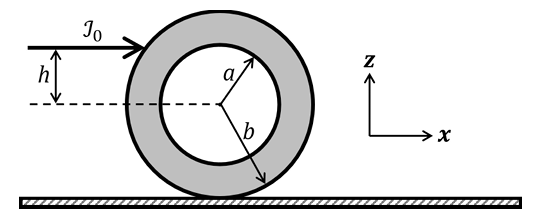
An annular disk of mass $$M$$, inner radius $$a$$ and outer radius $$b$$ is placed on a horizontal surface with coefficient of friction $$\mu$$, as shown in the figure. At some time, an impulse $$J_0 \hat{x}$$ is applied at a height h above the center of the disk. If $$h = h_m$$ then the disk rolls without slipping along the x-axis. Which of the following statement(s) is(are) correct?
The electric field associated with an electromagnetic wave propagating in a dielectric medium is given by $$\vec{E} = 30(2\hat{x} + \hat{y})\sin\left[2\pi\left(5 \times 10^{14}t - \frac{10^7}{3}z\right)\right]$$ V m$$^{-1}$$. Which of the following option(s) is(are) correct?
[Given: The speed of light in vacuum, $$c = 3 \times 10^8$$ ms$$^{-1}$$]
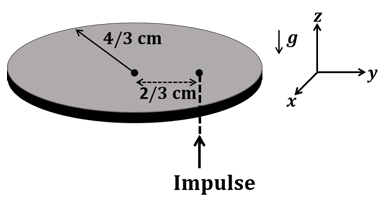
A thin circular coin of mass 5 gm and radius 4/3 cm is initially in a horizontal $$xy$$-plane. The coin is tossed vertically up (+z direction) by applying an impulse of $$\sqrt{\frac{\pi}{2}} \times 10^{-2}$$ N-s at a distance 2/3 cm from its center. The coin spins about its diameter and moves along the +z direction. By the time the coin reaches back to its initial position, it completes $$n$$ rotations. The value of $$n$$ is ____.
[Given: The acceleration due to gravity $$g = 10$$ ms$$^{-2}$$]
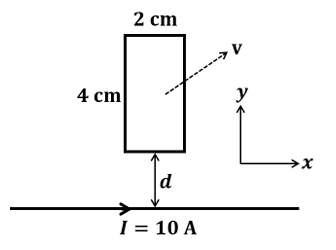
A rectangular conducting loop of length 4 cm and width 2 cm is in the $$xy$$-plane, as shown in the figure. It is being moved away from a thin and long conducting wire along the direction $$\frac{\sqrt{3}}{2}\hat{x} + \frac{1}{2}\hat{y}$$ with a constant speed $$v$$. The wire is carrying a steady current I = 10 A in the positive $$x$$-direction. A current of 10 $$\mu$$A flows through the loop when it is at a distance $$d = 4$$ cm from the wire. If the resistance of the loop is 0.1 $$\Omega$$, then the value of $$v$$ is ____ ms$$^{-1}$$.
[Given: The permeability of free space $$\mu_0 = 4\pi \times 10^{-7}$$ NA$$^{-2}$$]
A string of length 1 m and mass $$2 \times 10^{-5}$$ kg is under tension T. When the string vibrates, two successive harmonics are found to occur at frequencies 750 Hz and 1000 Hz. The value of tension T is ____ Newton.
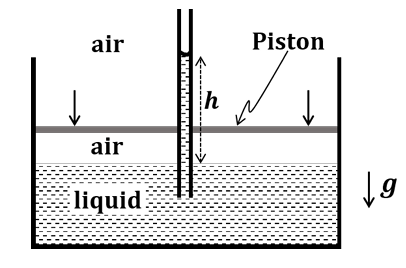
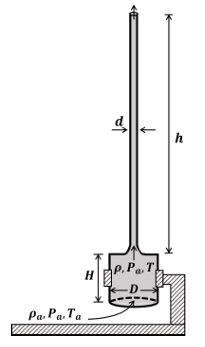
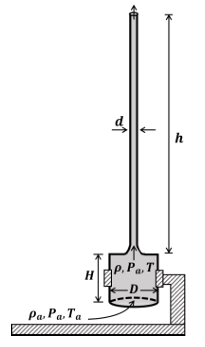
An incompressible liquid is kept in a container having a weightless piston with a hole. A capillary tube of inner radius 0.1 mm is dipped vertically into the liquid through the airtight piston hole, as shown in the figure. The air in the container is isothermally compressed from its original volume $$V_0$$ to $$\frac{100}{101}V_0$$ with the movable piston. Considering air as an ideal gas, the height ($$h$$) of the liquid column in the capillary above the liquid level in cm is ____.
[Given: Surface tension of the liquid is 0.075 Nm$$^{-1}$$, atmospheric pressure is $$10^5$$ N m$$^{-2}$$, acceleration due to gravity (g) is 10 m s$$^{-2}$$, density of the liquid is $$10^3$$ kg m$$^{-3}$$ and contact angle of capillary surface with the liquid is zero]
In a radioactive decay process, the activity is defined as $$A = -\frac{dN}{dt}$$, where $$N(t)$$ is the number of radioactive nuclei at time $$t$$. Two radioactive sources, $$S_1$$ and $$S_2$$ have same activity at time $$t = 0$$. At a later time, the activities of $$S_1$$ and $$S_2$$ are $$A_1$$ and $$A_2$$, respectively. When $$S_1$$ and $$S_2$$ have just completed their 3rd and 7th half-lives, respectively, the ratio $$A_1/A_2$$ is ____.
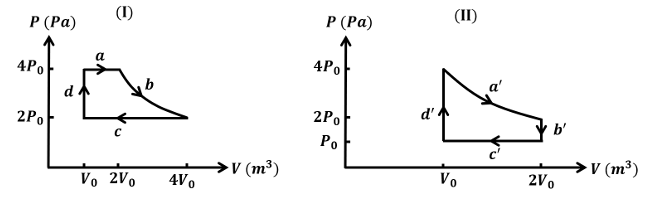
One mole of an ideal gas undergoes two different cyclic processes I and II, as shown in the $$P$$-$$V$$ diagrams below. In cycle I, processes a, b, c and d are isobaric, isothermal, isobaric and isochoric, respectively. In cycle II, processes a', b', c' and d' are isothermal, isochoric, isobaric and isochoric, respectively. The total work done during cycle I is $$W_I$$ and that during cycle II is $$W_{II}$$. The ratio $$W_I/W_{II}$$ is ____.