91- 6303239042
 IPMAT WhatsApp Group



IPMAT Exam Pattern 2027
The official IPMAT Exam Pattern 2027 establishes the exact structure for upcoming management tests. IIM Indore holds its exam tentatively in the first week of May 2027. Rohtak schedules its respective test later in the second week of May 2027. Candidates face distinct testing models based entirely on the specific institute they target.
General category students pay Rs. 4,130 for the Indore exam and Rs. 4,937 for Rohtak. Age limits strictly cap all candidates at a maximum of 20 years old. IIM Indore measures numerical precision through subjective inputs. IIM Rohtak prefers testing rapid analytical processing over raw endurance.
Feature | IPMAT Indore 2027 | IPMAT Rohtak 2027 |
Exam Mode | Computer-Based Test | Computer-Based Test |
Section Count | 3 Sections | 3 Sections |
Question Format | MCQ and Short Answer | MCQ only |
IPMAT Marking Scheme 2027
Understanding the IPMAT Marking Scheme 2027 gives candidates a highly functional guessing strategy. Both exams award +4 marks for every correct answer recorded in the system. Incorrect responses on multiple-choice questions incur a direct penalty of -1 mark. Blank questions safely yield 0 marks.
Unattempted questions always result in zero points across both institute exams. Students need a solid risk management plan to avoid severe mathematical penalties. Blind guessing damages the final score heavily. Smart candidates leave confusing questions blank to protect their accumulated marks.
IPMAT Indore Marking Scheme
The IPMAT Indore Marking Scheme operates with a mixed penalty format for test takers. Correct responses add +4 marks to the total score. Wrong multiple-choice selections subtract -1 mark. Incorrect short answers carry absolutely 0 penalty. Smart students attempt every single short answer question. This rule exists because typing an exact answer is naturally harder than selecting an option.
Question Type | Correct Answer | Incorrect Answer | Unattempted |
QA (MCQ) and VA (MCQ) | +4 marks | -1 mark | 0 marks |
QA (Short Answer) | +4 marks | 0 penalty | 0 marks |
IPMAT Rohtak Marking Scheme
The IPMAT Rohtak Marking Scheme applies strict negative marking across the entire paper. Students earn +4 marks for a correct choice on any question. Every wrong answer instantly drops the score by -1 mark. No section offers a safety net for blind guessing. High time pressure makes reckless guessing a very dangerous strategy. The strict penalty system rapidly destroys hard-earned points.
Section | Correct Answer | Incorrect Answer | Unattempted |
All Sections (QA, LR, VA) | +4 marks | -1 mark | 0 marks |
Also Read, IPMAT Previous Year Papers, IIM Indore & Rohtak Papers PDF
IPMAT 2027 Number of Questions
The IPMAT 2027 Number of Questions creates two completely different testing environments for candidates. Indore presents test takers with 90 questions in total. Rohtak increases the volume to exactly 120 questions. This total count directly dictates the pacing strategy required for success.
A larger question bank naturally means less time available per problem. Institutes design tests this way to separate fast thinkers from deep thinkers. Candidates adjust their speed based entirely on the total question count. Focus shifts from deep calculations to rapid visual elimination.
IPMAT Indore 2027
The IPMAT Indore exam historically uses a baseline of 90 questions. The test distributes these as 15 subjective questions and 75 multiple-choice questions. Candidates adjust their speed based entirely on the section they attempt. Focus shifts heavily toward calculation precision.
IIM Indore Section | Number of Questions |
Quantitative Ability (SA) | 15 Questions |
Quantitative Ability (MCQ) | 30 Questions |
Verbal Ability (MCQ) | 45 Questions |
Total | 90 Questions |
IPMAT Rohtak 2027
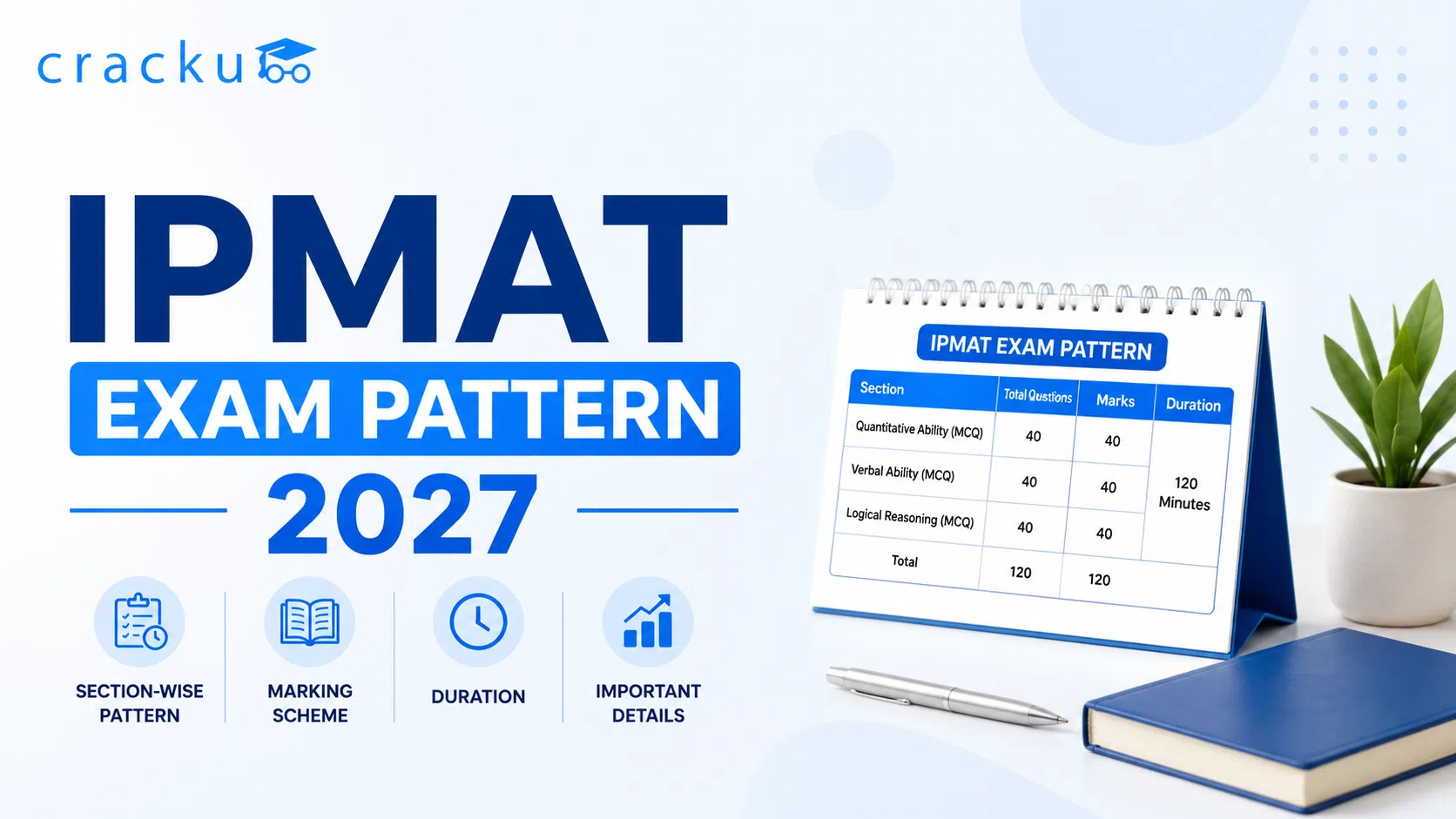
The IPMAT Rohtak paper contains a fixed count of 120 questions. Each of the three sections carries exactly 40 items. This layout shifts the exam focus heavily toward pure calculation speed. The volume is exactly 33 percent higher than the Indore paper. A larger question bank means less time available per problem.
IIM Rohtak Section | Number of Questions |
Quantitative Ability | 40 Questions |
Logical Reasoning | 40 Questions |
Verbal Ability | 40 Questions |
Total | 120 Questions |
IPMAT Section-Wise Pattern
The IPMAT Section-Wise Pattern determines the specific weightage given to each subject. Indore allocates 50 percent of its normalized weightage entirely to Verbal Ability. This makes English the single largest deciding factor for that institute. English commands major attention here.
Rohtak divides the cognitive load into perfectly equal parts. Math, English, and Logic each represent a precise 33.3 percent of the paper. Candidates experience a highly balanced testing environment. Institutes balance sections differently to find students with specific intellectual traits.
IPMAT Indore Exam Pattern
The IPMAT Indore Exam Pattern enforces a permanently locked progression system on test day. Candidates solve 15 subjective Math questions, 30 multiple-choice Math questions, and 45 English questions. The digital interface completely prevents jumping between different subjects. Test takers cannot view the Reading Comprehension passages early. Test administrators lock sections to observe how students handle isolated pressure. The forced order removes fluid test-taking tactics.
Section | Sequence | Format |
QA (SA) | Locked | Type in the answer |
QA (MCQ) | Locked | Multiple Choice |
VA (MCQ) | Locked | Multiple Choice |
IPMAT Exam Pattern
The IPMAT Rohtak Exam Pattern introduces Logical Reasoning as a core subject. This topic does not exist in the Indore curriculum. Candidates answer 40 questions across Math, Logic, and English blocks. The platform allows completely free navigation between all areas. Unrestricted navigation gives test takers the freedom to hunt for the easiest questions first. This design heavily rewards candidates with strong time management skills.
Section | Flexibility | Format |
QA, LR, VA | Free Navigation | Multiple Choice |
Also Read, IPMAT Syllabus 2026, Indore & Rohtak Pattern, Topics, and PDF
IPMAT Exam Duration 2027
The scheduled IPMAT Exam Duration 2027 stands at a strict 120 minutes for both major testing institutes. Test duration translates directly into speed requirements. Rohtak demands one completed question per minute. Indore allows slightly more breathing room at 1.33 minutes per item. The extra time at Indore compensates for the heavy calculation precision required by subjective mathematical questions.
Exam | Total Duration | Number of Questions |
IPMAT Indore | 120 Minutes | 90 Questions |
IPMAT Rohtak | 120 Minutes | 120 Questions |
IPMAT 2027 Total Marks
The IPMAT Total Marks dictate the final selection criteria weightages for each campus. Maximum raw scores differ significantly based on the program selected. Indore applies a 65 percent weightage to the aptitude test score. Rohtak applies a 55 percent weightage.
Final score sheets reflect completely different mathematical scales. A high raw score does not guarantee admission if the section balance is poor. Institutes assign different values to the test to balance academic history with raw intelligence. Both colleges prioritize exam performance heavily.
IPMAT Indore Total Marks
The maximum raw score for IPMAT Indore totals exactly 360 marks. The subjective Math section yields 60 marks, multiple-choice Math gives 120 marks, and the Verbal provides 180 marks. A normalization algorithm translates these raw numbers into a final aptitude score. Which subject heavily impacts the final rank? English clearly dominates the final normalized outcome. The institute normalizes scores to equalize difficulty variations.
Section | Max Marks | Weightage during Normalization |
QA (SA) and QA (MCQ) | 180 Marks | 50 percent |
Verbal Ability | 180 Marks | 50 percent |
Total | 360 Marks | 100 percent |
IPMAT Rohtak Total Marks
The maximum raw score for the standard IPMAT Rohtak paper reaches 480 marks. Every single question across the three main sections carries identical mathematical value. The admissions team uses this absolute total raw score to filter candidates for the personal interview round. Rohtak completely avoids the complex section-wise normalized filtering used by other campuses. Total volume matters more than balanced perfection here.
Section | Max Marks |
QA, LR, VA (160 each) | 480 Marks |
IPMAT 2027 Sectional Time Limit
Understanding the IPMAT 2027 Sectional Time Limit changes fundamental test psychology for all candidates. Subject limits govern exactly how long test takers spend in one specific area before the digital system intervenes. Extra time cannot transfer from an easy section to a highly difficult one.
Structured timers force constant forward movement through the digital question bank. Students must abandon difficult puzzles instantly when the clock runs out. Time fences exist strictly to test emotional recovery after a poor performance. Unfinished questions simply vanish from the screen when the timer expires.
IPMAT Indore Sectional Time Limit
The Indore paper enforces a permanent 40-minute limit for each of the three isolated subject sections. The digital testing interface actively locks the active module when the strict countdown ends. The testing system automatically submits all saved answers immediately without warning. Candidates find themselves forced onto the next subject immediately. You cannot return to verify previous mathematical calculations under any circumstances.
Section | Time Limit | Flexibility |
QA (SA) | 40 Minutes | Locked |
QA (MCQ) | 40 Minutes | Locked |
VA (MCQ) | 40 Minutes | Locked |
IPMAT Rohtak Sectional Time Limit
The Rohtak digital platform operates with absolutely zero sectional time limits across the board. The total 120 minutes remain dynamically shared across all three major subject areas. Test takers manage their own customized minute allocations completely independently. Fast reading actively banks valuable extra minutes for the highly calculation-heavy Quantitative section.
Sections | Total Shared Time | Flexibility |
QA, LR, VA | 120 Minutes | Full |
IPMAT 2027 Question Types
Reviewing the exact IPMAT 2027 Question Types reveals a very heavy mix of varied testing formats. Exams feature standard multiple-choice items alongside strict numerical short-answer inputs. These different question structures demand completely different mental approaches from the well-prepared candidate.
Subjective numerical inputs force candidates to solve a math problem completely from absolute scratch. Elimination tactics and reverse back-substitution tricks fail completely without visible multiple-choice options. The academic institute uses open text fields to identify true conceptual mastery over clever guessing.
IPMAT Indore Question Types
The Indore paper heavily features 75 multiple-choice questions split effectively between Math and English. The digital test specifically includes 15 distinct short-answer items dedicated solely to the Quantitative section. Candidates must manually calculate the exact numerical value heavily on provided rough paper. The final test step requires entering that specific number into the digital system using a virtual on-screen keypad.
Section | Format |
Quantitative Ability | MCQ and Short Answer |
Verbal Ability | MCQ |
IPMAT Rohtak IPM Question Types
The official Rohtak IPM program exam features 120 multiple-choice questions across all testing sections. Short-answer numerical typing fields do not appear anywhere on this specific institute paper. Candidates simply select one correct digital bubble from four clearly provided visual options. Fast visual scanning completely replaces the heavy need for drawn-out manual calculations. Completely and instantly.
Section | Format |
QA, LR, VA | All MCQs |
IPMAT Indore vs Rohtak Exam Pattern
Comparing the core IPMAT Indore vs Rohtak Exam Pattern clearly highlights severe structural differences. Indore permanently locks three sections with rigid timers and includes typed short answers. Rohtak shares a single flexible countdown across three sections in a purely multiple-choice layout.
Final selection metrics mathematically separate the two campuses even further apart. Indore actively applies 0 percent weightage to Class 10 and 12 marks on the final generated merit list. Rohtak demands a massive 30 percent combined weightage for past high school academic performance.
Comparison Point | IPMAT Indore | IPMAT Rohtak |
Logical Reasoning Section | No | Yes |
Short Answer Questions | Yes (15 Questions) | No |
Time Flexibility | Locked at 40 mins/section | 120 mins dynamically shared |
Class 10 and 12 Score Weightage | 0 percent for Merit List | 30 percent combined for Merit List |
Also Read, IPMAT Preparation Strategy, Section-Wise Tips for Exam
IPMAT Negative Marking 2027
The official IPMAT Negative Marking 2027 policy heavily enforces strict numerical score deductions. A standard mathematical penalty of -1 mark applies directly to all incorrect multiple-choice responses. Subjective short-answer questions at Indore remain completely exempt from this harsh daily penalty system.
Statistical reality naturally demands a highly conservative approach to all uncertain test choices. A strict fifty-percent certainty rule protects the overall candidate rank effectively. Guess on a multiple-choice question only if you can confidently eliminate exactly two mathematically incorrect options first.
Exam | Penalty per Wrong MCQ | Penalty per Wrong SA |
IPMAT Indore | -1 mark | 0 penalty |
IPMAT Rohtak | -1 mark | Not Applicable |
IPMAT Exam Structure 2027
The physical testing environment heavily defines the IPMAT Exam Structure 2027 just as much as the actual syllabus. Security officials strictly prohibit electronic devices, mobile phones, and digital watches inside the venue. All mathematical calculations take place strictly on physical center-provided rough sheets.
IPMAT Indore 2027 Exam Structure
The Indore environment limits movement using a strict 40-minute limit block per subject. Skipping ahead or returning to previous questions remains impossible due to the predefined testing order. The software provides an integrated on-screen calculator for complex arithmetic during this specific exam. Access to calculation tools means the questions focus heavily on conceptual logic rather than basic arithmetic speed. Guessing on subjective entries carries no risk.
Section | Question Type | Number of Questions | Marking Scheme | Sectional Time |
Quantitative Ability (SA) | Short Answer | 15 Questions | +4 Correct / 0 Wrong | 40 Minutes |
Quantitative Ability (MCQ) | Multiple Choice | 30 Questions | +4 Correct / -1 Wrong | 40 Minutes |
Verbal Ability (MCQ) | Multiple Choice | 45 Questions | +4 Correct / -1 Wrong | 40 Minutes |
Total | All Types | 90 Questions | 360 Marks Total | 120 Minutes |
IPMAT Rohtak 2027 Exam Structure
The Rohtak digital interface entirely removes rigid barriers to allow completely free test movement. Candidates actively manage their 120 minutes freely across Logic, Math, and English questions. Digital calculators are strictly prohibited anywhere inside the official Rohtak testing software. Rapid mental math skills immediately become an absolute necessity for finishing the entire paper before the countdown expires.
Section | Question Type | Number of Questions | Marking Scheme |
Quantitative Ability | Multiple Choice (MCQ) | 40 Questions | +4 Correct / -1 Wrong |
Logical Reasoning | Multiple Choice (MCQ) | 40 Questions | +4 Correct / -1 Wrong |
Verbal Ability | Multiple Choice (MCQ) | 40 Questions | +4 Correct / -1 Wrong |
Total | All MCQs | 120 Questions | 480 Marks Total |
IPMAT Exam Pattern 2027: Conclusion
Understanding the IPMAT 2027 exam pattern is crucial for success. Candidates must focus on section-specific strategies, time management, and familiarization with both Indore’s mixed MCQ + short answer format and Rohtak’s full MCQ + flexible timing system. Proper practice helps improve speed, accuracy, and decision-making under pressure.
Strategically approaching the IPMAT 2027 syllabus, marking scheme, and sectional allocation ensures maximum score potential. Comparing Indore and Rohtak highlights the need for tailored preparation techniques, including precision calculation for Indore and rapid analytical skills for Rohtak. A clear study plan enhances performance and boosts chances of securing admission into top IIMs.