Join WhatsApp Icon IPMAT WhatsApp Group

IIM Bangalore UG 15th Nov 2026

For the following questions answer them individually

In a group of 80 students, 45 study French and 38 study German. If 12 study neither language, how many study exactly one of the two languages?

A bag contains 5 red balls and 4 blue balls. Two balls are drawn at random without replacement. What is the probability that they are of different colours?

The curve $$y = x^2 - 4x + 7$$ has a tangent parallel to the line $$y = 2x + 5$$. At which point does this tangent touch the curve?

Let $$f(x) = \int_{-10}^{x} e^{(t-1)(t-2)}(t-1)(t-2)(t-3)\,dt$$. Which of the following is true?

Let $$f(x) = \frac{x^2 - ax + b}{x - 2}$$ be a continuous function defined on the real numbers such that $$\lim_{x \to 2} f(x) = 1$$. Then, $$a - b$$ is equal to

A rectangular enclosure is made using 40 m of fencing along three sides, with a straight wall forming the fourth side. What is the greatest possible enclosed area?

Consider the cubic polynomial equation $$x^3 + Ax + B = 0$$, where $$A, B$$ are complex numbers. If two roots of the equation are $$u + iv$$ and $$u - iv$$ where $$i = \sqrt{-1}$$ is the fundamental imaginary unit and $$u, v$$ are real constants, then which of the following options is true?

$$A = \frac{1}{1 \times 2} + \frac{1}{2 \times 3} + \frac{1}{3 \times 4} + \frac{1}{4 \times 5} + \cdots + \frac{1}{2025 \times 2026}$$
$$B = 1 + \frac{1}{1 + 2} + \frac{1}{1 + 2 + 3} + \frac{1}{1 + 2 + 3 + 4} + \cdots + \frac{1}{1 + 2 + 3 + \cdots + 2025}$$

There are two questions on Information-F below. Answer this question based on this information.

Information-F
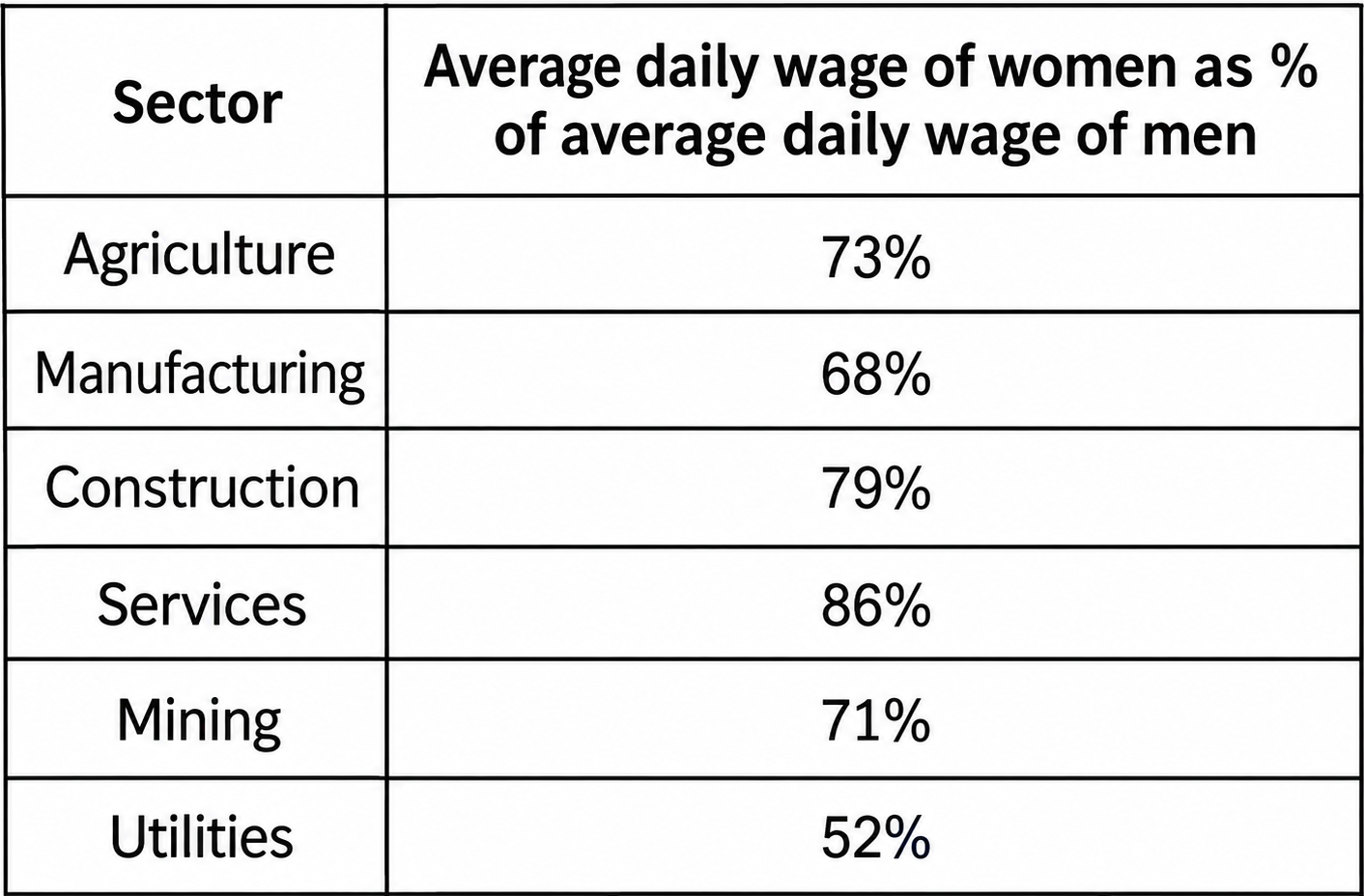
The table shows the average daily wage earned by women as percentage of the average daily wage of men working in the same sector. The sectors listed are Agriculture (Agri), Manufacturing (Mfg), Construction (Const), Services, Mining and Utilities.

Women’s Average Daily Wage by Sector

This is the first question based on Information-F.
It is known that the average daily wages earned by men in the Manufacturing Sector and in the Utilities Sector are the same. Further, women's average daily wage in the Manufacturing Sector is Rs. 1360. Then, the difference between the women's average daily wage in Manufacturing Sector and in the Utilities sector is

This is the second question based on Information-F.
A politician makes the following two remarks based on the data given in the above graph.
Statement 1 - In the Services Sector, the highest daily wage of a woman is less than the highest daily wage of a man.
Statement 2 - In the Manufacturing Sector, the lowest daily wage of a woman is less than the average daily wage of a man.
Which of the statements has to be true?

For the following questions answer them individually

From a point on level ground, the angle of elevation of the top of a vertical tower is $$30^\circ$$. After moving 20 m towards its base along a straight line, the angle becomes $$60^\circ$$. What is the height of the tower?

In a chessboard, two "rooks" are said to be in an attacking position if they are in the same row or in the same column. If you have a 13-by-13 chessboard, in how many ways can you place 13 rooks so that none of them are attacking each other?

Let $$g(t) = f(t + a) - 2$$, where $$f(\cdot)$$ is a non-negative continuous function defined on the set of real numbers and $$a > 0$$ is a real constant. If $$g(-t) = -g(t)$$, then $$\int_0^{2a} f(x)\,dx$$ equals

There are two questions on Information-C below. Answer this question based on this information.
Information-C
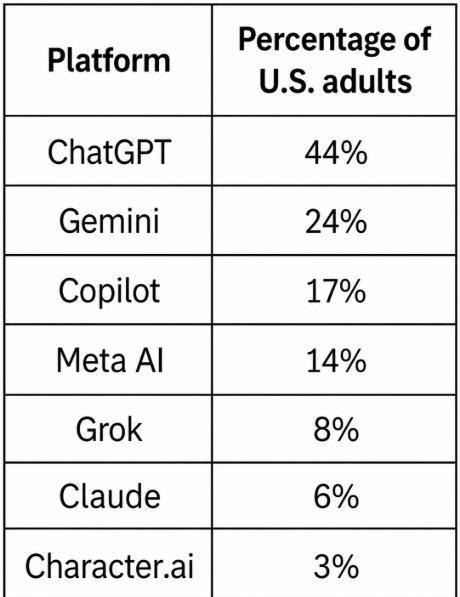
The table shows the data based on "Americans and AI 2026, Chatbots, Smart Devices and Views on Impact," published on June 17, 2026, by the Pew Research Center. The table shows the percentages of U.S. adults who use different AI services in 2026 (till the time of collection of the data). Note that these categories are not mutually exclusive, and a person may use more than one platform.

image

This is the first question based on Information-C.
Suppose that in 2026, the percentage of U.S. adults who use any AI chatbot is $$49\%$$. Consider the percentage of U.S. adults who use both ChatGPT and Gemini. Which of the following statements must be true? Choose the MOST PRECISE option.

This is the second question based on Information-C.
Suppose that in 2026, the percentage of U.S. adults who use any AI chatbot is $$49\%$$. Consider the percentage of U.S. adults who use both ChatGPT and Gemini. Which of the following statements must be true? Choose the MOST PRECISE option.

For the following questions answer them individually

Suppose the function $$f \colon \mathbb{R} \to \mathbb{R}$$ is differentiable and satisfies $$f(x)f'(x) < 0$$ for all real $$x$$. Then which of the following is true?

Let $$A = \left\{(x, y) \mid y < \pi \sin x \text{ and } \frac{x^2}{4\pi^2} + \frac{y^2}{9\pi^2} < 1\right\}$$. Then, area of A is

Three sides of a right-angled triangle are in arithmetic progression, and the perimeter of the triangle is 36. Then, the area of this triangle is

Consider the set $$S$$ which contains all positive integers that are less than or equal to 2026 and are relatively prime with 2026. What is the arithmetic mean of the integers in $$S$$?

The equation $$x^2y^2 - 4x^3 - y^2 + 4x = 0$$ represents

There are three questions on Information-B below. Answer this question based on this information.
Information-B
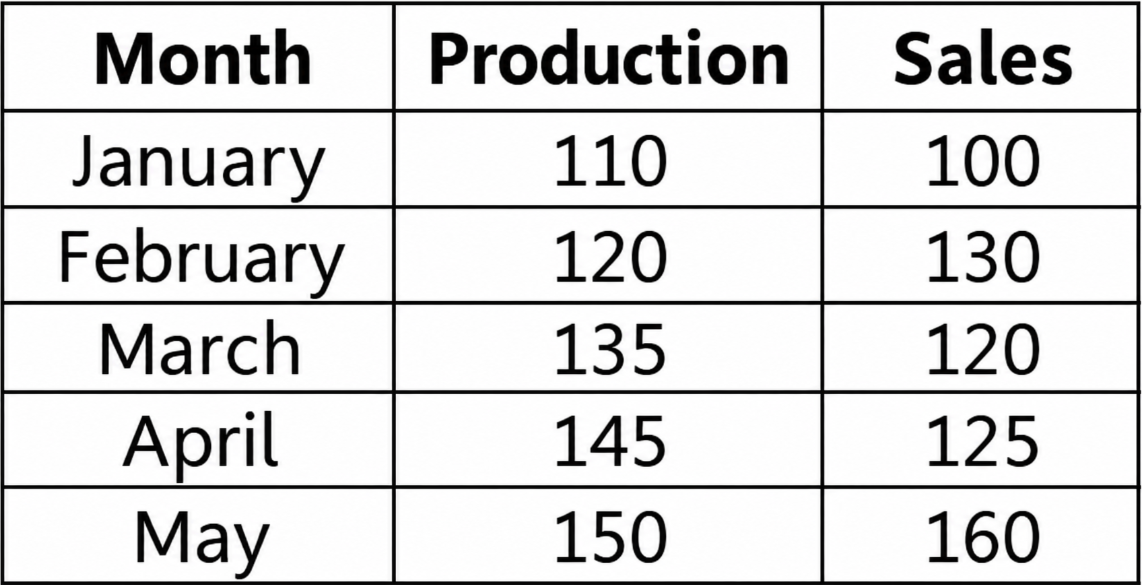
The table below shows the numbers of bicycles produced and sold by a workshop in five consecutive months.

image

This is the second question based on Information-B.
There were 20 unsold bicycles in stock immediately before January. All production was added to stock, all sales were taken from stock, and there were no other stock changes. How many unsold bicycles remained at the end of May?

This is the third question based on Information-B.
If it is assumed that the sales would continue to increase from May to June at a rate equal to the average of the month-over-month percentage changes from January to May, what would be the predicted sales (nearest integer) in June?

For the following questions answer them individually

Suppose $$a < 0$$. The function $$f(x) = \max\{ax^2 + x + 1, e^x\}$$ is differentiable for all real $$x$$. If $$f(x) = ax^2 + x + 1$$ for some $$x \in A$$, then which of the following can be $$A$$?

In a class of 101 students, the median score is 40, the minimum score is 20, and the maximum score is 100. What is the lowest possible average score of the class?

There are three questions on Information-A below. Answer this question based on this information.
Information-A
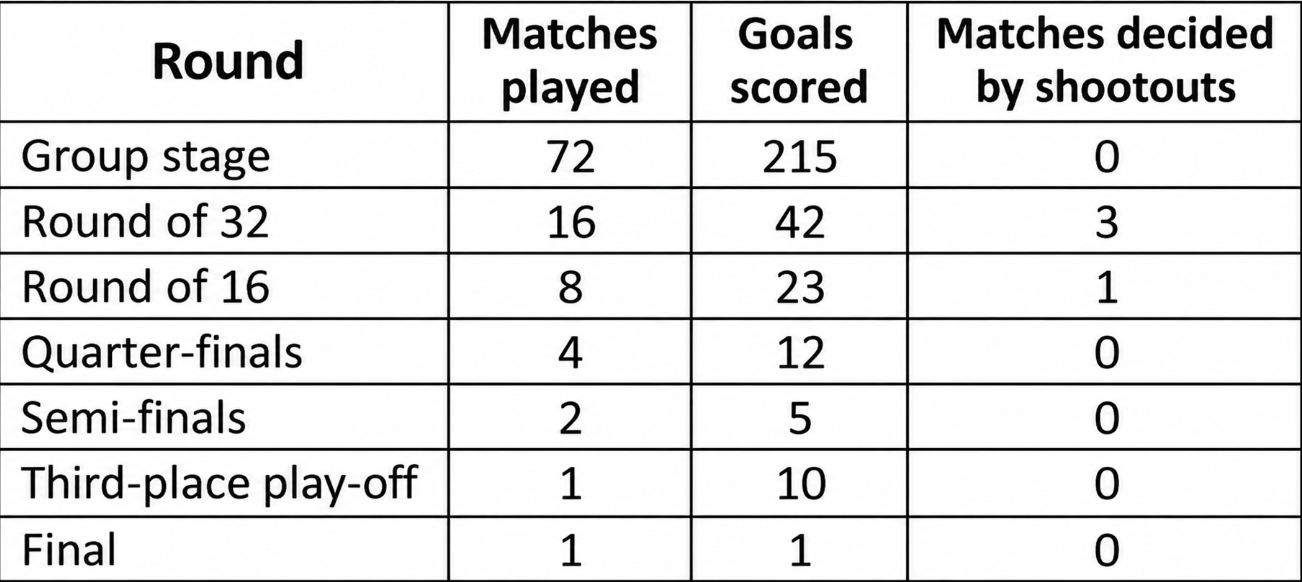
The FIFA World Cup 2026 was played during the summer of 2026, among 48 teams. The table shows matches played, goals scored and matches decided by penalty shootouts (this is only relevant after group stage) across different rounds. Note that all matches after the group stage are knockout matches (defined as the losing team gets knocked out from the tournament). Goals include those scored in the regulation time and the extra time but exclude penalty-shootout kicks.

image

This is the first question based on Information-A.
If we select a match at random from the knockout matches (i.e., all matches after the group stage), what is the probability that it was decided by a penalty shootout?

This is the second question based on Information-A.
If there was no group stage, and all matches were to be decided in a knockout format, how many matches would be needed to decide the champion?

This is the third question based on Information-A.
In any dataset, an observation is called an "outlier" or an unusual observation if it is too high or too low with respect to the mean of the data. Based on the information in the table, considering the average number of goals scored in a given round, which of the rounds in the FIFA World Cup 2026 shows the strongest evidence of an outlier?

For the following questions answer them individually

A date from the current year is chosen from the twelve listed below.
March 17, March 19, April 19, May 15, May 16, May 19, May 20, June 18, July 14, July 15, July 16, July 18.
Mathew is told only the month part of the chosen date, while Hari is told only the day of the month, but not the month. At the beginning itself, both are aware of the complete list of twelve possible dates. Consider the following sequence of statements below to be true.
• Mathew says, "I do not know the date."
• Hari says, "I do not know it either."
• Mathew says, "I still do not know it."
• Hari says, "I know the date now."
Which date was chosen?

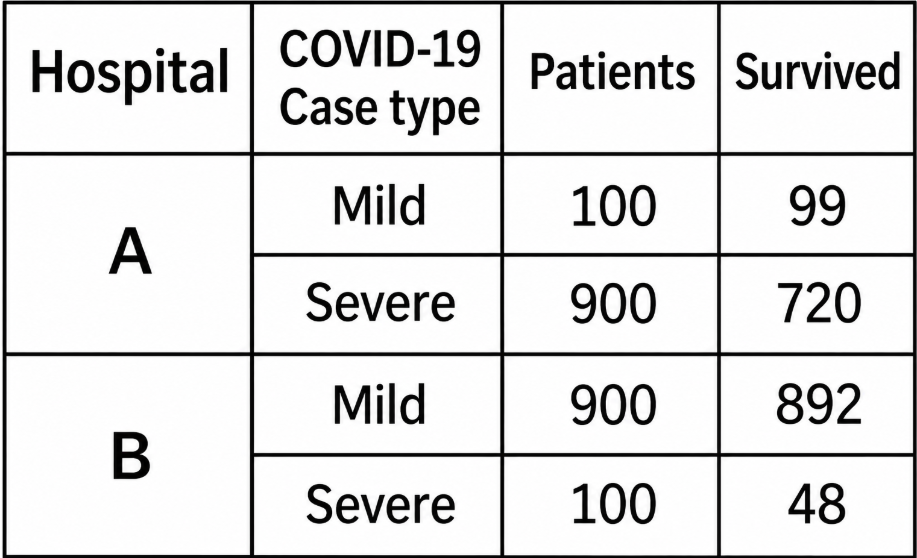
A review report concludes that Hospital B performed better than Hospital A in treating patients with COVID-19 in terms of the survival rates computed from the data presented in the table below.

image


Which of the following statements provides the strongest evidence against the conclusion of the report?

N is a whole number between 1 and 25, inclusive of both. The following statements are made about N. Each statement may either correct or incorrect.
I) N is even.
II) N is a multiple of 3.
III) N is greater than 12.
IV) N is a multiple of 4.
V) N is a multiple of 5.
For how many values of N, EXACTLY one of the above statements about N is incorrect?

A pile holds 21 matchsticks. Two players Anil and Bela, make moves alternately. A move consists of removing either 1, or 2 or 3 sticks. Whoever takes the last stick wins. Anil makes the first move.
Assume that both players adopt the best strategy. Who would win and what is the correct opening move?

A state ranks its 600 schools based on the average score of students in the board examination. The teachers from the bottom 50 schools based on last year's rank underwent an intensive teacher-training program. This year, average score of students from those 50 schools improved by $$9\%$$ on average, while those from the other 550 improved by $$2\%$$ on average. Officials concluded that the training program is successful.
Which one of the following, if true, most weakens that conclusion?

Amit and Dola are having face-to-face conversations in the evening. Neela and Sumit are having face-to-face conversations at the same time. When Neela is facing Sumit, she (Neela), Amit, and Dola are standing on a line with Dola positioned just to the left of Neela. In these positions
• Dola and Neela are facing different directions and are neither facing each other nor standing with their backs to each other.
• Amit is standing further from Neela than Dola is.
• Sumit's shadow is falling on Neela.
Who among the four is facing north?

There are four questions on Information-D below. Answer this question based on this information.
Information-D
Seven manuscripts - F, G, H, J, K, L and M - are placed, one each, on seven shelves. The shelves are numbered consecutively 1 to 7, from bottom to the top. The following additional information is known.
I) G is on a shelf lower than H.
II) Exactly two manuscripts are on shelves between K and L.
III) J is on shelf 4.
IV) Neither M nor F is on a shelf adjacent to either G or H.
V) F is on a shelf higher than G. K is on a shelf higher than F.
This is the first question based on Information-D.
For how many manuscripts, can the corresponding shelf number(s) be identified?

There are four questions on Information-D below. Answer this question based on this information.
Information-D
Seven manuscripts - F, G, H, J, K, L and M - are placed, one each, on seven shelves. The shelves are numbered consecutively 1 to 7, from bottom to the top. The following additional information is known.
I) G is on a shelf lower than H.
II) Exactly two manuscripts are on shelves between K and L.
III) J is on shelf 4.
IV) Neither M nor F is on a shelf adjacent to either G or H.
V) F is on a shelf higher than G. K is on a shelf higher than F.
This is the second question based on Information-D.
Which one of the following MUST be true?
(i) F and J are on adjacent shelves.
(ii) G and H are on adjacent shelves.

There are four questions on Information-D below. Answer this question based on this information.
Information-D
Seven manuscripts - F, G, H, J, K, L and M - are placed, one each, on seven shelves. The shelves are numbered consecutively 1 to 7, from bottom to the top. The following additional information is known.
I) G is on a shelf lower than H.
II) Exactly two manuscripts are on shelves between K and L.
III) J is on shelf 4.
IV) Neither M nor F is on a shelf adjacent to either G or H.
V) F is on a shelf higher than G. K is on a shelf higher than F.
This is the third question based on Information-D.
Which one of the following CANNOT be true?
(i) Exactly one manuscript is on shelf between H and J.
(ii) Exactly one manuscript is on shelf between G and J.

There are four questions on Information-D below. Answer this question based on this information.
Information-D
Seven manuscripts - F, G, H, J, K, L and M - are placed, one each, on seven shelves. The shelves are numbered consecutively 1 to 7, from bottom to the top. The following additional information is known.
I) G is on a shelf lower than H.
II) Exactly two manuscripts are on shelves between K and L.
III) J is on shelf 4.
IV) Neither M nor F is on a shelf adjacent to either G or H.
V) F is on a shelf higher than G. K is on a shelf higher than F.
This is the fourth question based on Information-D.
Which of the following CAN be true?
(i) H is on an odd-numbered shelf.
(ii) L is on an odd-numbered shelf.

A club applies the following five rules to its members.
1. Every member who coaches also umpires.
2. Every member on the finance panel pays a levy.
3. No umpire is on the finance panel.
4. No member who pays a levy umpires.
5. No member on the finance panel coaches.
Which one of the following rules is/are redundant given the other rules?
(I) Rule 3
(II) Rule 5

There are four questions on Information-E below. Answer this question based on this information.
Information-E
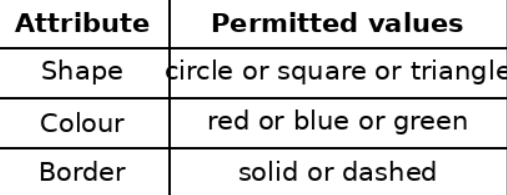
A security door opens for some badges and not for others. Every badge has three attributes, with permitted values as given below.

image


The door's rule has the following characteristics.
• The rule carries at most one condition per attribute.
• A condition names a single permitted value for that attribute.
• An attribute carrying no condition is unrestricted.
• The door opens only for those badges that satisfy every condition in the rule.
For example, one possible rule is "green and solid", which would open for every green badge with a solid border, of any shape. Another possible rule is "triangle", which would open for every triangular badge, irrespective of its colour and border.
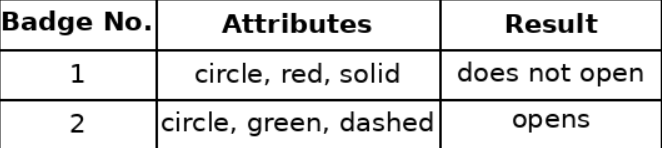
Two badges have been tested with the present rule. The attributes of the badges and the corresponding results are given below.

image

This is the second question based on Information-E.
Which badge(s) among the following combination of attributes is/are certain not to open the door?
(i) triangle, blue, dashed
(ii) square, green, solid

This is the third question based on Information-E.
Testing a badge with which combination of the attributes from the following would yield no additional information about the present rule?
(i) square, blue, solid
(ii) triangle, red, solid

This is the fourth question based on Information-E.
Suppose a third badge with attributes - circle, green, solid - is now tested, and the door opens. How many rules remain possible now?

For the following questions answer them individually

Each of these questions has one or more sentences with two blank spaces. Below each sentence, there are four options each consisting of a pair of words. Choose the option with words that best fill the blank spaces in the sentence.
Although the government had invested heavily in expanding public transportation, many commuters retained a strong ________ to use private vehicles, suggesting that improvements in infrastructure alone were insufficient to ________ deeply established travel habits.

Each of these questions has one or more sentences with two blank spaces. Below each sentence, there are four options each consisting of a pair of words. Choose the option with words that best fill the blank spaces in the sentence.
The historian cautioned against viewing the decline of the old trading centres as evidence of economic ________, arguing instead that commercial activity had merely ________ to newer locations better suited for changing patterns of transportation and consumption.

Comprehension:

There are four questions based on PASSAGE-G.

PASSAGE-G

When people outside India imagine Indian food, they often imagine tradition. The picture is familiar: a grandmother in a sari, sitting in a kitchen, grinding spices by hand and passing recipes down to her children and grandchildren. A dish becomes more “authentic” when it is described as something that a mother or grandmother prepared for the family, perhaps using a recipe that has supposedly remained unchanged for generations.

There is something appealing about this story. Food can carry memories across generations, and recipes can preserve details of family histories that might otherwise disappear. But the association between Indian food and inherited family tradition can also create a distorted picture of Indian culture. It assumes that there is a single, stable tradition waiting to be preserved, when Indian food has always been shaped by movement, exchange and adaptation.

Indian grandmothers did not all spend their lives preparing elaborate meals in traditional kitchens. Many travelled, lived in different parts of India or encountered new ingredients through migration and trade. Some experimented with ingredients that would have seemed foreign to an earlier generation. Her cooking was therefore not simply the preservation of an old tradition; it was also a product of the world in which she lived.

The same is true of the generations that followed. An Indian household may combine dishes associated with different regions, communities and historical influences. Noodles, packaged foods, burgers and other global products have entered Indian kitchens and have been modified to suit local tastes. Such changes are sometimes described as evidence that traditional food is being lost. But another interpretation is possible: these foods are becoming part of Indian food culture precisely because people are adapting them and making them their own.

Technology has accelerated this process. Today young Indians may learn cooking from a food blogger, a YouTube video or a social-media post. The authority of the family recipe has therefore been joined by a much larger and more diverse collection of sources. This does not mean that inherited recipes have become irrelevant. Quite the opposite: memories of family food can be deeply meaningful, particularly when a dish is associated with a person, place or community that is no longer easily accessible.

There is also a paradox here. The more people insist that a traditional recipe must remain unchanged, the less likely it may be to survive as a living practice. Food carries traces of the past while absorbing influences from the present. The challenge, therefore, is not to choose between tradition and change. It is to recognise that change itself has always been part of Indian cultural history.

Why does the author disagree with the view that food such as noodles and burgers is destroying traditional Indian food?

What according to the author is the primary attraction of traditional food?

Which among the following best captures the paradox that the author explains in the last paragraph?

Which among the following might be another cultural artifact like food, which would be representative of Indian culture?

For the following questions answer them individually

In each of the questions there is a passage consisting of six sentences. The first and sixth sentences are in their correct positions, while the order of the middle four sentences has been jumbled and numbered (i), (ii), (iii) and (iv). Below each set of sentences are four options indicating the possible order of the four sentences. Choose the option that best makes the six sentences into a logical and coherent paragraph.
The history of Indian architecture is often described through monuments that have survived, but buildings tell only part of the story.
(i) Materials that were inexpensive and readily available could consequently shape the appearance of entire settlements.
(ii) Much of everyday architecture, by contrast, was created from materials that were vulnerable to weather, neglect and redevelopment.
(iii) Mud, thatch, timber and other such materials rarely leave behind structures that can be studied centuries later.
(iv) Their disappearance creates a curious imbalance in our understanding of the past, since monumental buildings are far more likely to survive than ordinary homes.
What remains visible today, therefore, may reveal less about how most people lived than about what societies chose to preserve.

In each of the questions there is a passage consisting of six sentences. The first and sixth sentences are in their correct positions, while the order of the middle four sentences has been jumbled and numbered (i), (ii), (iii) and (iv). Below each set of sentences are four options indicating the possible order of the four sentences. Choose the option that best makes the six sentences into a logical and coherent paragraph.
A musical tradition can remain remarkably stable even when the way in which it is learned changes substantially.
(i) Recordings, however, introduced a different possibility - a performance could be preserved and heard repeatedly by people who had never encountered the musician in person.
(ii) For centuries, much of Indian classical music was transmitted through direct interaction between teacher and student.
(iii) This meant that learning involved more than memorising compositions, since students also absorbed subtle aspects of timing, expression and interpretation by observing their teacher.
(iv) The technology did not eliminate the need for personal instruction, but it altered what could be carried beyond the immediate teacher-student relationship.
The tradition consequently acquired a new means of transmission without necessarily abandoning its older forms of apprenticeship

Each of these questions has one or more sentences that has a bold italicized word or phrase. Below each question, there are four options consisting of a word or phrase. Choose the word or phrase that best retains the meaning of the original sentence if it replaces the bold italicized word or phrase.
The historian does not dismiss the traditional account entirely, but casts doubt on the assumption that the kingdom's decline can be attributed to a single military defeat.

Each of these questions has one or more sentences that has a bold italicized word or phrase. Below each question, there are four options consisting of a word or phrase. Choose the word or phrase that best retains the meaning of the original sentence if it replaces the bold italicized word or phrase.
Although the new policy generated considerable public discussion and attracted substantial media attention, its tangible effects on the lives of ordinary citizens remained difficult to identify, with little evidence that it had altered their daily behaviour.

Each of these questions has one or more sentences that has a bold italicized word or phrase. Below each question, there are four options consisting of a word or phrase. Choose the word or phrase that best retains the meaning of the original sentence if it replaces the bold italicized word or phrase.
The committee's decision to postpone the project was predicated on the assumption that additional funding would become available within the next six months.

Comprehension:

There are four questions based on PASSAGE-F.

PASSAGE-F

Predicting what sport will look like twenty-five years from now is an exercise in controlled speculation. Yet the history of technology suggests that developments that initially appear absurd can eventually become ordinary. In the late 1990s, Japanese robotics researchers imagined a competition in which a team of humanoid robots would eventually be capable of defeating the human football world champions. At the time, the idea seemed fanciful. Today, autonomous robots already play football against one another, although their performance remains far removed from that of professional athletes.

The more immediate transformation may not involve robots replacing athletes, but technology becoming part of the athletes themselves. Advances in brain-computer interfaces could eventually allow neural implants to interact directly with sporting technology. One possible consequence would be earlier detection of injuries, allowing medical intervention before an athlete experiences serious physical damage. Athletes competing at the highest level in their fifties, once almost unimaginable, might become increasingly common.

Technology could also change the experience of spectators. Virtual-reality devices may eventually allow fans sitting at home to experience something close to being physically present inside a stadium. The social experience of being a fan may change as well. Digital platforms already allow supporters to discuss matches continuously with friends who may be nowhere nearby. In the future, artificial-intelligence companions could become part of these conversations. They might remember a person's sporting preferences, understand their interests and respond in ways that seem increasingly natural. The result could be a strange combination of greater social connection and greater technological mediation.

The economics of sport may change at least as significantly. Major international events could become more frequent because organizers and host countries have strong financial incentives to generate additional television, sponsorship and tourism revenues.

Perhaps the most important challenge, however, lies outside elite sport. While enormous resources are being invested in making professional competition more sophisticated, many children are becoming less physically active. If participation in physical activity declines while professional sport becomes increasingly commercialized and technologically advanced, society could end up with an unusual contradiction: sport may become more spectacular to watch while fewer people regularly participate in it.

Which of the following can be inferred from author's hypothesis about advancements in brain-computer interfaces?

Why does the author find the combination of greater social connection and greater technological mediation to be strange?

Which of the following can be inferred from the example of autonomous robots playing football?

Which of the following is the best example of controlled speculation that the author mentions in the opening sentence?

Over 8000+ registered students have benefitted from Cracku's IPMAT Course

Crack IPMAT 2026 with Cracku