 91- 6303239042
What is the currency of Spain?
Sign in
Please select an account to continue using cracku.in
↓ →
What is the currency of Spain?
Which of the following benefits is available under the Pradhan Mantri Jan Dhan
Yojana? - •
Loading solution...
What is the full form of FII?
Loading solution...
Who has authored The Mother I Never Knew’?
Loading solution...
What does I,’ stand for in SLR?
Loading solution...
Money laundering is done to
Loading solution...
Who among the following won two bronze medals at the 17th Asian Games before announcing his/her retirement?
Loading solution...
On which recent data did Indian Mars Orbital MissionMangalyaan reach Mars?
Loading solution...
Under the KYC rules, the financial assets or economic resources of the nature of immovable properties have to be verified within
Loading solution...
Nukualofa is the capital of
Loading solution...
To which of the following ministries is Nitin Gadkari related?
Loading solution...
Which of the following movies has been selected as India’s entry at the 2015 Oscar Awards?
Loading solution...
The Government recently increased deposit money under Public Provident Fund (PPF) from Rs. 1 lakh to
Loading solution...
Which of the following is the largest hydroelectric power plant in India?
Loading solution...
18 countries recently signed the Minamata Convention on ……………….at the 69th session of the United Nations General Assembly.
Loading solution...
What does ‘M’ stands for in MIFF?
Loading solution...
Who recently resigned as the CEO of Heidelberg Cement India?
Loading solution...
Mogadishu is the capital of
Loading solution...
Total credits in Basic Savings Bank Deposit Account should not exceed…in a year.
Loading solution...
What is the full form of NIM?
Loading solution...
What does MTSS stand for?
Loading solution...
The Kisan Vikas Patra Scheme was stopped by the government to
Loading solution...
Vishal Sikka is CMD of which company?
Loading solution...
A Negotiable Instrument means a…………… payable either to order or to bearer.
Loading solution...

The RBI recently permitted Muthoot finance to set up
Loading solution...
SBI Life Insurance is a joint venture between State Bank of India and
Loading solution...
Merchant payments in India is controlled by
Loading solution...
For Basic Savings Bank Deposit Account (BSBDA)-Small Account, the total of debits by way of cash withdrawals and transfers should not exceed
Loading solution...
What is the full form of PKI?
Loading solution...
Which of the following committees was set up to update the Banking Ombudsman
Scheme?
Loading solution...
Why is RTGS used?
Loading solution...
Maximum money that can remitted to Nepal from any of the NEFT -enabled branches in India is
Loading solution...
What does the letter ‘S’ stand for in the acronym NSDL?
Loading solution...
The tag line of State Bank of India (SBI) is
Loading solution...
Who was awarded the Santi Swaroop Bhatnagar award 2014 for Mathematical Sciences?
Loading solution...
Which bank recently celebrated 150 years of its operations in Sri Lanka?
Loading solution...
With which of the following is the feature of crossing not available?
Loading solution...
What is the rate at which the scheduled banks can borrow funds overnight from RBI against government securities?
Loading solution...
Who, at present, is the Union Minister for Housing and Urban Poverty Alleviation?
Loading solution...
What is the full form of CPI?
Loading solution...
Read the following passage carefully and answer the questions given below it. Certain words/phrases have been printed in bold to help you locate them while answering some of the questions. The wisdom of learning from failure is incontrovertible. Yet organisations that do it well are extraordinarily rare. This gap is not due to a lack of commitment to learning. Managers in the vast majority of enterprises that I have studied over the past 20 years
—pharmaceutical. financial services, product design, telecommunications, and construction companies: hospitals; and NASA’s space shuttle program, among others— genuinely wanted to help their organisations learn from failures to improve future performance. In some cases they and their teams had devoted many hours to afteraction reviews, postmortems, and the like. But time after time I saw that these painstaking efforts led to no real change. The reason: Those managers were thinking about failure the wrong way. Most executives I’ve talked to believe that failure is bad (of course!). They also believe that learning from it is pretty straightforward: Ask people to reflect on what they did wrong and exhort them to avoid similar mistakes in the future—or, better yet, assign a team to review and write a report on what happened and then distribute it throughout the organisation. These widely held beliefs are misguided. First, failure is not always bad. In organisational life it is sometimes bad, sometimes inevitable, and sometimes even good. Second, learning from organisational failures is anything but straightforward. The attitudes and activities required to effectively detect and analyze failures are in short supply in most companies, and the need for context-specific learning strategies is underappreciated. Or – ganisations need new and better ways to go beyond lessons that are superficial (“Procedures weren’t followed”) or self-serving (“The market just wasn’t ready for our great new product”). That means jettisoning old cultural beliefs and stereotypical notions of success and embracing failure’s lessons. Leaders can begin by
understanding how the blame game gets in the way. The Blame Game Failure and fault are virtually inseparable in most households. organisations, and cultures. Every child learns at some point that admitting failure means taking the blame. That is why so few organisations have shifted to a culture of psychological safety in
which the rewards of learning from failure can be fully realised. Executives I’ve interviewed in organisations as different as hospitals and investment banks admit to being torn: How can they respond constructively to failures without giving rise to an anything-goes attitude? If people aren’t blamed for failures, what will
ensure that they try as hard as possible to do their best work? This concern is based on a false dichotomy. In actuality, a culture that makes it safe to admit and report on failure can—and in some organisational contexts must–coexist with high standards for performance. To understand why, look at the exhibit “A Spectrum of
Reasons for Failure,” which lists causes ranging from deliberate deviation to thoughtful
experimentation. Which of these causes involve blameworthy actions? Deliberate deviance, first on the
list, obviously warrants blame. But inattention might not. If it results from a lack of effort, perhaps it’s blameworthy. But if it results from fatigue near the end of an overly long shift, the manager who assigned the shift is more at fault than the employee. As we go down the list, it gets more and more difficult to find blameworthy acts. In fact, a failure resulting from thoughtful experimentation that generates valuable information
may actually be praiseworthy. When I ask executives to consider this spectrum and then to estimate how many of the failures in their organisations are truly blameworthy, their answers are usually in single digits—perhaps 2% to 5%. But when I ask how many are treated as blameworthy, they say (after a pause or a laugh) 70% to 90%. The unfortunate consequence is that many failures go unreported and their lessons are lost. Question : sophisticated understanding of failure’s causes and contexts will help to avoid the blame game and institute an effective strategy for learning from failure. Although an infinite number of things can go wrong in organisations, mistakes fall into three broad categories: preventable, complexity-related, and intelligent.
Which of the following statement (s) is/are true in the context of the given passage
?
I. Most executives believe that failure is bad and learning from it is pretty
straightforward.
II. The wisdom of learning from failure is disputable.
III. Deliberate deviance, first on the list of the exhibit, “A Spectrum of Reasons for
Failure” obviously warrants blame.
Loading solution...
Which of the following statements is not true in the context of the given passage ?
Loading solution...
As opined by the writer of this article, although an infinite number of things can go
wrong in organisations, mistakes fall into three broad categories. What are these categories ?
Loading solution...
Why have so few organisations shifted to a culture of psychological safety in which
the rewards of learning from failure can be fully realised ?
Loading solution...
What in your opinion should be the most appropriate title of this passage ?
Loading solution...
Choose the word/group of words which is most similar in meaning to the word /group of words printed in bold as used in the passage.
Exhort
Loading solution...
Jettison
Loading solution...
Dichotomy
Loading solution...
Choose the word/group of words which is most opposite in meaning to the word/group of words printed in bold as used in the passage.
Incontrovertible
Loading solution...
Overly
Loading solution...
Rearrange the following six sentences (A), (B), (C), (D), (E) and (F) in the proper sequence to form a meaningful paragraph; then answer the questions given below them.
(A) Speculations , on future events in the epidemiology, evolution, and biological expression of dengue are presented.
(B) At the root of the emergence of dengue as a major health problem are changes in human demography and behavior, leading to unchecked populations of and increased exposure to the principal domestic mosquito vector, Aedes aegypti. Virus-specified factors also influence the epidemiology of dengue.
(C) The risk of sequential infections, and consequently the incidence of DHF, has risen dramatically, first in Asia and now in the Americas.
(D) A severe form, dengue hemorrhagic fever (DI-IF), is an immunopathologic disease occurring in persons who experience sequential dengue infections.
(E) In the last 20 years the incidence of dengue fever epidemics has increased and hyper-endemic transmission has been established over a geographically expanding area.
(F) Dengue viruses are members of the Flaviviridae, transmitted principally in a cycle involving humans and mosquito vectors.
Which of the following should be the First sentence after rearrangement ?
Loading solution...
Which of the following should be the Third sentence after rearrangement ?
Loading solution...
Which of the following should be the Last sentence after rearrangement ?
Loading solution...
Which of the following should be the Fourth sentence after rearrangement ?
Loading solution...
Which of the following should be the Second sentence after rearrangement ?
Loading solution...
Each question below has two blanks, each blank indicating that something has been omitted. Choose the word for each blank which best fits the meaning of the sentence as a whole.
Manufacturing growth across Asia, Europe and the Americas eased in current month as heavy price cutting failed to revive , providing more evidence that a feeble global economic recovery may be to a halt.
Loading solution...
Crude oil markets rose after a five year low rebounding after data suggested that tumbling prices may have started to affect activjty in the fast growing US shale oil industry
Loading solution...
In fact, there is a strong case to promote liquor in high quality factories under regulation so that the of illicit liquor and hooch goes down.
Loading solution...
The government ease foreign direct norms for the construction development sector , which is expected to provide a boost to the sector in terms of greater foreign capital inflows.
Loading solution...
The banks were nationalised in to take banking to the country and all its citizens.
Loading solution...
Read the following passage carefully and answer the questions given below it. Certain words/phrases have been printed in bold to help you locate them while answering some of the questions. The past quarter of a century has seen several bursts of selling by the world’s governments, mostly but not always in benign market conditions. Those in the OECD, a rich-country club, divested plenty of stuff in the 20 years before the global financial crisis. The first privatisation wave, which built up from the mid-1980s and peaked in 2000, was largely European. The drive to cut state intervention under Margaret Thatcher in Britain soon spread to the continent. The movement gathered pace after 1991, when eastern Europe put thousands of rusting state-owned enterprises (SOEs) on the block. A second wave came in the mid-2000s, as European economies sought to cash in on buoyant markets. But activity in OECD countries slowed sharply as the financial crisis began. In fact, it reversed. Bailouts of failing banks and companies have contributed to a dramatic increase in government purchases of corporate equity during the past five years. A more lasting fea ture is the expansion of the state capitalism practised by China and other emerging economic powers. Governments have actually bought more equity than they have sold in most years since 2007, though sales far exceeded purchases in 2013. Today privatisation is once again “alive and well”, says William Megginson of the Michael Price College of Business at the University of Oklahoma. According to a global tally he recently completed, 2012 was the third-best year ever, and preliminary evidence suggests that 2013 may have been better. However, the geography of sell-offs has changed, with emerging markets now to the fore. China, for instance, has been selling minority stakes in banking, energy, engineering and broadcasting; Brazil is selling airports to help finance a $20 billion investment programme. Eleven of the 20 largest IPOs between 2005 and 2013 were sales of minority stakes by SOEs, mostly in developing countries. By contrast, state-owned assets are now “the forgotten side of the balance-sheet” in many advanced economies, says Dag Detter, managing partner of Whetstone Solutions, an adviser to governments on asset restructuring. They shouldn’t be. Governments of OECD countries still oversee vast piles of assets, from banks and utilities to buildings, land and the riches beneath (see table). Selling some of these holdings could work wonders: reduce debt, finance infrastructure, boost economic efficiency. But governments often barely grasp the value locked up in them. The picture is clearest for companies or company-like entities held by central governments. According to data compiled by the OECD and published on its website, its 34 member countries had 2,111 fully or majority-owned SOEs, with 5.9m employees, at the end of 2012. Their combined value (allowing for some but not all pension-fund liabilities) is estimated at $2.2 trillion, roughly the same size as the global hedge-fund industry. Most are in network industries such as telecoms, electricity and transport. In addition, many countries have large minority stakes in listed firms. Those in which they hold a stake of between 10% and 50% have a combined market value of $890 billion and employ 2.9m people.
The data are far from perfect. The quality of reporting varies widely, as do definitions of what counts as a state-owned company: most include only centralgovernment holdings. If all assets held at sub-national level, such as local water companies, were included, the total value could be more than $4 trillion. Reckons Hans Christiansen, an OECD economist. Moreover, his team has had to extrapolate because some QECD members, including America and Japan, provide patchy data. America is apparently so queasy about discussions of public ownership of -commercial assets that the Treasury takes no part in the OECD’s working group on the issue, even though it has vast holdings, from Amtrak and the 520,000-employee Postal Service to power generators and airports. The club’s efforts to calculate the value that SOEs add to, or subtract from, economies were abandoned after several countries, including America, refused to co-operate.
Privatisation has begun picking up again recently in the OECD for a variety of reasons. Britain’s Conservative-led coalition is fbcused on (some would say obsessed with) reducing the public debt-to-GDP ratio. Having recently sold the Royal Mail through a public offering, it is hoping to offload other assets, including its stake in URENCO, a uranium enricher, and its student-loan portfolio. From January 8th, under a new Treasury scheme, members of the public and businesses will be allowed to buy government land and buildings on the open market. A website will shortly be set up to help potential buyers see which bits of the government’s /..337 billion-worth of holdings ($527 billion at today’s rate, accounting for 40% of developable sites round Britain) might be surplus. The government, said the chief treasury secretary, Danny Alexander, “should not act as some kind of compulsive hoarder”. Japan has different reasons to revive sell-offs, such as to finance reconstruction after its devastating earthquake and tsunami in 2011. Eyes are once again turning to Japan Post, a giant postal-to-financial-services conglomerate whose oftpostponed partial sale could at last happen in 2015 and raise (Yen) 4 trillion ($40 billion) or more. Australia wants to sell financial, postal and aviation assets to offset the fall in revenues caused by the commodities slowdown. In almost all the countries of Europe, privatisation is likely “to surprise on the upside” as long as markets continue to mend, reckons Mr Megginson. Mr Christiansen expects to see three main areas of activity in coming years. First will
be the resumption of partial sell-offs in industries such as telecoms, transport and utilities. Many residual stakes in partly privatised firms could be sold down further. France, for instance, still has hefty stakes in GDF SUEZ, Renault, Thales and Orange. The government of Francois Hollande may be ideologically opposed to privatisation, but it is hoping to reduce industrial stakes to raise funds for livelier sectors, such as broadband and health.
The second area of growth should be in eastern Europe, where hundreds of large firms, including manufacturers, remain in state hands. Poland will sell down its stakes in listed firms to make up for an expected reduction in EU structural funds. And the third area is the reprivatisation of financial institutions rescued during the crisis. This process is under way: the largest privatisation in 2012 was the $18 billion offering of America’s residual stake in AIG, an insurance company.
Which of the following statements is not true in the context of the given passage ?
Loading solution...
Which of the following statement (s) is/are true in regard to the data compiled by
the OECD ?
I. The 34 member countries of OECD had 2111 fully or majority owned stateowned enterprises (SOEs)
II. In these SOEs there were 5.9 million employees at the end of 2012.
III. The combined value of these SOEs is estimated at $ 2.2 trillion, roughly the same size as the global hedge-fund industry.
Loading solution...
Privatisation has begun picking up again recently in the OECD for a variety of
reasons. Which of the following statements does not support the above mentioned
view ?
Loading solution...
Which of the following statement(s) is/are true in the context of the given article ?
Loading solution...
What should be the most appropriate title of the passage ?
Loading solution...
In almost all the countries of- Europe, privatisation is to surprise. As expected by
Mr. Christiansen, Which of the following is/are to be the main areas of activity ?
I. Resumption of partial sell-offs in industries such as telecoms. transport and
utilities.
II. The other area of growth should be in eastern Europe
III. The other area is the reprivatisation of financial institutions rescued during the
crisis.
Loading solution...
Choose the word/group of words which is most similar in meaning to the word /group of words printed in bold as used in the passage.
Buoyant
Loading solution...
Revive
Loading solution...
Choose the word/group of words which is most opposite in meaning to the word/group of words printed in bold as used in the passage.
Benign
Loading solution...
Offload
Loading solution...
In the following passage there are blanks, each of which has been numbered. These numbers are printed below the passage and against each, five words are suggested, one of which fits the blank appropriately. Find
out the appropriate word in each case. There is already an extensive empirical literature – often using growth accounts – that (31) these and other aspects of India’s economic growth. Many of the studies (32) one or more of the following topics. First, a number of analysts (33) focused on characterizing India’s economic performance at the most aggregate level. While there is agreement that growth did indeed improve during the past quarter
century, researchers have reached vary ing conclusions on some issues such as the timing and precise magnitude of this acceleration, and the relative importance of changes in domestic policy.. There are on-going discussions over the extent to which the current growth can be maintained and various means by (34) it might be increased.
Second, analysts have examined the behavior of particular output sectors. A number of authors have studied productivity in manufacturing – reaching a wide range of conflicting conclusions. However, as explained in detail by Goldar and Mitra (2002), differences in the findings can be (35) to a variety of measurement issues, such as the use of singe versus double deflation to construct estimates of real growth in manufacturing value added. Goldar (2004) provides a careful recent update showing that TFP growth in manufacturing (36) to have slowed in the post reform period – raising additional puzzles discussed below. However, (37,) difficulties in measuring employment within individual industries, our analysis focuses (38) on the broader industrial sector. The 3 studies that focus on India’s services sector (many of which discuss the issue of sustain-ability), and
those that discuss agriculture, are discussed in the body of the paper. Given the large body of prior research, many of the results to be discussed below (39) already well-known to those in the field. Nonethe-less, this paper seeks to make a contribution to that literature in a variety of ways. In particular, the growth accounting framework, com- bined with our emphasis on data issues, pulls together concerns that have typically been treated separately, and in some cases, raise implications that do not appear to have been (40) recognized. Our updated
growth accounts incorporate recent data revisions, some of which are quite large. They also provide new estimates for the contributions to overall growth of labor productivity growth within the major economic sectors
versus the gains from reallocation of labor and capital among the factors. Furthermore, we have examined a variety of additional data in our analysis of the role of capital accumulation – providing estimates of the returns to schooling for human capital, and reporting on trends in sectoral saving and investment, for phystcal capital. Thus, this paper is comprised of four remaining sections. The next section details the construction of growth accounts for India, with considerable attention paid to the quality of the underlying data.
Loading solution...
Loading solution...
Loading solution...
Loading solution...
Loading solution...
Loading solution...
Loading solution...
Loading solution...
Loading solution...
Loading solution...
In the following figure, ABCD is a square whose each side is 10cm long. Mangles AEC and AEFC are congruent. Point B’ is the mid-point of side EC. Find the area of AEFC (in sq. cm).

Loading solution...
In the following figure, ABC is an equilateral triangle and BCDE is a square whose each side is 8 cm long. Find the area of pentagon ABDEC in square cm.
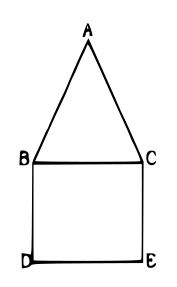
Loading solution...
If 36 persons are engaged on a piece of work, the work can be completed in 40 days. After 32 days, only 3/4 th of the work was completed. How many more persons are required to complete the work on time?
Loading solution...
A shopkeeper bought 84 identical shirts priced at Rs. 240 each. He spent a total of Rs. 3200 on transportation and packaging. He put the label of marked price of Rs.420 on each shirt. He offered a discount of 15% on each shirt at the marked price. What is the total profit of the shopkeeper in the whole transaction ?
Loading solution...
There is a rectangular plot whose length is 36 metre and breadth is 28 metre. There are two paths parallel to length and breadth of plot as is shown shaded in the following figure. The remaining part is lawn whose area is 825 square metre. What is the area of paths ?

Loading solution...
In the following questions two equations numbered I and II are given. You have to solve both the equations and
Give answer If
a:x > y
b: x ≥ y
c: x < y
d: x ≤ y
e: x = y or the relationship cannot be established
$$I. 8x^{2} + 26x+ 15 =0$$
$$II. 4y^{2} + 24y+ 35 = 0$$
Loading solution...
$$I. x^{2} - 5x - 24 = 0$$
$$II. y^{2} - 7y - 18 = 0$$
Loading solution...
$$I.6x^{2} + 19x +15 = 0$$
$$II. 24y^{2} + 11y + 1=0$$
Loading solution...
$$I. 9x^{2} - 27x + 20 = 0$$
$$II. 6y^{2} - 5y + 1 =0$$
Loading solution...
$$I. x^{2}- 6x + 9 = 0$$
$$II. y^{2} - 11y+24 = 0$$
Loading solution...
In the following graph, production of rice per hectare (in quintal) during last six years in three states of West Bengal, Odisha and Andhra Pardesh has been shown, Study the graph carefully and answer the questions given below it.

What was the average production of rice per hectare by the state of Odisha taking all the years together (in quintals) ?
Loading solution...
What is the ratio between average production of rice per hectare by all three states in the years 2004 and 2007 respectively ?
Loading solution...
In which year was the production of rice per hectare by all three states highest ?
Loading solution...
What was the percentage increase in production of rice per hectare in Andhra Pradesh in the year 2009 with respect to the year 2005 ?
Loading solution...
In how many years was the production of rice per hectare more than the average production of rice per hectare in the given years in West Bengal ?
Loading solution...
Study the following table carefully and answer the questions given below it. Annual salary (in Rs lakh) of each employee working in different departments of a certain company ‘X’ during the given years

What is the average annual salary of an employee in finance department in the given years ?
Loading solution...
An employee who had worked in marketing department from 2010 to 2013, earned a total sum of Rs. (in lakh)
Loading solution...
If there were 50 employees in 2008 and 100 employees in 2010 in procurement department, what amount was spent on their annual salaries in these years by the company ? (In Rs. lakh)
Loading solution...
In the given years, there were an average of 190 employees in production department. What amount did the company spend on an average per year on the payment of their salaries ? (In Rs. lakh)
Loading solution...
By what percent approximately was the increase in the annual salary of an employee in the Human Resources department from year 2010 to the year 2012 ?
Loading solution...
In the following table, the number of officers and clerks working in five different departments of an office is given. Read the table carefully and answer the questions given below it. Department Officer Clerk

What is the difference between the total number of officers and clerks taking all the departments together ?
Loading solution...
The respective ratio betWeen the number of officers in department C and that of clerks in department B is
Loading solution...
By what percent is the number of officers more than that of clerks taking all the departments together ?
Loading solution...
A boat running downstream covers a distance of 16 km in 2 hours while for covering the same distance upstream, it takes 4 hours. What is the speed of the boat in still water ?
Loading solution...
Two persons A and B start a business with investments of Rs. 24000 and Rs.28000 respectively. After 4 months C also joined them with certain investment. Total profit at the end of the year was Rs. 19950. C’s share in profit was Rs. 7600. What was the C’s investment in the business ?
Loading solution...
A car starts at 11 am from point A towards point B at 36 kmph while another car starts at 1 pm from point B towards A at 44 kmph. They cover a distance of 592 km till meeting. At what time will they meet each other ?
Loading solution...
The ratio of present ages of P and Q is 8 : 5. After 4 years their ages will be in the ratio 4 : 3 respectively. What will be the ratio of P’s age after 7 years from now and Q’s age now?
Loading solution...
A vessel contains 64 litres of mixture of milk and water in the ratio 7 : 3 respectively. 8 litres of mixture is replaced by 8 litres of milk. What is the ratio of milk and water in the resulting mixture ?
Loading solution...
The average weight of boys in a class is 45 kg while that of girls is 36 kg. The average weight of the whole class is 42.25 kg. What is the respective ratio between the number of boys and girls in the class ?
Loading solution...
A person invested equal amounts in two schemes A and B at the same rate of interest. Scheme A offers simple interest while scheme B offers compound interest. After two years he got Rs. 1920 from scheme A as interest and Rs. 2112 from scheme B. If the rate of interest is increased by 4%, what will be the total interest after two years from both schemes?
Loading solution...
In the following number series only one number is wrong. Find the wrong number.
130 129 154 203 284 405
Loading solution...
11 14 22 37 68 96 144
Loading solution...
20 10 12 15 30 75 225
Loading solution...
39 43 51 60 87 110 167
Loading solution...
3 4 12 45 198 1005 6066
Loading solution...
Study the following bar-diagram carefully and answer the questions given below it. Number of students attending Maths and Science classes in four different schools

What is the average number of students who attend the Maths . classes taking all
the schools together ?
Loading solution...
What is the average number of students- who attend the Science classes taking all
the schools together ?
Loading solution...
The respective ratio between the total number of students of Maths and Science in schools W and X is respectively
Loading solution...
By what per cent is the total number of students of school Y more than that of school W ?
Loading solution...
What is the respective ratio between the total number of students of Maths and Science taking all the schools together ?
Loading solution...
A city X has six villages around it. The population of village A is 25% of the population of city X while that of village B is 20% of that of city X. The population of village C is 2/5th of that of city X. The population of village D is 60% of that of village ‘C. The population of village E is 85% of that of village B. The population of village F is 21000 which is 35% of that of city X.
What is the population of city X?
Loading solution...
The respecive ratio of between the population of village A and village D is
Loading solution...
The difference between the population of village C and village D is
Loading solution...
By what per cent is the population of village E less than that of village A ?
Loading solution...
The following questions are based on a pie-chart and a table. The pie chart deals with percentagewise distribution of sales of mobile phones of three brands by a store X in the year 2013 where as the table deals with the ratio of respective sales. You are required to study the pie-chart and the table carefully to answer the questions.
Percentage wise distribution of sales of mobile phones by 6 stores A B C D E and F
Total number of mobile phones sold =66000

Ratio of mobiles phones sold by all stores

The difference between the number of HTC brand mobile phones sold by store A and that of Samsung brand mobile phones sold by store C is
Loading solution...
What was the total number of Nokia brand mobile phones sold by sotres A, C and D ?
Loading solution...
How many mobile phones (including all three brands) were sold by stores D, E and F?
Loading solution...
What will be the corresponding central angle in circular representation for the total number of mobile phones sold by the store D ?
Loading solution...
The respective ratio between the number of Samsung brand mobile phones sold by stores E and F is
Loading solution...
By what per cent is the number of all mobile phones sold by store D more than that sold by sotre B ?
Loading solution...
Study the following information carefully and answer the questions given below :
There are seven friends – J, K, L, M. N, 0 and P. Each one of them has different profession viz., Accountant, Actor, Athlete, Choreographer, Doctor, Engineer and Lawyer, but not necessarily in the same order. They were born in the years 1983, 1984, 1986, 1987. 1990, 1992 and 1994, but not necessarily in the same order. The Lawyer
was born in 1986 while the Athlete was born in 1984. K is a doctor and he was riot born in the year 1983. P was born in the year 1992. P is neither Choreographer nor Actor. N was not born in the year 1994. Nis not an Athlete. L was born in the year 1990. L is neither Accountant nor Choreographer. Doctor was not born in the year 1994. J is an Engineer. J was not born in the year 1994. O is not a Choreographer.
In which year 0 was born ?
Loading solution...
Which of the, following statements is NOT true on the basis of, information given above ?
Loading solution...
Who among the following is a Choreographer ?
Loading solution...
Which of the following combinations of FriendProfession-Year of Birth is correct ?
Loading solution...
Who among the following is the eldest ?
Loading solution...
In these question relationships between different elements is shown in the statements. These statements are followed by four Conclusions numbered I, II, III and N. Study the statements and Conclusions carefully and select the correct answer :
Statement :
Y> R ≥ S = T < M ≤ N < J
Conclusions :
I. T < Y
II. N > S
III. J < S
IV. S ≥ Y
Loading solution...
Statements :
S > H ≥ T ≤ C;
Y > T ≥ N
Conclusions :
I. H > Y
II. S > C
III. C = Y
IV. C ≥ N
Loading solution...
Statement
K > H < Y ≤ Z < A > R ≥ L
Conclusions :
I. A > Y
II. L < A
III. H < A
IV. K > R
Loading solution...
Statements:
D > M > U ≥ E;
N < U ≥ J
Conclusions :
I. D > E
II. E ≤ J
III. M > N
IV. D > J
Loading solution...
Statement
P > L = U ≥ C ≤ K > S
Conclusions :
I. P > C
II. K ≤ L
III. S ≤ U
IV. C ≤ L
Loading solution...
Statements :
K > G = M ≤ T;
U < S < M
Conclusions :
I. T ≥ K
II. S < K
III. T > U
IV. G ≤ U
Loading solution...
Study the following information carefully and answer the
questions given below :
Point J is 6 metres to the west of Point P.
Point P is 5 metres to the north of Point L.
Point W is 4 metres to the west of point L.
Point S is 3 metres to the south of Point W.
Point S is 7 metres to the west of Point B.
Point X is 8 metres to the north of point B.
Which of the three points lie in a straight line ?
Loading solution...
Point J is in which direction with respect to point L ?
Loading solution...
Study the following information carefully and answer the questions given below :
Eight persons- P, Q, R, S, T, U, V and W - are sitting around a square table in such Question : way that four of them sit at four corners of the square while other four sit in the middle of each of the four sides. P, Q, R and S are facing towards the centre of table while T, U, V and W are facing outside. The ones who sit at the four corners face towards the centre while those who sit in the middle of the sides face outside. Each one of them has different legislative post viz, Defence Secretary, Finance Minister, Home Minister, Foreign Minister, HRD Minister, Education Minister, Prime Minister and Leader of Opposition but not necessarily in the same order. W is the second to the right of the Leader of Opposition. The Leader of Opposition is facing outside. T is the third to the left of Finance Minister. Finance Minister is not the immediate neighbour of W or Defence Secretary. R is not the Prime Minister and he is not the immediate neighbour of HRD Minister. U is to the immediate left of Prime Minister. Prime Minister is not the immediate neighbour of Defence Secretary. Home Minister and Foreign Minister are immediate neighbours of each other. Foreign Minister is not the immediate neighbour of the Leader of Opposition. There is only one person between Home Minister and S. V is Education Minister and he is not the immediate neighbour of P. S is not the Prime Minister.
Who among the following is the Prime Minister ?
Loading solution...
What is the position of the Leader of Opposition with respect to the Prime Minister ?
Loading solution...
Which of the following statements is/are true on the basis of given arrangement ?
Loading solution...
Who among the following sits exactly between the Prime Minister and Q ?
Loading solution...
Which of the following pairs represents the immediate neighbours of Education Minister ?
Loading solution...
Who among the following sit(s) between Q and Home Minister when counted in
clockwise direction from Q ?
Loading solution...
If W is made to face the opposite direction, who would sit to his immediate right ?
Loading solution...
Each of the questions below consists of a question and two statements numbered I and H are given below it. You have to decide whether the data provided in the statements are sufficient to answer the question. Read both the statements and –
Six friends- A, B, C, D, E and F- are sitting around a circular table. Some of them are facing outside while some others are facing towards the centre. What is theposition of C with respect to F ?
I. C is sitting second to the left of D. D is facing towards the centre. F is an immediate neighbour of both A and D. E is sitting second to the right of B. B is not an immediate neighbour of A. F faces just opposite to that of B.
II. Two persons are sitting between D and E. D and E are facing towards the centre. E is an immediate neighbour of both C and A. F faces the same direction asthat of D. D is an immediate neighbour of both B and F. F is not an immediate neighbour of C.
Loading solution...
Seven people- P, Q, R, S, T, W and X- are sitting in a straight line facing north but not necessarily in the same order. How many people sit to the right of P?
I. R sits at one of the extreme ends of the line. T has as many people sitting on his right, as to his left.
II. S sits third to the left of X. Q sits to the immediate left of W. Q does not sit at any of the extreme ends of the line.
Loading solution...
Point M is towards which direction from point H ?
I. If a person walks 6 metres towards west from point M, takes a left turn and walks 6 metres again, he would be 5 metres away from point H.
II. Point M is towards the North of point N; point N is towards the East of point T and point H is towards the East of point T.
Loading solution...
How ‘party’ is written in a certain code language ?
I. In that code language ‘going to a party’ is written as ‘la fa gi ne’ and ‘for a party’
is written as ‘fa di ne’.
II. In that code language ‘start the party’ is written as ‘ne bs am’ and ‘going to
start is written as ‘gi bs la’.
Loading solution...
How is Ranjay related Parvati ?
I. Ranjay is son of Parvati’s grandfather’s only daughter.
II. Ranjay has no siblings. Parvati has only one brother.
Loading solution...
Among M, R, H, D and S who scored the highest marks in an Examination ?
I. R scored more than D but less than S.
II. M scored less than H and D. H has not scored the highest marks,
Loading solution...
Study the following information carefully and answer the questions given below:
When a word and number arrangement machine is given an input line of words and numbers, it arranges them following a particular rule. The following is an illustration of input and rearrangement :
(All the numbers are two digit numbers).
Input : bike 51 ride 37 11 duke 58 damp line 75 tent 84
Step I : 84 51 ride 37 11 duke 58 damp line 75 tent bike
Step II : 75 84 51 ride 37 11 duke 58 line tent bike damp
Step III : 58 75 84 51 ride 37 11 line tent bike damp duke
Step IV : 51 58 75 84 ride 37 11 tent bike damp duke line
Step V : 37 51 58 75 84 11 tent bike damp duke line ride
Step VI : 11 37 51 58 75 84 bike damp duke line ride tent
Step VI is the last step of the above arrangement as the intended arrangement is obtained.
As per the rules followed in the above steps, find out in each of the following questions the appropriate steps for the given input.
Input : find 64 belt 28 54 lamp 17 give flat 69 real 95
Which of the following would be the Step III ?
Loading solution...
What will be the position of the ‘lamp’ in the Step IV ?
Loading solution...
How many elements (words/ numbers) are there between “28” and “69” as they
appear in the Step I ?
Loading solution...
At which of the following position “real” would appear from the right in the Step V
?
Loading solution...
Which word/number would be the second to the left of the fifth element from the
right in the Step III ?
Loading solution...
Which Step number would be the following output ?
28 54 64 69 95 17 real belt find flat give lamp
Loading solution...
Study the following information carefully and answer the questions given below :
Eight persons – J, K, L, M, W, X, Y and Z – are standing in a straight line, but not necessarily in the same order. Some of them are facing north while some others are facing south. J is standing at the fourth position to the right of X. X is standing at one of the extreme ends of the line. Both the immediate neighbours of J face north. M is standing at the third position to the right of J. M is facing the same direction as that of J. There is only one person between M and L. L is standing at the third position to the right of Y. Z is standing to the immediate left of L. K is not facing north. Z is facing the same direction as that of W. K is not standing at any of the extreme ends of the line.
Who among the following are facing South ?
Loading solution...
How many persons are standing exactly between Y and Z ?
Loading solution...
Who among the following is to the immediate left of W ?
Loading solution...
Four of the following five are alike in a certain way based on the above arrangement and hence form a group. Which is the one that does not belong to the group ?
Loading solution...
Who among the following is standing at one of the ends excluding X ?
Loading solution...
In each of the following questions are given four statements followed by five conclusions given as five alternative choices. You have to assume every thing in the statements to be true even if they seem to be at variance from commonly known facts and then decide which of the given conclusions does not logically follows from the information given in the statements disregarding commonly known facts. The conclusion which does not follow is your answer.
Statements
All rivers are oceans. All oceans are ponds. No pond is stream. All streams are canals.
Loading solution...
Statements
All colours are brushes. All paints are brushes. All colours are inks. All inks are dyes.
Loading solution...
Statements
No talk is speech. All lectures are talks. All addresses are speeches. All classes are addresses.
Loading solution...
Statements
All shelters are dens. Some dens are houses. All houses are buildings. No building is nest.
Loading solution...
Statements
Some ends are terminals. All terminals are stops. All stops are posts. All posts are locations.
Loading solution...
Statements
All cities are towns. All towns are villages. All villages are districts. All lanes are cities.
Loading solution...
Statement :
Company G terminates contract with company S. Company G starts buying raw material from Company L. Which of the following may be the most plausible reason for the termination of the contract ?
Loading solution...
Statements :
The outbreak of the food-borne illness is causing serious problem in day-to-day lifestyle. Many doctors advise people to reduce the consumption of fast food. It will lower down the health problem to a certain extent.
(A). According to a survey about the health issues, people should improve the quality of food. Busy lifestyle and increase in the consumption of fast food is causing mouthful of diseases.
(B). Synthetic fertilizers and pesticides used in vegetables and fruits are equally harmful for consumption.
Which of the two statements mentioned above would weaken the argument given in the paragraph ?
Loading solution...
Statement :
Doctors found that Company M is selling drugs without testing the
important aspects of the drugs. Such practice tends the doctor to negate the use of
drug. Which of the following arguments would strengthen the stance of the
Company M ?
Loading solution...
Study the following information and five statements given below it carefully and answer the questions which follow : Advertisements play an important role in the sell of a product. Advertisements help consumer to decide which product he/she should buy. In the absence of
advertisements consumer has very little choices to buy the products of his/her needs.
(A) Advertisements highlight only the bright side of the product. They do not reveal the weak features of the product.
(B) Most of the people wish that companies should stop issuing advertisements as these attract people and they start using the glamorous articles.
(C) The increased frequency of advertisements attracts more different classes of people to buy the products.
(D) The products which are heavily advertised attract a large number of people and they start buying the products. For example, a large number of people buy potato chips.
(E) Consumers lose faith in the advertisement when they do not find the products upto mark.
Which of the statements numbered (A). (B), (C), (D) and (E) mentioned above represents an effect of the given information most appropriately ?
Loading solution...
Which of the statements numbered (A), (B), (C), (D) and (E) mentioned above
would weaken/contradict the facts presented in the paragraph ?
Loading solution...
Which of the statements numbered (A),(B), (C), (D) and (E) mentioned above
represents a cause for issuing advertisements ?
Loading solution...
Which of the statements numbered (A) ,(B), (C) , (D) and (E) mentioned above
highlights the limitation of an advertisement ?
Loading solution...
The result after applying an encryption key and algorithm to a message is
Loading solution...
Which of the following is graphics solution for Word Processors?
Loading solution...
The process of copying Software program from secondary storage media to hard disk is called
Loading solution...
Which network security features prevent users on a network from using program and information that are unauthorized?
Loading solution...
Accidental click on undo button in Excel 2007 is reversed by clicking
Loading solution...
First generation programming language used
Loading solution...
When a computer is turned on, where does it get the first instructions that it loads into RAM?
Loading solution...
What is the name for a thin credit card size device used principally on laptop to expand capabilities?
Loading solution...
When you save a file, it is permanently saved on the
Loading solution...
Good password helps organization
Loading solution...
Which of the following refers to an upside down mouse?
Loading solution...
If you change Windows 98 to Windows XP, you are actually performing
Loading solution...
Change from command line interface to GUI has made personal computer
Loading solution...
Which of the following is not a malware?
Loading solution...
Which option is for print preview in MS Office?
Loading solution...
……………uses Palm Operating system.
Loading solution...
Java is referred to as
Loading solution...
……………………..are printed lines on most products.
Loading solution...
The first part of a complete URL is the…………………….. needed to access the web resource.
Loading solution...
Windows Explorer is a
Loading solution...
Start your IIM journey with the right preparation and crack CAT 2026.

Educational materials for CAT preparation
 Share
Share
