
Join Our JEE Preparation Group
Prep with like-minded aspirants; Get access to free daily tests and study material.
Sign in
Please select an account to continue using cracku.in
↓ →
Join Our JEE Preparation Group
Prep with like-minded aspirants; Get access to free daily tests and study material.
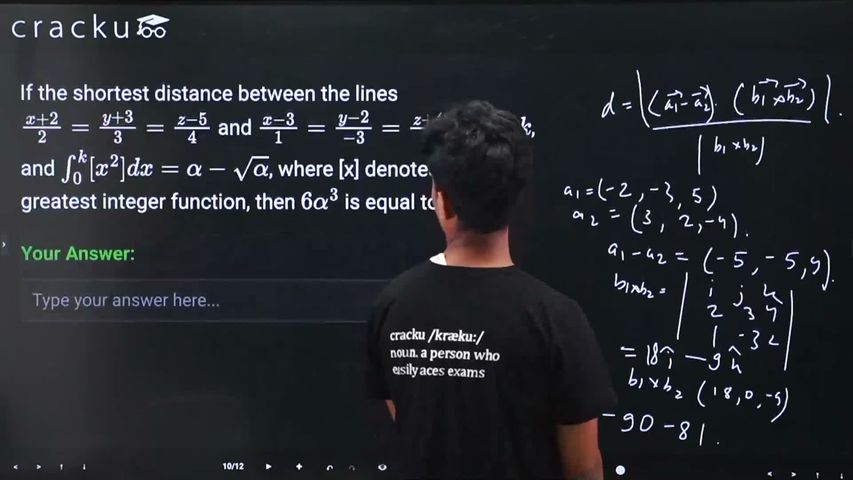
If the shortest distance between the lines $$\frac{x+2}{2} = \frac{y+3}{3} = \frac{z-5}{4}$$ and $$\frac{x-3}{1} = \frac{y-2}{-3} = \frac{z+4}{2}$$ is $$\frac{38}{3\sqrt{5}}k$$, and $$\int_0^k [x^2]dx = \alpha - \sqrt{\alpha}$$, where [x] denotes the greatest integer function, then $$6\alpha^3$$ is equal to ______.
Correct Answer: 48
Since the first line can be represented by a point $$\overrightarrow{a_1} = (-2, -3, 5)$$ and direction vector $$\overrightarrow{b_1} = (2, 3, 4)$$ while the second line corresponds to a point $$\overrightarrow{a_2} = (3, 2, -4)$$ and direction $$\overrightarrow{b_2} = (1, -3, 2)$$,
$$ \overrightarrow{b_1} \times \overrightarrow{b_2} = \begin{vmatrix} \hat{i} & \hat{j} & \hat{k} \\ 2 & 3 & 4 \\ 1 & -3 & 2 \end{vmatrix} $$
$$18\hat{i} - 0\hat{j} - 9\hat{k}$$, that is $$(18, 0, -9)$$, and its magnitude is $$\sqrt{324 + 0 + 81} = \sqrt{405} = 9\sqrt{5}$$.
$$\overrightarrow{a_2} - \overrightarrow{a_1} = (5, 5, -9)$$
$$ d = \frac{|(\overrightarrow{a_2}-\overrightarrow{a_1}) \cdot (\overrightarrow{b_1} \times \overrightarrow{b_2})|}{|\overrightarrow{b_1} \times \overrightarrow{b_2}|} $$
$$ (\overrightarrow{a_2}-\overrightarrow{a_1}) \cdot (18, 0, -9) = 90 + 0 + 81 = 171 $$
$$ d = \frac{171}{9\sqrt{5}} = \frac{19}{\sqrt{5}} = \frac{19\sqrt{5}}{5} = \frac{38}{2\sqrt{5}}\,. $$
We are told $$d = \frac{38}{3\sqrt{5}}k$$, so
$$ \frac{19}{\sqrt{5}} = \frac{38}{3\sqrt{5}}k \implies k = \frac{19 \cdot 3}{38} = \frac{3}{2}\,. $$
Next we evaluate the integral $$\int_0^{3/2} [x^2]\,dx$$ by noting that $$x^2$$ crosses the integer values on the interval $$[0, 3/2]$$ at $$x=0$$, $$x=1$$, and $$x=\sqrt{2}\approx 1.414$$, while at $$x=3/2$$ we have $$x^2=9/4=2.25$$ so that $$[x^2]=2$$.
$$2 - \sqrt{2}$$
$$\alpha = 2$$.
$$ 6\alpha^3 = 6 \cdot 8 = 48\,. $$
Was this solution helpful?
Click on the Email ☝️ to Watch the Video Solution
Create a FREE account and get:
_1.webp)

Educational materials for JEE preparation

Ask our AI anything

AI can make mistakes. Please verify important information.
AI can make mistakes. Please verify important information.
