
Join Our JEE Preparation Group
Prep with like-minded aspirants; Get access to free daily tests and study material.
Sign in
Please select an account to continue using cracku.in
↓ →
Join Our JEE Preparation Group
Prep with like-minded aspirants; Get access to free daily tests and study material.
The length of the chord of the ellipse $$\frac{x^{2}}{4}+\frac{y^{2}}{2}=1$$, whose mid-point is $$(1,\frac{1}{2})$$, is :
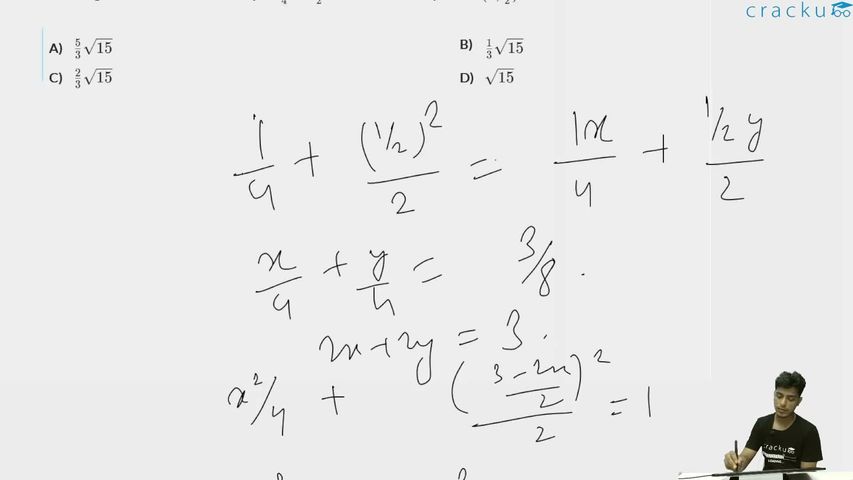
Consider the ellipse $$\frac{x^2}{4}+\frac{y^2}{2}=1$$ and let the midpoint of a chord be $$(1, 1/2)$$. For an ellipse $$\frac{x^2}{a^2}+\frac{y^2}{b^2}=1$$, a chord with midpoint $$(h,k)$$ is given by the equation $$\frac{xh}{a^2}+\frac{yk}{b^2} = \frac{h^2}{a^2}+\frac{k^2}{b^2}$$. Substituting $$a^2=4, b^2=2, h=1, k=1/2$$ yields
$$\frac{x}{4}+\frac{y/2}{2} = \frac{1}{4}+\frac{1/4}{2} = \frac{1}{4}+\frac{1}{8} = \frac{3}{8}$$
which simplifies to
$$\frac{x}{4}+\frac{y}{4} = \frac{3}{8} \implies x + y = \frac{3}{2} \implies y = \frac{3}{2}-x$$.
Substituting into the ellipse equation gives
$$\frac{x^2}{4}+\frac{(3/2-x)^2}{2}=1$$
which expands to
$$\frac{x^2}{4}+\frac{9/4-3x+x^2}{2}=1$$
and simplifies as
$$\frac{x^2}{4}+\frac{9}{8}-\frac{3x}{2}+\frac{x^2}{2}=1$$
leading to
$$\frac{3x^2}{4}-\frac{3x}{2}+\frac{1}{8}=0 \implies 6x^2-12x+1=0$$.
Solving this quadratic yields
$$x = \frac{12\pm\sqrt{144-24}}{12} = \frac{12\pm\sqrt{120}}{12} = \frac{12\pm2\sqrt{30}}{12} = 1\pm\frac{\sqrt{30}}{6}$$.
The difference between the two $$x$$-values is $$\Delta x = \frac{2\sqrt{30}}{6} = \frac{\sqrt{30}}{3}$$. Since $$y = 3/2-x$$, it follows that $$\Delta y = -\Delta x$$. Therefore the length of the chord is
$$\sqrt{(\Delta x)^2+(\Delta y)^2} = |\Delta x|\sqrt{2} = \frac{\sqrt{30}}{3}\cdot\sqrt{2} = \frac{\sqrt{60}}{3} = \frac{2\sqrt{15}}{3}$$.
The correct answer is Option 3: $$\frac{2}{3}\sqrt{15}$$.
Was this solution helpful?
Click on the Email ☝️ to Watch the Video Solution
Create a FREE account and get:
_1.webp)

Educational materials for JEE preparation

Ask our AI anything

AI can make mistakes. Please verify important information.
AI can make mistakes. Please verify important information.
