
Join Our JEE Preparation Group
Prep with like-minded aspirants; Get access to free daily tests and study material.
Sign in
Please select an account to continue using cracku.in
↓ →
Join Our JEE Preparation Group
Prep with like-minded aspirants; Get access to free daily tests and study material.
The figure shows a liquid of a given density flowing steadily in a horizontal tube of a varying cross-section. Cross-sectional area at A is $$1.5$$ cm$$^2$$, and that at B is $$25$$ mm$$^2$$, if the speed of liquid at B is $$60$$ cm s$$^{-1}$$ then $$(P_A - P_B)$$ is
(Given $$P_A$$ and $$P_B$$ are liquid pressures at A and B points. Density $$\rho = 1000$$ kg m$$^{-3}$$. A and B are on the axis of tube)
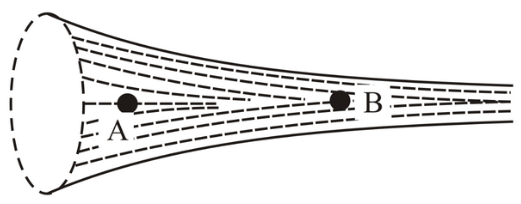
Using the continuity equation ($$A_A v_A = A_B v_B$$),
$$v_A = v_B \cdot \frac{A_B}{A_A} = 60 \cdot \frac{25}{150} = 60 \cdot \frac{1}{6} = 10\text{ cm/s} = 0.1\text{ m/s}$$
$$P_A + \frac{1}{2}\rho v_A^2 = P_B + \frac{1}{2}\rho v_B^2$$ (Bernoulli's equation for horizontal tube)
$$P_A - P_B = \frac{1}{2}\rho (v_B^2 - v_A^2)$$
$$P_A - P_B = \frac{1}{2} \times 1000 \times (0.6^2 - 0.1^2)$$
$$P_A - P_B = 500 \times 0.35 = 175\text{ Pa}$$
Was this solution helpful?
Create a FREE account and get:
_1.webp)

Educational materials for JEE preparation

Ask our AI anything

AI can make mistakes. Please verify important information.
AI can make mistakes. Please verify important information.


