
Join Our JEE Preparation Group
Prep with like-minded aspirants; Get access to free daily tests and study material.
Sign in
Please select an account to continue using cracku.in
↓ →
Join Our JEE Preparation Group
Prep with like-minded aspirants; Get access to free daily tests and study material.
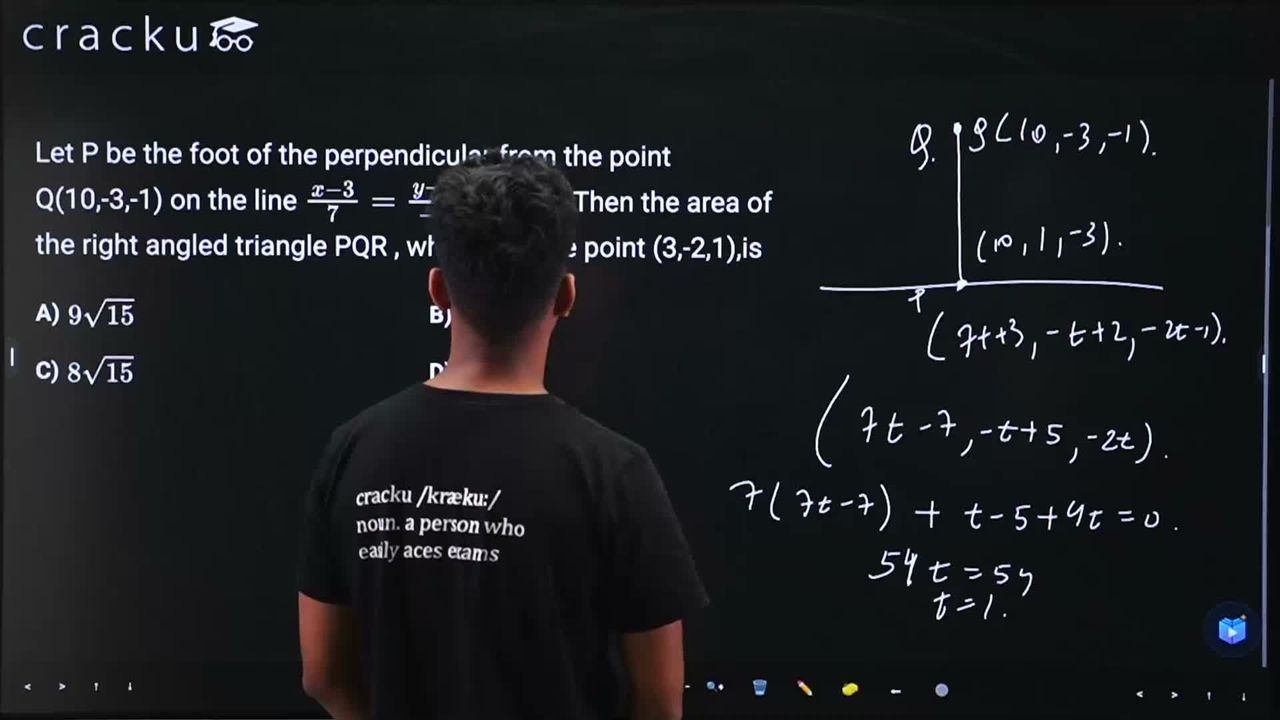
Let P be the foot of the perpendicular from the point Q(10,-3,-1) on the line $$\frac{x-3}{7}=\frac{y-2}{-1}=\frac{z+1}{-2}$$. Then the area of the right angled triangle PQR , where R is the point (3,-2,1),is
Parametrize the line by setting $$\frac{x-3}{7} = \frac{y-2}{-1} = \frac{z+1}{-2} = \lambda$$. Then any point on the line is:
$$x = 3 + 7\lambda$$ $$y = 2 - \lambda$$ $$z = -1 - 2\lambda$$
So P has coordinates $$(3 + 7\lambda, 2 - \lambda, -1 - 2\lambda)$$.
The direction vector of the line is $$\vec{d} = (7, -1, -2)$$. The vector $$\overrightarrow{PQ}$$ from P to Q is:
$$\overrightarrow{PQ} = (10 - (3 + 7\lambda), -3 - (2 - \lambda), -1 - (-1 - 2\lambda)) = (7 - 7\lambda, -5 + \lambda, 2\lambda)$$
Since $$\overrightarrow{PQ}$$ is perpendicular to $$\vec{d}$$, their dot product is zero:
$$(7 - 7\lambda) \cdot 7 + (-5 + \lambda) \cdot (-1) + (2\lambda) \cdot (-2) = 0$$
$$49 - 49\lambda + 5 - \lambda - 4\lambda = 0$$
$$54 - 54\lambda = 0$$
$$\lambda = 1$$
Substitute $$\lambda = 1$$ to find P:
$$x = 3 + 7(1) = 10$$
$$y = 2 - 1 = 1$$
$$z = -1 - 2(1) = -3$$
So P is $$(10, 1, -3)$$.
Given R is $$(3, -2, 1)$$, the vertices of triangle PQR are P(10, 1, -3), Q(10, -3, -1), and R(3, -2, 1).
To confirm the right angle, compute vectors:
$$\overrightarrow{PQ} = Q - P = (10 - 10, -3 - 1, -1 - (-3)) = (0, -4, 2)$$
$$\overrightarrow{QR} = R - Q = (3 - 10, -2 - (-3), 1 - (-1)) = (-7, 1, 2)$$
$$\overrightarrow{PR} = R - P = (3 - 10, -2 - 1, 1 - (-3)) = (-7, -3, 4)$$
$$\overrightarrow{PQ} \cdot \overrightarrow{QR} = (0)(-7) + (-4)(1) + (2)(2) = 0 - 4 + 4 = 0$$
Since the dot product is zero, $$\overrightarrow{PQ}$$ and $$\overrightarrow{QR}$$ are perpendicular, so the right angle is at Q.
The area of a right-angled triangle is half the product of the legs. The legs are PQ and QR.
$$|\overrightarrow{PQ}| = \sqrt{0^2 + (-4)^2 + 2^2} = \sqrt{0 + 16 + 4} = \sqrt{20} = 2\sqrt{5}$$
$$|\overrightarrow{QR}| = \sqrt{(-7)^2 + 1^2 + 2^2} = \sqrt{49 + 1 + 4} = \sqrt{54} = 3\sqrt{6}$$
Area $$= \frac{1}{2} \times |\overrightarrow{PQ}| \times |\overrightarrow{QR}| = \frac{1}{2} \times 2\sqrt{5} \times 3\sqrt{6} = \frac{1}{2} \times 6 \times \sqrt{30} = 3\sqrt{30}$$
Thus, the area is $$3\sqrt{30}$$, which corresponds to option D.
Was this solution helpful?
Click on the Email ☝️ to Watch the Video Solution
Create a FREE account and get:
_1.webp)

Educational materials for JEE preparation

Ask our AI anything

AI can make mistakes. Please verify important information.
AI can make mistakes. Please verify important information.
