
Join Our JEE Preparation Group
Prep with like-minded aspirants; Get access to free daily tests and study material.
Sign in
Please select an account to continue using cracku.in
↓ →
Join Our JEE Preparation Group
Prep with like-minded aspirants; Get access to free daily tests and study material.
If the points of intersection of the ellipses $$x^{2}+2y^{2}-6x-12y+23=0$$ and $$4x^{2}+2y^{2}-20x-12y+35=0$$ lie on a circle of radius r and centre (a, b), then the value of $$ab+18r^{2}$$ is
Ellipse 1: $$x^2 + 2y^2 - 6x - 12y + 23 = 0$$
Ellipse 2: $$4x^2 + 2y^2 - 20x - 12y + 35 = 0$$
To find the intersection points, subtract Ellipse 1 from Ellipse 2:
$$3x^2 - 14x + 12 = 0$$
Using quadratic formula: $$x = \frac{14 \pm \sqrt{196 - 144}}{6} = \frac{14 \pm \sqrt{52}}{6} = \frac{14 \pm 2\sqrt{13}}{6} = \frac{7 \pm \sqrt{13}}{3}$$
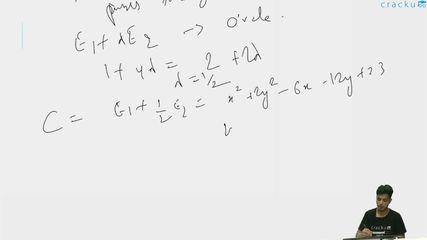
To find the circle through the intersection points, we use the family $$\lambda(\text{Ellipse 1}) + \mu(\text{Ellipse 2}) = 0$$ and choose $$\lambda, \mu$$ so the coefficients of $$x^2$$ and $$y^2$$ are equal (circle condition).
Ellipse 1: $$x^2 + 2y^2 - 6x - 12y + 23 = 0$$
Ellipse 2: $$4x^2 + 2y^2 - 20x - 12y + 35 = 0$$
Subtract: $$3x^2 - 14x + 12 = 0$$. This is the radical axis (a pair of vertical lines). Adding $$k$$ times this to Ellipse 1:
$$(1+3k)x^2 + 2y^2 + (-6-14k)x - 12y + (23+12k) = 0$$
For a circle: $$1 + 3k = 2$$, so $$k = 1/3$$.
$$2x^2 + 2y^2 + (-6 - 14/3)x - 12y + (23 + 4) = 0$$
$$2x^2 + 2y^2 - \frac{32}{3}x - 12y + 27 = 0$$
$$x^2 + y^2 - \frac{16}{3}x - 6y + \frac{27}{2} = 0$$
Center: $$a = \frac{8}{3}$$, $$b = 3$$.
$$r^2 = \left(\frac{8}{3}\right)^2 + 9 - \frac{27}{2} = \frac{64}{9} + 9 - \frac{27}{2} = \frac{128 + 162 - 243}{18} = \frac{47}{18}$$
$$ab + 18r^2 = \frac{8}{3} \times 3 + 18 \times \frac{47}{18} = 8 + 47 = 55$$
The correct answer is Option C: 55.
Was this solution helpful?
Click on the Email ☝️ to Watch the Video Solution
Create a FREE account and get:
_1.webp)

Educational materials for JEE preparation

Ask our AI anything

AI can make mistakes. Please verify important information.
AI can make mistakes. Please verify important information.
