
Join Our JEE Preparation Group
Prep with like-minded aspirants; Get access to free daily tests and study material.
Sign in
Please select an account to continue using cracku.in
↓ →
Join Our JEE Preparation Group
Prep with like-minded aspirants; Get access to free daily tests and study material.
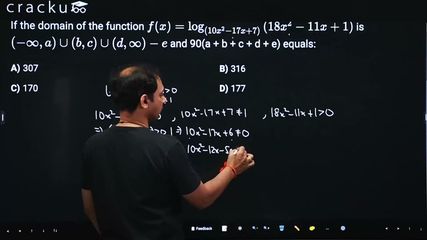
If the domain of the function $$f(x)=\log_{(10x^{2}-17x+7)}{(18x^{2}-11x+1)}$$ is $$(-\infty ,a)\cup (b,c)\cup (d,\infty)-{e}$$ and 90(a + b + c + d + e) equals:
To define the domain, let's analyse the argument and the base of the logarithmic function $$f(x)$$:
Base: $$10x^{2}-17x+7>0$$
Which gives $$x>\dfrac{17+\sqrt{9}}{20}$$ and $$x<\dfrac{17-\sqrt{9}}{20}$$ or $$x>1$$ and $$x<0.7$$
Also, the base $$10x^{2}-17x+7\neq 1$$ gives,
$$10x^2-17x+6\neq 0$$ or $$x\neq \dfrac{17\pm \sqrt{49}}{20}$$
Thus, $$x\neq 1.2$$ and $$x\neq 0.5$$
Of these, $$1.2$$ only falls in the given range, and will have to be excluded.
Similarly,
Argument: $$18x^{2}-11x+1>0$$
Which gives $$x>\dfrac{11+\sqrt{49}}{36}$$ and $$x<\dfrac{11-\sqrt{49}}{36}$$ or $$x>0.5$$ and $$x<0.\overline{1}$$, where $$0.\overline{1} = \dfrac{1}{9}$$
Thus, the combined domain is;
$$(-\infty, 0.\overline{1}) \cup (0.5, 0.7) \cup (1, \infty) - {1.2}$$
Hence, $$a=\dfrac{1}{9}$$, $$b=0.5$$, $$c=0.7$$, $$d=1$$, and $$e=1.2$$
Which gives
$$90(a + b + c + d + e) = 10 + 45 + 63+ 90 + 108 = \boxed{316}$$
Was this solution helpful?
Click on the Email ☝️ to Watch the Video Solution
Create a FREE account and get:
_1.webp)

Educational materials for JEE preparation

Ask our AI anything

AI can make mistakes. Please verify important information.
AI can make mistakes. Please verify important information.
