
Join Our JEE Preparation Group
Prep with like-minded aspirants; Get access to free daily tests and study material.
Sign in
Please select an account to continue using cracku.in
↓ →
Join Our JEE Preparation Group
Prep with like-minded aspirants; Get access to free daily tests and study material.
If $$\sum_{r=1}^{9} \left(\frac{r+3}{2^r}\right) \cdot \,^{9}C_r = \alpha\left(\frac{3}{2}\right)^9 - \beta$$, $$\alpha, \beta \in \mathbb{N}$$, then $$(\alpha + \beta)^2$$ is equal to
We need to evaluate the finite sum
$$S=\sum_{r=1}^{9}\frac{\,r+3\,}{2^{r}}\;{}^{9}C_{r}$$
and express it in the form
$$S=\alpha\left(\frac{3}{2}\right)^{9}-\beta,\qquad\alpha,\beta\in\mathbb{N}.$$
Split $$S$$ into two simpler sums:
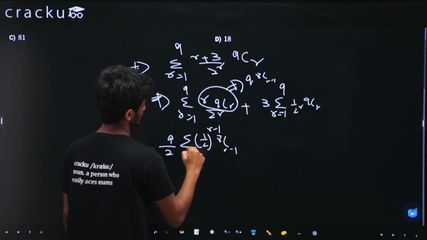
$$S=\sum_{r=1}^{9}\frac{r}{2^{r}}\;{}^{9}C_{r}+3\sum_{r=1}^{9}\frac{1}{2^{r}}\;{}^{9}C_{r}$$
Let
$$S_{1}=\sum_{r=1}^{9}\frac{r}{2^{r}}\;{}^{9}C_{r},\qquad
S_{2}=\sum_{r=1}^{9}\frac{1}{2^{r}}\;{}^{9}C_{r}.$$
Case 1: Calculation of $$S_{1}$$
Start with the binomial expansion:
$$(1+x)^{9}=\sum_{r=0}^{9}{}^{9}C_{r}\,x^{r}.$$
Differentiate both sides with respect to $$x$$:
$$9(1+x)^{8}=\sum_{r=1}^{9}r\,{}^{9}C_{r}\,x^{\,r-1}.$$
Multiply by $$x$$ to match the power $$x^{r}$$:
$$9x(1+x)^{8}=\sum_{r=1}^{9}r\,{}^{9}C_{r}\,x^{\,r}.$$
Hence
$$S_{1}=\sum_{r=1}^{9}r\,{}^{9}C_{r}\left(\frac{1}{2}\right)^{r}=9\left(\frac{1}{2}\right)(1+\tfrac12)^{8}.$$
Now $$1+\tfrac12=\tfrac32$$, so
$$S_{1}=9\left(\frac{1}{2}\right)\left(\frac{3}{2}\right)^{8}
=\frac{9}{2}\left(\frac{3}{2}\right)^{8}.$$
Rewrite $$S_{1}$$ with the power $$\left(\tfrac32\right)^{9}$$:
$$\frac{9}{2}\left(\frac{3}{2}\right)^{8}
=\frac{9}{2}\left(\frac{3}{2}\right)^{9}\!\!\left(\frac{2}{3}\right)
=3\left(\frac{3}{2}\right)^{9}.$$
Case 2: Calculation of $$S_{2}$$
Again use the binomial expansion:
$$(1+x)^{9}=\sum_{r=0}^{9}{}^{9}C_{r}\,x^{r}.$$
Put $$x=\tfrac12$$ and subtract the $$r=0$$ term:
$$S_{2}=(1+\tfrac12)^{9}-1=\left(\frac{3}{2}\right)^{9}-1.$$
Combine the results
$$S=S_{1}+3S_{2}
=3\left(\frac{3}{2}\right)^{9}+3\left[\left(\frac{3}{2}\right)^{9}-1\right]$$
$$\quad=3\left(\frac{3}{2}\right)^{9}+3\left(\frac{3}{2}\right)^{9}-3
=6\left(\frac{3}{2}\right)^{9}-3.$$
Therefore
$$\alpha=6,\qquad\beta=3,\qquad \alpha+\beta=9.$$
Finally,
$$(\alpha+\beta)^{2}=9^{2}=81.$$
Option C is correct.
Was this solution helpful?
Click on the Email ☝️ to Watch the Video Solution
Create a FREE account and get:
_1.webp)

Educational materials for JEE preparation

Ask our AI anything

AI can make mistakes. Please verify important information.
AI can make mistakes. Please verify important information.


