
Join Our JEE Preparation Group
Prep with like-minded aspirants; Get access to free daily tests and study material.
Sign in
Please select an account to continue using cracku.in
↓ →
Join Our JEE Preparation Group
Prep with like-minded aspirants; Get access to free daily tests and study material.
A polyatomic ideal gas has 24 vibrational modes. What is the value of $$\gamma$$?
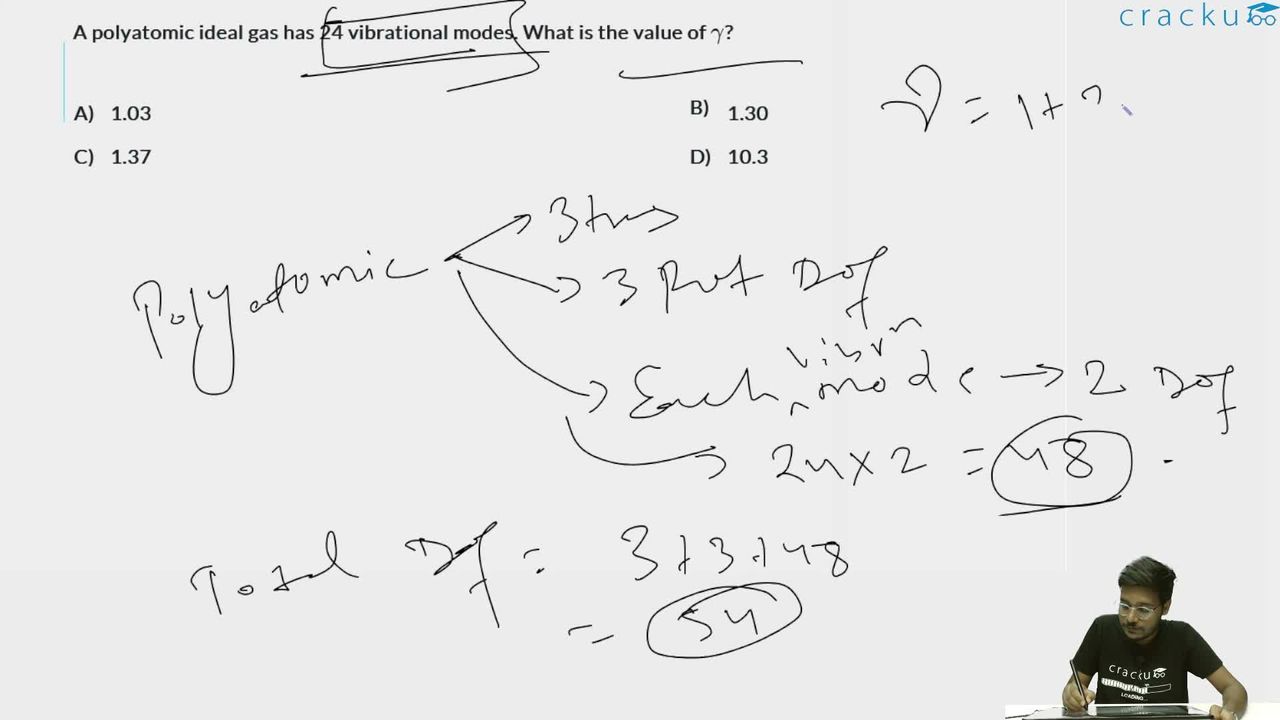
A polyatomic ideal gas has degrees of freedom from three types of motion: translational, rotational, and vibrational. Every gas molecule in three-dimensional space has 3 translational degrees of freedom (motion along $$x$$, $$y$$, and $$z$$ axes). A nonlinear polyatomic molecule also has 3 rotational degrees of freedom (rotation about each principal axis).
Each vibrational mode contributes 2 degrees of freedom: one for kinetic energy and one for potential energy. Since the gas has 24 vibrational modes, the vibrational contribution is $$2 \times 24 = 48$$ degrees of freedom.
The total number of degrees of freedom is therefore $$f = 3 \text{ (translational)} + 3 \text{ (rotational)} + 48 \text{ (vibrational)} = 54$$.
For an ideal gas, the molar specific heat at constant volume is $$C_V = \frac{f}{2}R$$ and at constant pressure is $$C_P = C_V + R = \frac{f}{2}R + R = \frac{f+2}{2}R$$. The ratio of specific heats is $$\gamma = \frac{C_P}{C_V} = \frac{f+2}{f} = 1 + \frac{2}{f}$$.
Substituting $$f = 54$$: $$\gamma = 1 + \frac{2}{54} = 1 + \frac{1}{27} = 1.037$$, which is closest to 1.03.
The correct answer is option 1: 1.03.
Was this solution helpful?
Click on the Email ☝️ to Watch the Video Solution
Create a FREE account and get:
_1.webp)

Educational materials for JEE preparation

Ask our AI anything

AI can make mistakes. Please verify important information.
AI can make mistakes. Please verify important information.
