
Join Our JEE Preparation Group
Prep with like-minded aspirants; Get access to free daily tests and study material.
Sign in
Please select an account to continue using cracku.in
↓ →
Join Our JEE Preparation Group
Prep with like-minded aspirants; Get access to free daily tests and study material.
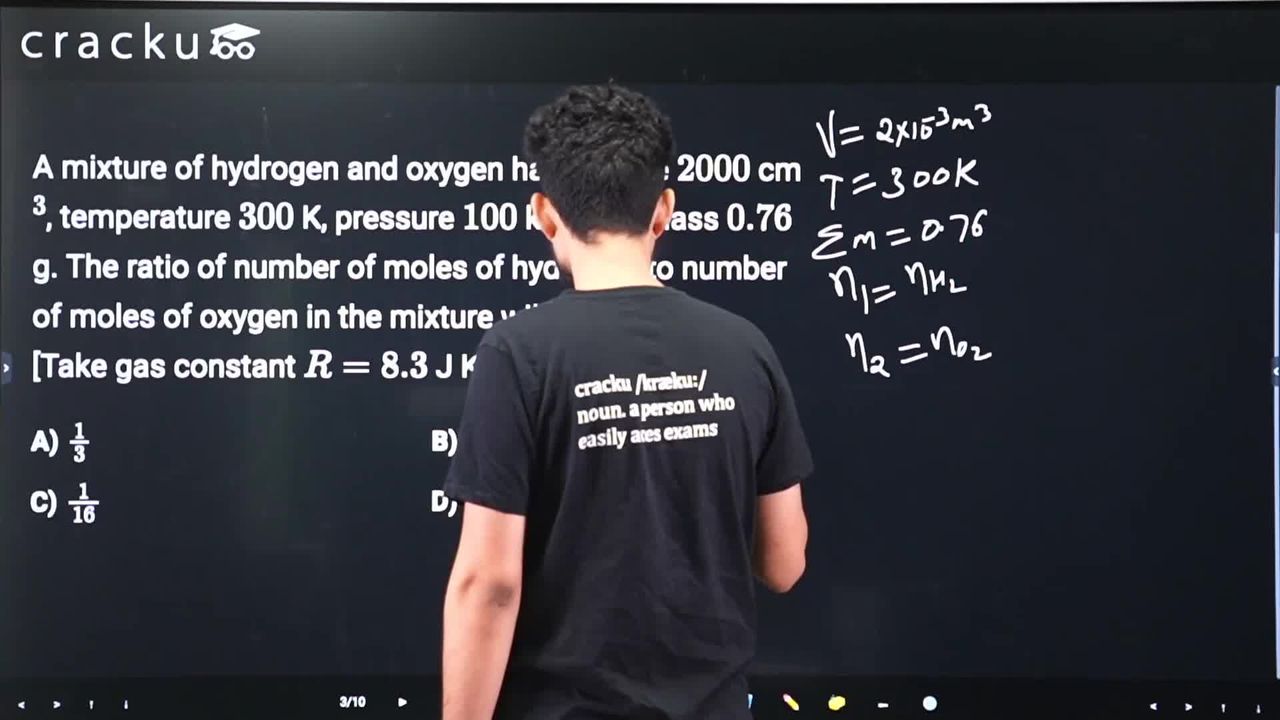
A mixture of hydrogen and oxygen has volume $$2000$$ cm$$^3$$, temperature $$300$$ K, pressure $$100$$ kPa and mass $$0.76$$ g. The ratio of number of moles of hydrogen to number of moles of oxygen in the mixture will be
[Take gas constant $$R = 8.3$$ J K$$^{-1}$$ mol$$^{-1}$$]
Given: $$V = 2000 \text{ cm}^3 = 2 \times 10^{-3} \text{ m}^3$$, $$T = 300$$ K, $$P = 100$$ kPa $$= 10^5$$ Pa, total mass $$= 0.76$$ g, $$R = 8.3$$ J K$$^{-1}$$ mol$$^{-1}$$.
Let the number of moles of hydrogen be $$n_1$$ and oxygen be $$n_2$$.
Using the ideal gas law for the mixture:
$$PV = (n_1 + n_2)RT$$
$$10^5 \times 2 \times 10^{-3} = (n_1 + n_2) \times 8.3 \times 300$$
$$200 = (n_1 + n_2) \times 2490$$
$$n_1 + n_2 = \frac{200}{2490} = \frac{20}{249} \approx 0.08 \text{ mol}$$
From the total mass:
$$2n_1 + 32n_2 = 0.76$$ g
From the ideal gas equation: $$n_1 + n_2 = 0.08$$, so $$n_2 = 0.08 - n_1$$.
Substituting:
$$2n_1 + 32(0.08 - n_1) = 0.76$$
$$2n_1 + 2.56 - 32n_1 = 0.76$$
$$-30n_1 = 0.76 - 2.56 = -1.80$$
$$n_1 = \frac{1.80}{30} = 0.06 \text{ mol}$$
$$n_2 = 0.08 - 0.06 = 0.02 \text{ mol}$$
Therefore:
$$\frac{n_1}{n_2} = \frac{0.06}{0.02} = \frac{3}{1}$$
The correct answer is Option B.
Was this solution helpful?
Click on the Email ☝️ to Watch the Video Solution
Create a FREE account and get:
_1.webp)

Educational materials for JEE preparation

Ask our AI anything

AI can make mistakes. Please verify important information.
AI can make mistakes. Please verify important information.
