
Join Our JEE Preparation Group
Prep with like-minded aspirants; Get access to free daily tests and study material.
Sign in
Please select an account to continue using cracku.in
↓ →
Join Our JEE Preparation Group
Prep with like-minded aspirants; Get access to free daily tests and study material.
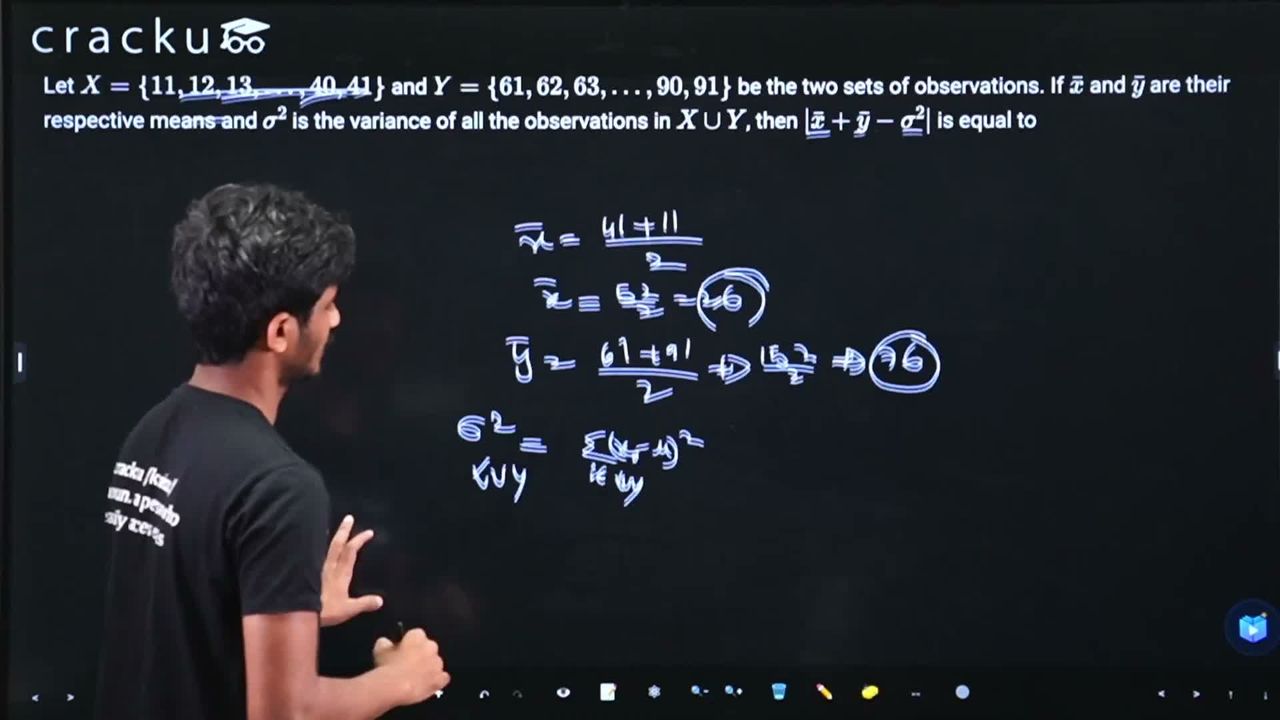
Let $$X = \{11, 12, 13, \ldots, 40, 41\}$$ and $$Y = \{61, 62, 63, \ldots, 90, 91\}$$ be the two sets of observations. If $$\bar{x}$$ and $$\bar{y}$$ are their respective means and $$\sigma^2$$ is the variance of all the observations in $$X \cup Y$$, then $$|\bar{x} + \bar{y} - \sigma^2|$$ is equal to
Correct Answer: 603
Let $$X = \{11,12,13,\ldots,40,41\}$$ and $$Y = \{61,62,63,\ldots,90,91\}$$. Both sets contain $$31$$ elements, so the total number of observations in $$X \cup Y$$ is $$n = 62$$.
The mean of $$X$$ is $$\bar{x} = \frac{11 + 41}{2} = 26$$ and the mean of $$Y$$ is $$\bar{y} = \frac{61 + 91}{2} = 76$$. Hence the combined mean of $$X \cup Y$$ is $$\mu = \frac{31 \times 26 + 31 \times 76}{62} = \frac{26 + 76}{2} = 51$$.
To find the variance $$\sigma^2$$, we compute $$\frac{1}{n}\sum (x_i - \mu)^2$$ over all observations.
For elements of $$X$$, as $$k$$ ranges from $$11$$ to $$41$$, $$(k - 51)$$ ranges from $$-40$$ to $$-10$$, so $$\sum_{k=11}^{41}(k-51)^2 = \sum_{j=10}^{40} j^2 = \frac{40 \times 41 \times 81}{6} - \frac{9 \times 10 \times 19}{6} = 22140 - 285 = 21855$$.
Similarly, for elements of $$Y$$, as $$k$$ ranges from $$61$$ to $$91$$, $$(k - 51)$$ ranges from $$10$$ to $$40$$, and one similarly finds $$\sum_{k=61}^{91}(k-51)^2 = \sum_{j=10}^{40} j^2 = 21855$$.
It follows that $$\sigma^2 = \frac{21855 + 21855}{62} = \frac{43710}{62} = 705$$.
Hence $$|\bar{x} + \bar{y} - \sigma^2| = |26 + 76 - 705| = |102 - 705| = \boxed{603}$$.
Click on the Email ☝️ to Watch the Video Solution
Create a FREE account and get:
_1.webp)

Educational materials for JEE preparation

Ask our AI anything

AI can make mistakes. Please verify important information.
AI can make mistakes. Please verify important information.


