
Join Our JEE Preparation Group
Prep with like-minded aspirants; Get access to free daily tests and study material.
Sign in
Please select an account to continue using cracku.in
↓ →
Join Our JEE Preparation Group
Prep with like-minded aspirants; Get access to free daily tests and study material.
The area (in sq. units) of the region $$A = \{(x, y) \in R \times R \mid 0 \le x \le 3, 0 \le y \le 4, y \le x^{2} + 3x\}$$ is:
We are asked to find the area of the set
$$A=\{(x,y)\in\mathbb{R}\times\mathbb{R}\;|\;0\le x\le 3,\;0\le y\le 4,\;y\le x^{2}+3x\}.$$
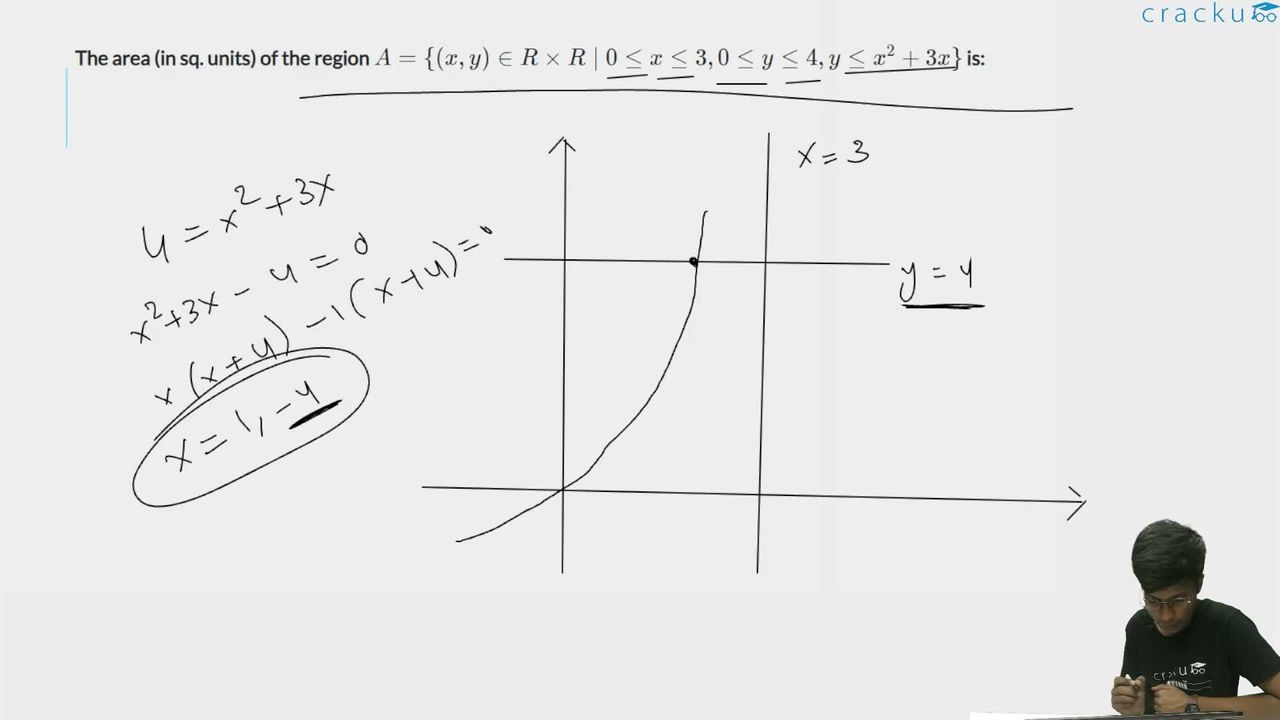
The three simultaneous conditions can be understood one by one. First, $$0\le x\le 3$$ confines us to the vertical strip that starts at the $$y$$-axis and ends at the line $$x=3$$. Second, $$0\le y\le 4$$ limits us to the horizontal strip from the $$x$$-axis up to the line $$y=4$$. Finally, $$y\le x^{2}+3x$$ keeps every point below the parabola $$y=x^{2}+3x.$$
Inside the rectangle $$0\le x\le 3,\;0\le y\le 4$$ we therefore keep only those points that are under the parabola. For each fixed $$x$$ in the interval $$[0,3]$$ the vertical extent of the region is
$$0\le y\le\min\{4,\;x^{2}+3x\}.$$
So the upper boundary for $$y$$ at any $$x$$ is the smaller of the two numbers $$4$$ and $$x^{2}+3x$$. Let us compare these two quantities on the domain $$0\le x\le 3$$.
We have
$$x^{2}+3x=4\quad\Longrightarrow\quad x^{2}+3x-4=0\quad\Longrightarrow\quad (x+4)(x-1)=0,$$
so they are equal at $$x=1$$ (and at $$x=-4$$, which lies outside our interval). Now we study two sub-intervals.
1. For $$0\le x\le 1$$ we observe
$$0\le x\le1\;\Longrightarrow\;x^{2}+3x\le1+3=4,$$
so here the parabola is below or on the line $$y=4$$. Consequently $$\min\{4,\;x^{2}+3x\}=x^{2}+3x$$.
2. For $$1\le x\le3$$ we have
$$x\ge1\;\Longrightarrow\;x^{2}+3x\ge1+3=4,$$
so the parabola lies above or on the horizontal line. Hence $$\min\{4,\;x^{2}+3x\}=4$$ in this portion.
This analysis splits the entire strip $$0\le x\le3$$ into two parts, and the total required area becomes the sum of two separate integrals:
$$\text{Area}= \int_{0}^{1}\bigl(x^{2}+3x\bigr)\,dx \;+\; \int_{1}^{3} 4\,dx.$$
We now evaluate each integral step by step.
For the first integral we explicitly integrate the polynomial term by term:
$$\int_{0}^{1}\bigl(x^{2}+3x\bigr)\,dx =\int_{0}^{1}x^{2}\,dx +\int_{0}^{1}3x\,dx.$$
Using the basic power rule $$\int x^{n}\,dx = \frac{x^{\,n+1}}{n+1}+C,$$ we obtain
$$\int_{0}^{1}x^{2}\,dx =\left.\frac{x^{3}}{3}\right|_{0}^{1}= \frac{1^{3}}{3}-\frac{0^{3}}{3}= \frac13,$$
and
$$\int_{0}^{1}3x\,dx = 3\int_{0}^{1}x\,dx =3\left.\frac{x^{2}}{2}\right|_{0}^{1}=3\left(\frac{1^{2}}{2}-0\right)=\frac{3}{2}.$$
Adding these two pieces we get
$$\int_{0}^{1}\bigl(x^{2}+3x\bigr)\,dx =\frac13+\frac32=\frac{1}{3}+\frac{9}{6}=\frac{2}{6}+\frac{9}{6}= \frac{11}{6}.$$
Next we handle the constant integrand in the second interval. Because the integrand is the constant $$4$$, the area is simply the base times the height:
$$\int_{1}^{3} 4\,dx = 4\,(3-1)=4\times2=8.$$
Finally we sum the two contributions:
$$\text{Area}= \frac{11}{6}+8 = \frac{11}{6}+\frac{48}{6}= \frac{59}{6}.$$
This number is already in simplest form, so the exact area of the given region is
$$\frac{59}{6}\text{ square units}.$$
Hence, the correct answer is Option 4.
Was this solution helpful?
Click on the Email ☝️ to Watch the Video Solution
Create a FREE account and get:
_1.webp)

Educational materials for JEE preparation

Ask our AI anything

AI can make mistakes. Please verify important information.
AI can make mistakes. Please verify important information.
