
Join Our JEE Preparation Group
Prep with like-minded aspirants; Get access to free daily tests and study material.
Sign in
Please select an account to continue using cracku.in
↓ →
Join Our JEE Preparation Group
Prep with like-minded aspirants; Get access to free daily tests and study material.
The area (in sq. units) of the region $$A = \left\{(x, y) : \frac{y^2}{2} \le x \le y + 4\right\}$$ is:
We are asked to find the area enclosed by the set $$A = \left\{(x,y) : \dfrac{y^{2}}{2} \le x \le y + 4\right\}.$$
For every value of $$y$$ in this region, the left-hand boundary is the parabola $$x = \dfrac{y^{2}}{2}$$ and the right-hand boundary is the straight line $$x = y + 4.$$ So, at a fixed ordinate $$y,$$ the horizontal width of the strip is
$$\bigl(\text{right } x\bigr) - \bigl(\text{left } x\bigr) \;=\; (y + 4) \;-\; \dfrac{y^{2}}{2}.$$
To integrate this width correctly we must know the range of $$y$$ over which the line actually lies to the right of the parabola. We therefore find the intersection points by solving
$$\dfrac{y^{2}}{2} = y + 4.$$
Multiplying both sides by $$2$$ (so that every term is cleared of the denominator) gives
$$y^{2} - 2y - 8 = 0.$$
This is a quadratic in $$y.$$ Using the quadratic-formula statement $$y = \dfrac{-b \pm \sqrt{b^{2} - 4ac}}{2a}$$ for $$a = 1,\; b = -2,\; c = -8,$$ we have
$$y = \dfrac{-(-2) \pm \sqrt{(-2)^{2} - 4 \cdot 1 \cdot (-8)}}{2 \cdot 1} = \dfrac{2 \pm \sqrt{4 + 32}}{2} = \dfrac{2 \pm 6}{2}.$$
This produces the two intersection ordinates
$$y = 4 \quad\text{and}\quad y = -2.$$
Because the line $$x = y + 4$$ is indeed to the right of the parabola $$x = \dfrac{y^{2}}{2}$$ throughout the open interval $$(-2,\,4),$$ these become the limits for our definite integral.
The required area is therefore
$$ \begin{aligned} \text{Area} & = \int_{y = -2}^{4} \Bigl[(y + 4) - \dfrac{y^{2}}{2}\Bigr]\,dy. \\ \end{aligned} $$
Now we perform the integration term by term. We recall the elementary antiderivatives:
$$\int y\,dy = \dfrac{y^{2}}{2}, \qquad \int 4\,dy = 4y, \qquad \int \dfrac{y^{2}}{2}\,dy = \dfrac{1}{2}\cdot\dfrac{y^{3}}{3} = \dfrac{y^{3}}{6}.$$
Applying these, we obtain
$$ \begin{aligned} \int \Bigl[(y + 4) - \dfrac{y^{2}}{2}\Bigr]\,dy &= \int y\,dy \;+\; \int 4\,dy \;-\; \int \dfrac{y^{2}}{2}\,dy \\ &= \dfrac{y^{2}}{2} + 4y - \dfrac{y^{3}}{6}. \end{aligned} $$
We must now evaluate this antiderivative from $$y = -2$$ to $$y = 4.$$ First at $$y = 4$$:
$$ \begin{aligned} \Bigl.\Bigl(\dfrac{y^{2}}{2} + 4y - \dfrac{y^{3}}{6}\Bigr)\Bigr|_{y = 4} &= \dfrac{4^{2}}{2} + 4(4) - \dfrac{4^{3}}{6} \\ &= \dfrac{16}{2} + 16 - \dfrac{64}{6} \\ &= 8 + 16 - \dfrac{32}{3} \\ &= 24 - \dfrac{32}{3} \\ &= \dfrac{72}{3} - \dfrac{32}{3} \\ &= \dfrac{40}{3}. \end{aligned} $$
Next at $$y = -2$$:
$$ \begin{aligned} \Bigl.\Bigl(\dfrac{y^{2}}{2} + 4y - \dfrac{y^{3}}{6}\Bigr)\Bigr|_{y = -2} &= \dfrac{(-2)^{2}}{2} + 4(-2) - \dfrac{(-2)^{3}}{6} \\ &= \dfrac{4}{2} - 8 - \dfrac{-8}{6} \\ &= 2 - 8 + \dfrac{8}{6} \\ &= -6 + \dfrac{4}{3} \\ &= -\dfrac{18}{3} + \dfrac{4}{3} \\ &= -\dfrac{14}{3}. \end{aligned} $$
The definite integral is obtained by subtracting the value at $$y = -2$$ from the value at $$y = 4$$:
$$ \text{Area} = \dfrac{40}{3} - \Bigl(-\dfrac{14}{3}\Bigr) = \dfrac{40}{3} + \dfrac{14}{3} = \dfrac{54}{3} = 18. $$
Thus the area of the region is $$18$$ square units.
Hence, the correct answer is Option B.
Was this solution helpful?
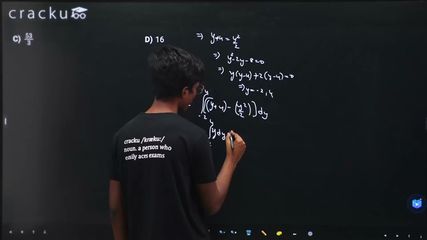
Click on the Email ☝️ to Watch the Video Solution
Create a FREE account and get:
_1.webp)

Educational materials for JEE preparation

Ask our AI anything

AI can make mistakes. Please verify important information.
AI can make mistakes. Please verify important information.


