
Join Our JEE Preparation Group
Prep with like-minded aspirants; Get access to free daily tests and study material.
Sign in
Please select an account to continue using cracku.in
↓ →
Join Our JEE Preparation Group
Prep with like-minded aspirants; Get access to free daily tests and study material.
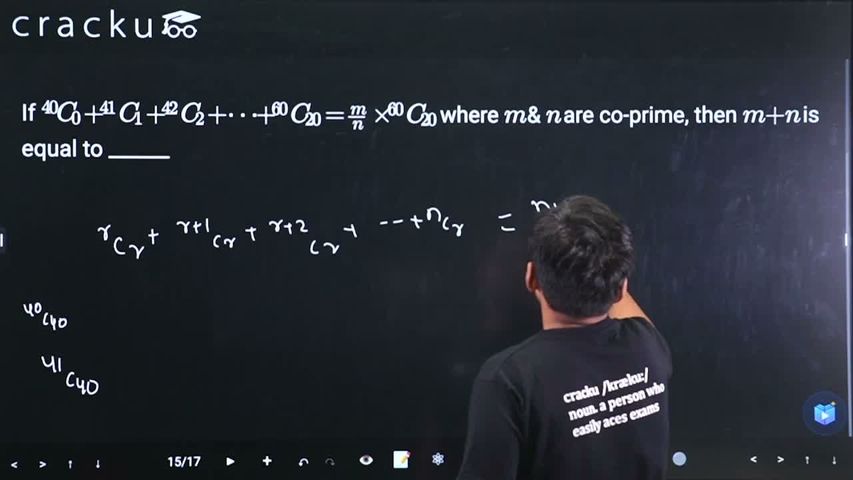
If $$^{40}C_0 + ^{41}C_1 + ^{42}C_2 + \cdots + ^{60}C_{20} = \frac{m}{n} \times ^{60}C_{20}$$ where $$m$$ & $$n$$ are co-prime, then $$m + n$$ is equal to ______
Correct Answer: 102
First, we need to find $$m + n$$ where $$\binom{40}{0} + \binom{41}{1} + \binom{42}{2} + \cdots + \binom{60}{20} = \frac{m}{n} \cdot \binom{60}{20}$$ and $$\gcd(m, n) = 1$$.
Next, we apply the Vandermonde-type identity: $$\binom{r}{r} + \binom{r+1}{r} + \binom{r+2}{r} + \cdots + \binom{n}{r} = \binom{n+1}{r+1}$$. Rewriting each term gives $$\binom{40+k}{k} = \binom{40+k}{40}$$ for $$k = 0, 1, 2, \ldots, 20$$.
Substituting this result into the sum yields $$\sum_{k=0}^{20} \binom{40+k}{40} = \binom{61}{41} = \binom{61}{20}$$.
Now, we express $$\binom{61}{20}$$ as a multiple of $$\binom{60}{20}$$. Since $$\binom{61}{20} = \frac{61!}{20! \cdot 41!} = \frac{61}{41} \cdot \frac{60!}{20! \cdot 40!} = \frac{61}{41} \cdot \binom{60}{20}$$, we have $$\frac{m}{n} = \frac{61}{41}$$ and because 61 and 41 are both prime, $$\gcd(61, 41) = 1$$.
Therefore, $$m + n = 61 + 41 = 102$$, and hence the answer is $$102$$.
Was this solution helpful?
Click on the Email ☝️ to Watch the Video Solution
Create a FREE account and get:
_1.webp)

Educational materials for JEE preparation

Ask our AI anything

AI can make mistakes. Please verify important information.
AI can make mistakes. Please verify important information.
