
Join Our JEE Preparation Group
Prep with like-minded aspirants; Get access to free daily tests and study material.
Sign in
Please select an account to continue using cracku.in
↓ →
Join Our JEE Preparation Group
Prep with like-minded aspirants; Get access to free daily tests and study material.
The number of 7-digit numbers which are multiples of 11 and are formed using all the digits $$1, 2, 3, 4, 5, 7$$ and $$9$$ is ______.
Correct Answer: 576
We need to find the number of 7-digit numbers formed using all the digits $$1, 2, 3, 4, 5, 7, 9$$ (each used exactly once) that are multiples of 11.
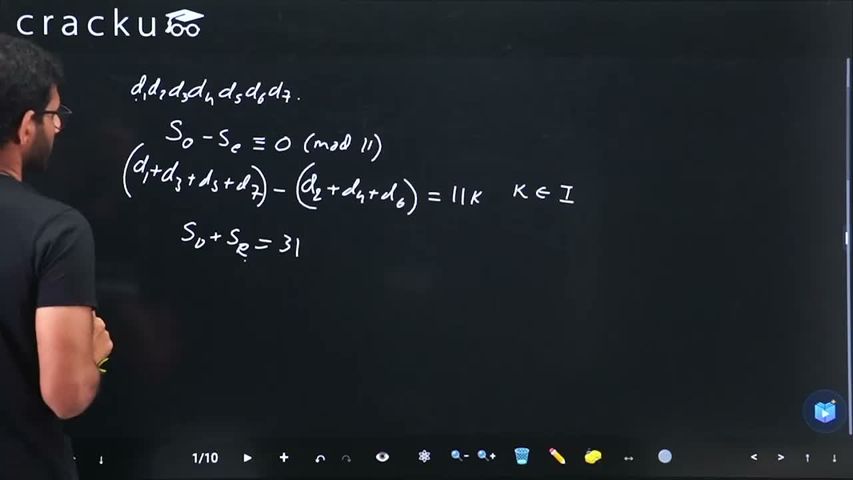
Divisibility rule for 11: A number is divisible by 11 if the alternating sum (sum of digits at odd positions minus sum of digits at even positions) is divisible by 11.
The total sum of all seven digits: $$1 + 2 + 3 + 4 + 5 + 7 + 9 = 31$$
For a 7-digit number $$d_1 d_2 d_3 d_4 d_5 d_6 d_7$$:
Positions 1, 3, 5, 7 (odd positions): 4 digits with sum $$S_o$$
Positions 2, 4, 6 (even positions): 3 digits with sum $$S_e$$
We need: $$S_o + S_e = 31$$ and $$S_o - S_e \equiv 0 \pmod{11}$$
Adding these: $$2S_o = 31 + 11k$$ for some integer $$k$$. Since $$S_o$$ must be an integer, $$31 + 11k$$ must be even, so $$k$$ must be odd.
Case $$k = 1$$: $$S_o = \frac{31+11}{2} = 21$$, $$S_e = 10$$
Case $$k = -1$$: $$S_o = \frac{31-11}{2} = 10$$, $$S_e = 21$$
Case $$k = 3$$: $$S_o = \frac{31+33}{2} = 32$$. The maximum possible $$S_o$$ with 4 digits from our set is $$4 + 5 + 7 + 9 = 25 < 32$$. Not possible.
Case $$k = -3$$: $$S_o = \frac{31-33}{2} = -1 < 0$$. Not possible.
So only $$k = \pm 1$$ are valid.
Finding 4-element subsets of $$\{1,2,3,4,5,7,9\}$$ with sum 21:
We systematically check all combinations including 9:
$$\{9, 7, 3, 2\}$$: $$9+7+3+2 = 21$$ $$\checkmark$$
$$\{9, 7, 4, 1\}$$: $$9+7+4+1 = 21$$ $$\checkmark$$
$$\{9, 5, 4, 3\}$$: $$9+5+4+3 = 21$$ $$\checkmark$$
$$\{9, 7, 5, ??\}$$: Need sum 0 from remaining - not possible.
$$\{9, 5, 3, 4\}$$: Already counted above.
Combinations without 9:
$$\{7, 5, 4, 3\}$$: $$7+5+4+3 = 19 \neq 21$$
$$\{7, 5, 4, 2\}$$: $$= 18$$. No.
Maximum without 9: $$\{7, 5, 4, 3\} = 19 < 21$$. None work.
So there are exactly 3 subsets with $$S_o = 21$$.
Finding 3-element subsets of $$\{1,2,3,4,5,7,9\}$$ with sum 21:
$$\{9, 7, 5\}$$: $$9+7+5 = 21$$ $$\checkmark$$
$$\{9, 7, 4\}$$: $$= 20$$. No.
$$\{9, 7, 3\}$$: $$= 19$$. No.
Maximum of any other triple: $$9+7+4 = 20 < 21$$, and $$9+7+5 = 21$$ is the only one.
So there is exactly 1 subset with $$S_e = 21$$.
Counting arrangements:
For each valid partition of digits into odd and even positions:
The 4 digits at odd positions can be arranged in $$4! = 24$$ ways.
The 3 digits at even positions can be arranged in $$3! = 6$$ ways.
Each subset contributes $$4! \times 3! = 24 \times 6 = 144$$ numbers.
Case 1 ($$S_o = 21$$): 3 subsets $$\times$$ 144 = 432
Case 2 ($$S_o = 10, S_e = 21$$): The 3-element subset $$\{5, 7, 9\}$$ goes to even positions, and the remaining 4 digits $$\{1, 2, 3, 4\}$$ (sum = 10) go to odd positions. This gives 1 subset $$\times$$ 144 = 144.
Total: $$432 + 144 = 576$$
The correct answer is $$576$$.
Was this solution helpful?
Click on the Email ☝️ to Watch the Video Solution
Create a FREE account and get:
_1.webp)

Educational materials for JEE preparation

Ask our AI anything

AI can make mistakes. Please verify important information.
AI can make mistakes. Please verify important information.
