
Join Our JEE Preparation Group
Prep with like-minded aspirants; Get access to free daily tests and study material.
Sign in
Please select an account to continue using cracku.in
↓ →
Join Our JEE Preparation Group
Prep with like-minded aspirants; Get access to free daily tests and study material.
Let $$[t]$$ denote the greatest integer $$\le t$$. If the constant term in the expansion of $$\left(3x^2 - \dfrac{1}{2x^5}\right)^7$$ is $$\alpha$$ then $$[\alpha]$$ is equal to ______.
Correct Answer: 1275
To find $$[\alpha]$$, we need to determine the constant term (the term where the power of $$x$$ is $$0$$) in the expansion of $$(3x^2 - \frac{1}{2x^5})^7$$.
The general term $$T_{r+1}$$ in the expansion of $$(a + b)^n$$ is $$^nC_r \cdot a^{n-r} \cdot b^r$$.
For $$(3x^2 - \frac{1}{2x^5})^7$$:
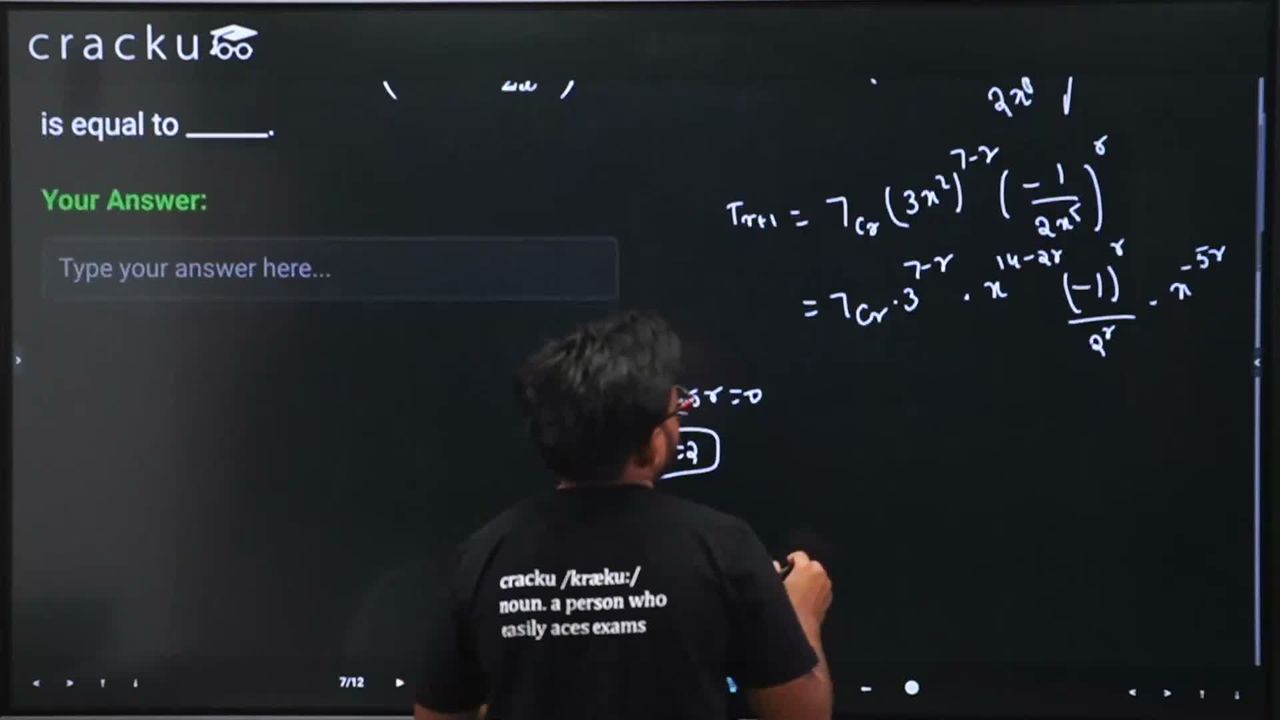
$$T_{r+1} = ^7C_r \cdot (3x^2)^{7-r} \cdot \left(-\frac{1}{2x^5}\right)^r$$
Combine the $$x$$ terms to find the total exponent:
$$T_{r+1} = ^7C_r \cdot 3^{7-r} \cdot \left(-\frac{1}{2}\right)^r \cdot \frac{x^{2(7-r)}}{x^{5r}}$$
$$x \text{ exponent} = 14 - 2r - 5r = 14 - 7r$$
Set the exponent to $$0$$:
$$14 - 7r = 0 \implies \mathbf{r = 2}$$
Plug $$r = 2$$ back into the coefficient part:
$$\alpha = ^7C_2 \cdot 3^{7-2} \cdot \left(-\frac{1}{2}\right)^2$$
$$\alpha = 21 \cdot 3^5 \cdot \frac{1}{4}$$
$$\alpha = 21 \cdot 243 \cdot 0.25 = \frac{5103}{4} = \mathbf{1275.75}$$
The problem asks for $$[\alpha]$$, which is the greatest integer $$\le \alpha$$:
$$[1275.75] = \mathbf{1275}$$
Was this solution helpful?
Click on the Email ☝️ to Watch the Video Solution
Create a FREE account and get:
_1.webp)

Educational materials for JEE preparation

Ask our AI anything

AI can make mistakes. Please verify important information.
AI can make mistakes. Please verify important information.
