
Join Our JEE Preparation Group
Prep with like-minded aspirants; Get access to free daily tests and study material.
Sign in
Please select an account to continue using cracku.in
↓ →
Join Our JEE Preparation Group
Prep with like-minded aspirants; Get access to free daily tests and study material.
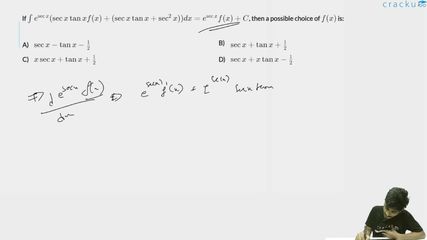
If $$\int e^{\sec x}(\sec x \tan x f(x) + (\sec x \tan x + \sec^2 x))dx = e^{\sec x}f(x) + C$$, then a possible choice of $$f(x)$$ is:
We are told that
$$\int e^{\sec x}\bigl(\sec x \tan x\,f(x)\;+\;(\sec x \tan x+\sec^2 x)\bigr)\,dx \;=\;e^{\sec x}f(x)+C.$$
The antiderivative on the right is already exhibited. Hence its derivative must reproduce the integrand on the left. So we differentiate $$e^{\sec x}f(x)$$ with respect to $$x$$.
First, we recall two basic rules:
1. The product rule: $$\dfrac{d}{dx}\,[u(x)v(x)]=u'(x)v(x)+u(x)v'(x).$$
2. The chain rule for the exponential function: $$\dfrac{d}{dx}\,e^{g(x)}=e^{g(x)}g'(x).$$
We take $$u(x)=e^{\sec x}$$ and $$v(x)=f(x)$$. Using the product rule we write
$$\dfrac{d}{dx}\,\bigl(e^{\sec x}f(x)\bigr) \;=\;\dfrac{d}{dx}\,(e^{\sec x})\;f(x)+e^{\sec x}\,f'(x).$$
Now, $$\dfrac{d}{dx}\,(e^{\sec x})=e^{\sec x}\dfrac{d}{dx}(\sec x)$$ by the chain rule, and we know $$\dfrac{d}{dx}(\sec x)=\sec x\tan x$$. Therefore
$$\dfrac{d}{dx}\,(e^{\sec x})=e^{\sec x}\sec x\tan x.$$
Substituting this result back, we get
$$\dfrac{d}{dx}\,\bigl(e^{\sec x}f(x)\bigr) =e^{\sec x}\sec x\tan x\,f(x)+e^{\sec x}\,f'(x).$$
Thus the derivative equals
$$e^{\sec x}\bigl(\sec x\tan x\,f(x)+f'(x)\bigr).$$
This expression must coincide with the given integrand $$e^{\sec x}\bigl(\sec x\tan x\,f(x)+(\sec x\tan x+\sec^2 x)\bigr).$$
Matching the two, we see that the coefficients of the common factor $$e^{\sec x}$$ must be equal, so
$$\sec x\tan x\,f(x)+f'(x)=\sec x\tan x\,f(x)+\sec x\tan x+\sec^2 x.$$
The $$\sec x\tan x\,f(x)$$ terms cancel on both sides, leaving the simple differential equation
$$f'(x)=\sec x\tan x+\sec^2 x.$$
Now we integrate both sides with respect to $$x$$ to obtain $$f(x)$$. We treat the two terms separately:
• We know $$\displaystyle\int \sec x\tan x\,dx=\sec x + C_1$$ because $$\dfrac{d}{dx}(\sec x)=\sec x\tan x.$$
• We also know $$\displaystyle\int \sec^2 x\,dx=\tan x + C_2$$ because $$\dfrac{d}{dx}(\tan x)=\sec^2 x.$$
Adding the antiderivatives, we find
$$f(x)=\sec x+\tan x+C,$$
where $$C$$ is an arbitrary constant. Any constant can be absorbed into the general constant of integration in the original integral, so we may choose any convenient constant. Among the given options, the expression matching this form is
$$f(x)=\sec x+\tan x+\frac12,$$
which is Option B.
Hence, the correct answer is Option B.
Was this solution helpful?
Click on the Email ☝️ to Watch the Video Solution
Create a FREE account and get:
_1.webp)

Educational materials for JEE preparation

Ask our AI anything

AI can make mistakes. Please verify important information.
AI can make mistakes. Please verify important information.


