
Join Our JEE Preparation Group
Prep with like-minded aspirants; Get access to free daily tests and study material.
Sign in
Please select an account to continue using cracku.in
↓ →
Join Our JEE Preparation Group
Prep with like-minded aspirants; Get access to free daily tests and study material.
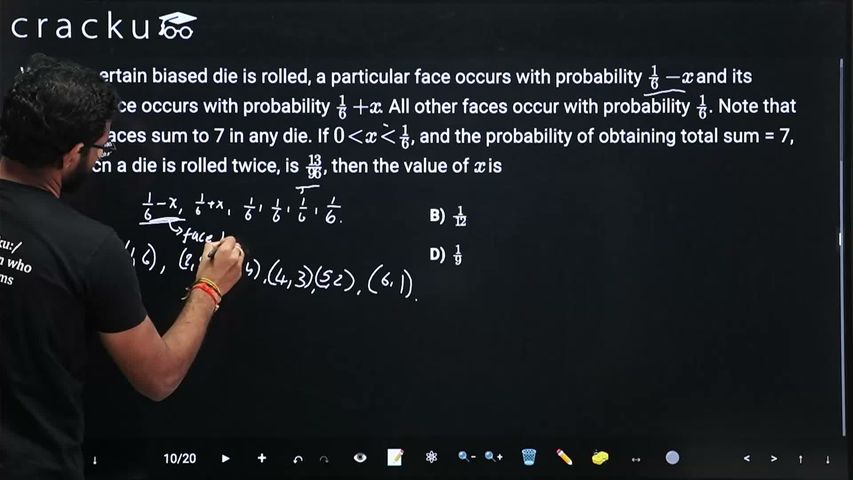
When a certain biased die is rolled, a particular face occurs with probability $$\frac{1}{6} - x$$ and its opposite face occurs with probability $$\frac{1}{6} + x$$. All other faces occur with probability $$\frac{1}{6}$$. Note that opposite faces sum to 7 in any die. If $$0 < x < \frac{1}{6}$$, and the probability of obtaining total sum = 7, when such a die is rolled twice, is $$\frac{13}{96}$$, then the value of $$x$$ is
Let us denote the six faces of the die by $$1,2,3,4,5,6$$. In an ordinary die the opposite faces are $$1\leftrightarrow 6,\;2\leftrightarrow 5,\;3\leftrightarrow 4$$ so that the numbers on opposite faces always add up to $$7$$. According to the statement, exactly one face is made a little less likely and its opposite face is made equally more likely. Concretely, for some face (let us call it the “particular face”) the probability is $$\dfrac16-x$$, for its opposite face the probability is $$\dfrac16+x$$, while the remaining four faces all keep the usual probability $$\dfrac16$$. We are also told that $$0<x<\dfrac16$$.
Without loss of generality we may assume that the face with reduced probability is $$1$$ and therefore its opposite face $$6$$ has the increased probability. (If we had chosen any other pair, the final calculation of the probability of the total sum $$7$$ would be identical because the set of ordered pairs giving a total of $$7$$ remains the same.) Hence we have
$$\begin{aligned} P(1)&=\frac16-x,\\ P(6)&=\frac16+x,\\ P(2)&=P(3)=P(4)=P(5)=\frac16. \end{aligned}$$
When two such dice are rolled independently, the total equals $$7$$ exactly when the ordered pair of results is one of
$$\bigl(1$$, $$6\bigr)$$, $$\;\bigl(2$$, $$5\bigr)$$, $$\;\bigl(3$$, $$4\bigr)$$, $$\;\bigl(4$$, $$3\bigr)$$, $$\;\bigl(5$$, $$2\bigr)$$, $$\;\bigl(6$$, $$1\bigr).$$
Because the two rolls are independent, the probability of a specific ordered pair is the product of the single-roll probabilities. Therefore the total probability of obtaining a sum of $$7$$ is
$$\begin{aligned} P(\text{sum}=7)&=P(1)P(6)+P(2)P(5)+P(3)P(4)+P(4)P(3)+P(5)P(2)+P(6)P(1)\\ &=2\Bigl[P(1)P(6)+P(2)P(5)+P(3)P(4)\Bigr]. \end{aligned}$$
Now we substitute the individual probabilities:
$$\begin{aligned} P(1)P(6)&=\left(\frac16-x\right)\left(\frac16+x\right) =\left(\frac16\right)^2-x^2 =\frac1{36}-x^2,\\[6pt] P(2)P(5)&=\frac16\cdot\frac16=\frac1{36},\\[6pt] P(3)P(4)&=\frac16\cdot\frac16=\frac1{36}. \end{aligned}$$
Adding these three products we get
$$\begin{aligned} P(1)P(6)+P(2)P(5)+P(3)P(4) =\left(\frac1{36}-x^2\right)+\frac1{36}+\frac1{36} =\frac3{36}-x^2 =\frac1{12}-x^2. \end{aligned}$$
Multiplying by the prefactor $$2$$, the desired probability is
$$P(\text{sum}=7)=2\left(\frac1{12}-x^2\right)=\frac16-2x^2.$$
The problem states that this probability equals $$\dfrac{13}{96}$$. Setting the two expressions equal gives
$$\frac16-2x^2=\frac{13}{96}.$$
To solve for $$x$$ we first write $$\dfrac16$$ with denominator $$96$$:
$$\frac16=\frac{16}{96}.$$
Substituting this, we have
$$\frac{16}{96}-2x^2=\frac{13}{96}.$$
Subtracting $$\dfrac{13}{96}$$ from both sides:
$$\frac{16}{96}-\frac{13}{96}=2x^2.$$
$$\frac{3}{96}=2x^2.$$
Dividing both sides by $$2$$:
$$x^2=\frac{3}{96}\cdot\frac12=\frac{3}{192}=\frac1{64}.$$
Because $$x>0$$, we take the positive square root:
$$x=\sqrt{\frac1{64}}=\frac18.$$
Since $$\dfrac18=\dfrac{1}{8}$$ corresponds to Option C, we conclude:
Hence, the correct answer is Option C.
Was this solution helpful?
Click on the Email ☝️ to Watch the Video Solution
Create a FREE account and get:
_1.webp)

Educational materials for JEE preparation

Ask our AI anything

AI can make mistakes. Please verify important information.
AI can make mistakes. Please verify important information.
