
Join Our JEE Preparation Group
Prep with like-minded aspirants; Get access to free daily tests and study material.
Sign in
Please select an account to continue using cracku.in
↓ →
Join Our JEE Preparation Group
Prep with like-minded aspirants; Get access to free daily tests and study material.
In a bolt factory, machines A, B and C manufacture respectively 20%, 30% and 50% of the total bolts. Of their output 3, 4 and 2 percent are respectively defective bolts. A bolt is drawn at random from the product. If the bolt drawn is found defective then the probability that it is manufactured by the machine C is
We begin by using Bayes’ theorem and letting D denote the event that a bolt is defective.
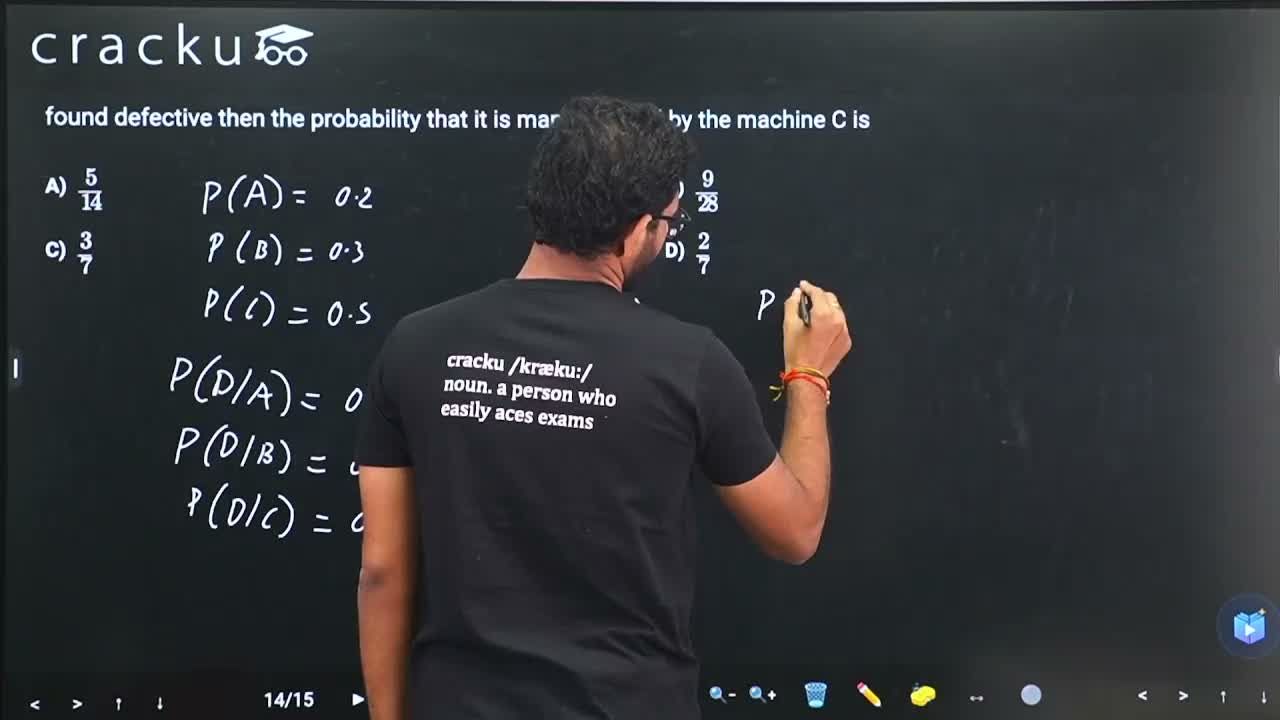
Next, we have the probabilities $$P(A) = 0.20$$, $$P(B) = 0.30$$, and $$P(C) = 0.50$$.
Similarly, the conditional probabilities are $$P(D|A) = 0.03$$, $$P(D|B) = 0.04$$, and $$P(D|C) = 0.02$$.
To find the total probability of a defective bolt, we apply the law of total probability and compute $$ P(D) = P(A) \cdot P(D|A) + P(B) \cdot P(D|B) + P(C) \cdot P(D|C) $$.
Substituting the values gives $$ = 0.20 \times 0.03 + 0.30 \times 0.04 + 0.50 \times 0.02 $$.
This gives $$ = 0.006 + 0.012 + 0.010 = 0.028 $$.
Then, by Bayes’ theorem, the probability that a defective bolt was manufactured by C is given by $$ P(C|D) = \frac{P(D|C) \cdot P(C)}{P(D)} = \frac{0.02 \times 0.50}{0.028} = \frac{0.01}{0.028} = \frac{10}{28} = \frac{5}{14} $$.
Therefore, the correct answer is $$\dfrac{5}{14}$$.
Click on the Email ☝️ to Watch the Video Solution
Create a FREE account and get:
_1.webp)

Educational materials for JEE preparation

Ask our AI anything

AI can make mistakes. Please verify important information.
AI can make mistakes. Please verify important information.


