
Join Our JEE Preparation Group
Prep with like-minded aspirants; Get access to free daily tests and study material.
Sign in
Please select an account to continue using cracku.in
↓ →
Join Our JEE Preparation Group
Prep with like-minded aspirants; Get access to free daily tests and study material.
Two number $$k_{1}$$ and $$k_{2}$$ are randomly chosen from the set of natural numbers. Then, the probability that the value of $$i^{k_{1}}+i^{k_{2}},(i=\sqrt{-1})$$ is non-zero, equals
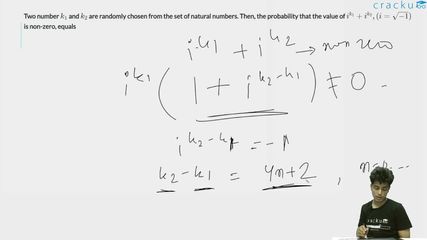
Two numbers $$k_1$$ and $$k_2$$ are randomly chosen from the set of natural numbers. We need to find the probability that $$i^{k_1} + i^{k_2} \neq 0$$, where $$i = \sqrt{-1}$$.
The powers of $$i$$ repeat with period 4:
$$i^1 = i, \quad i^2 = -1, \quad i^3 = -i, \quad i^4 = 1$$
$$i^5 = i, \quad i^6 = -1, \quad \ldots$$
So $$i^k$$ takes values $$\{i, -1, -i, 1\}$$ depending on $$k \pmod{4}$$.
To have $$i^{k_1} + i^{k_2} = 0$$ means $$i^{k_1} = -\,i^{k_2}$$, which occurs in the following cases:
- $$i^{k_1} = i$$ and $$i^{k_2} = -i$$: $$k_1 \equiv 1 \pmod{4}$$ and $$k_2 \equiv 3 \pmod{4}$$
- $$i^{k_1} = -i$$ and $$i^{k_2} = i$$: $$k_1 \equiv 3 \pmod{4}$$ and $$k_2 \equiv 1 \pmod{4}$$
- $$i^{k_1} = 1$$ and $$i^{k_2} = -1$$: $$k_1 \equiv 0 \pmod{4}$$ and $$k_2 \equiv 2 \pmod{4}$$
- $$i^{k_1} = -1$$ and $$i^{k_2} = 1$$: $$k_1 \equiv 2 \pmod{4}$$ and $$k_2 \equiv 0 \pmod{4}$$
Since each residue class modulo 4 has probability $$\frac{1}{4}$$, we get
$$P(i^{k_1} + i^{k_2} = 0) = 4 \times \frac{1}{4} \times \frac{1}{4} = \frac{1}{4},$$
and hence
$$P(i^{k_1} + i^{k_2} \neq 0) = 1 - \frac{1}{4} = \frac{3}{4}.$$
The correct answer is Option B: $$\frac{3}{4}$$.
Was this solution helpful?
Click on the Email ☝️ to Watch the Video Solution
Create a FREE account and get:
_1.webp)

Educational materials for JEE preparation

Ask our AI anything

AI can make mistakes. Please verify important information.
AI can make mistakes. Please verify important information.
