
Join Our JEE Preparation Group
Prep with like-minded aspirants; Get access to free daily tests and study material.
Sign in
Please select an account to continue using cracku.in
↓ →
Join Our JEE Preparation Group
Prep with like-minded aspirants; Get access to free daily tests and study material.
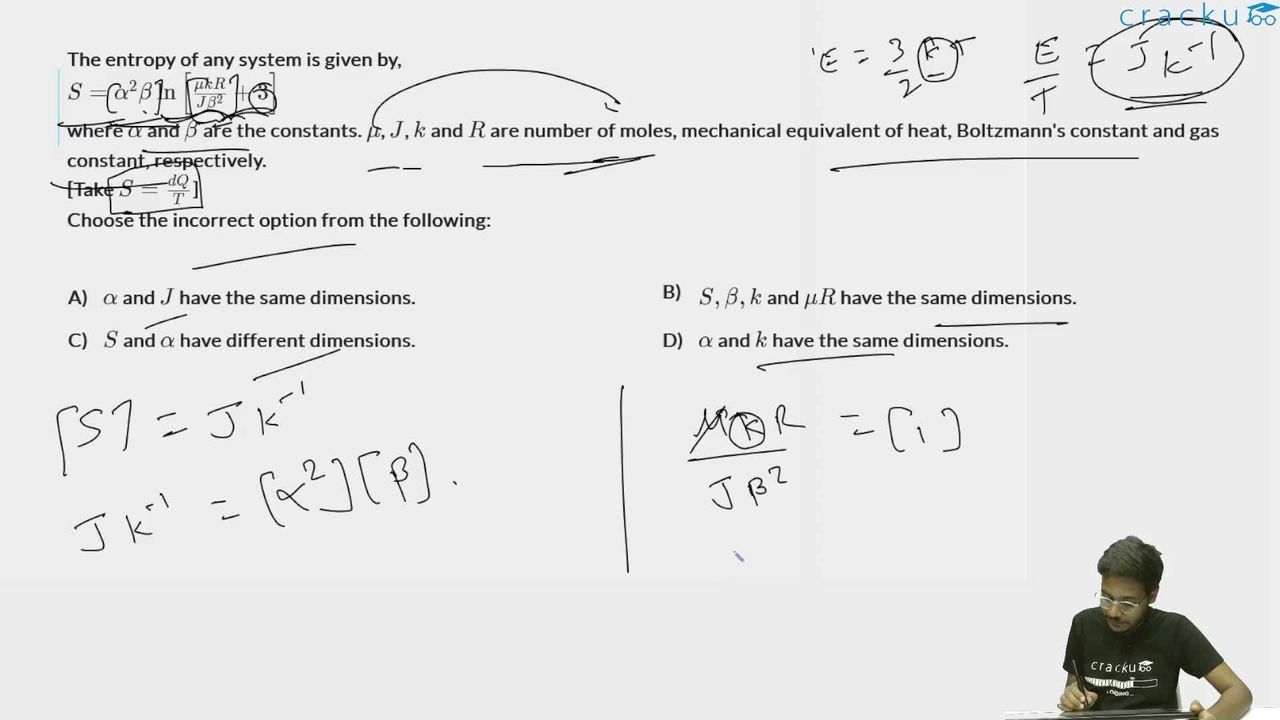
The entropy of any system is given by,
$$S = \alpha^2 \beta \ln\left[\frac{\mu kR}{J\beta^2} + 3\right]$$
where $$\alpha$$ and $$\beta$$ are the constants. $$\mu$$, $$J$$, $$k$$ and $$R$$ are number of moles, mechanical equivalent of heat, Boltzmann's constant and gas constant, respectively.
[Take $$S = \frac{dQ}{T}$$]
Choose the incorrect option from the following:
The entropy is $$S = \alpha^2\beta\ln\!\left[\frac{\mu kR}{J\beta^2}+3\right]$$, with $$[S] = \mathrm{J\,K^{-1}}$$. The logarithm is dimensionless, so $$[\alpha^2\beta] = [S] = \mathrm{J\,K^{-1}}$$.
For the log argument to be dimensionless: $$\left[\frac{\mu kR}{J\beta^2}\right] = 1$$. Since $$\mu$$ is dimensionless (number of moles treated as a pure number), $$[k] = \mathrm{J\,K^{-1}}$$, $$[R] = \mathrm{J\,K^{-1}}$$ (same dimension as $$k$$ for this analysis), and $$J$$ is dimensionless, we get $$[\beta^2] = [kR] = \mathrm{J^2\,K^{-2}}$$, so $$[\beta] = \mathrm{J\,K^{-1}}$$.
From $$[\alpha^2\beta] = \mathrm{J\,K^{-1}}$$ and $$[\beta] = \mathrm{J\,K^{-1}}$$, we get $$[\alpha^2] = 1$$, meaning $$\alpha$$ is dimensionless. The mechanical equivalent $$J$$ is also dimensionless, so $$\alpha$$ and $$J$$ share the same (dimensionless) dimensions — option 1 is correct. Also $$[S] = [\beta] = [k] = \mathrm{J\,K^{-1}}$$ and $$[\mu R] = \mathrm{J\,K^{-1}}$$, so option 2 is correct. $$S$$ and $$\alpha$$ differ (option 3 correct). However, option 4 claims $$\alpha$$ and $$k$$ have the same dimensions: $$[\alpha] = 1$$ (dimensionless) while $$[k] = \mathrm{J\,K^{-1}}$$ — these are different. Therefore option 4 is the incorrect statement.
Was this solution helpful?
Click on the Email ☝️ to Watch the Video Solution
Create a FREE account and get:
_1.webp)

Educational materials for JEE preparation

Ask our AI anything

AI can make mistakes. Please verify important information.
AI can make mistakes. Please verify important information.


