
Join Our JEE Preparation Group
Prep with like-minded aspirants; Get access to free daily tests and study material.
Sign in
Please select an account to continue using cracku.in
↓ →
Join Our JEE Preparation Group
Prep with like-minded aspirants; Get access to free daily tests and study material.
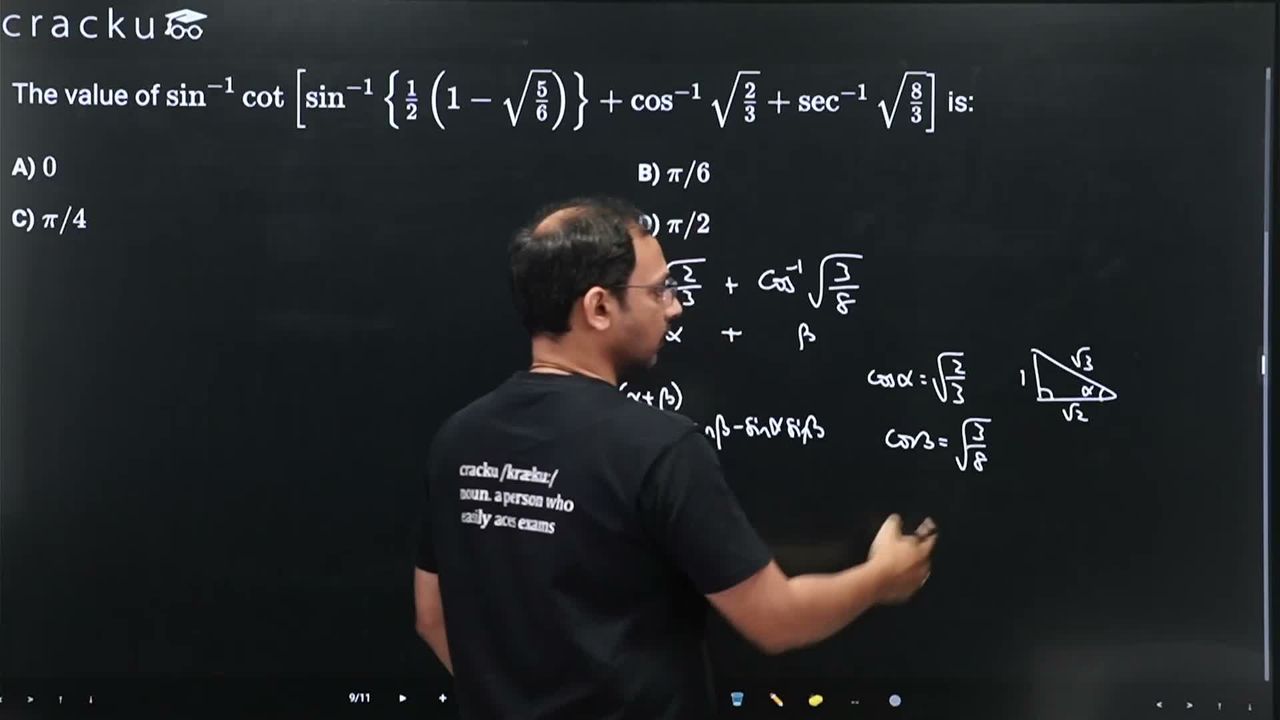
The value of $$\sin^{-1}\cot\left[\sin^{-1}\left\{\frac{1}{2}\left(1-\sqrt{\frac{5}{6}}\right)\right\}+\cos^{-1}\sqrt{\frac{2}{3}}+\sec^{-1}\sqrt{\frac{8}{3}}\right]$$ is:
To solve this problem, let us simplify the expression step by step, starting with the inverse trigonometric terms inside the bracket.
Let us rewrite the secant term into an inverse cosine function using the reciprocal relation:
$$\sec^{-1} \sqrt{\frac{8}{3}} = \cos^{-1} \sqrt{\frac{3}{8}}$$
Now, let us define two angles $$\alpha$$ and $$\beta$$ as:
$$\alpha = \cos^{-1} \sqrt{\frac{2}{3}} \implies \cos \alpha = \sqrt{\frac{2}{3}}$$
$$\beta = \cos^{-1} \sqrt{\frac{3}{8}} \implies \cos \beta = \sqrt{\frac{3}{8}}$$
From these, we can easily find the corresponding sine values:
$$\sin \alpha = \sqrt{1 - \left(\sqrt{\frac{2}{3}}\right)^2} = \sqrt{1 - \frac{2}{3}} = \frac{1}{\sqrt{3}}$$
$$\sin \beta = \sqrt{1 - \left(\sqrt{\frac{3}{8}}\right)^2} = \sqrt{1 - \frac{3}{8}} = \sqrt{\frac{5}{8}}$$
Next, let us evaluate the cosine of the sum of these two angles, $$\cos(\alpha + \beta)$$:
$$\cos(\alpha + \beta) = \cos \alpha \cos \beta - \sin \alpha \sin \beta$$
$$\cos(\alpha + \beta) = \left(\sqrt{\frac{2}{3}}\right)\left(\sqrt{\frac{3}{8}}\right) - \left(\frac{1}{\sqrt{3}}\right)\left(\sqrt{\frac{5}{8}}\right)$$
$$\cos(\alpha + \beta) = \sqrt{\frac{6}{24}} - \sqrt{\frac{5}{24}} = \frac{\sqrt{6} - \sqrt{5}}{2\sqrt{6}}$$
Rationalizing or simplifying the expression:
$$\cos(\alpha + \beta) = \frac{1}{2} \left(1 - \sqrt{\frac{5}{6}}\right)$$
Thus, we have:
$$\alpha + \beta = \cos^{-1}\left[ \frac{1}{2} \left(1 - \sqrt{\frac{5}{6}}\right) \right]$$
We know the standard co-function identity relating arcsine and arccosine:
$$\sin^{-1}(x) + \cos^{-1}(x) = \frac{\pi}{2}$$
Let $$x = \frac{1}{2} \left(1 - \sqrt{\frac{5}{6}}\right)$$.
Then the first term in our main expression is $$\sin^{-1}(x)$$, and the sum of the remaining two terms is $$\alpha + \beta = \cos^{-1}(x)$$.
Therefore, the entire argument inside the cotangent function simplifies to:
$$\sin^{-1}\left\{ \frac{1}{2} \left(1 - \sqrt{\frac{5}{6}}\right) \right\} + \cos^{-1} \sqrt{\frac{2}{3}} + \sec^{-1} \sqrt{\frac{8}{3}} = \sin^{-1}(x) + \cos^{-1}(x) = \frac{\pi}{2}$$
Substituting this back into the original expression:
$$\sin^{-1} \cot\left(\frac{\pi}{2}\right)$$
Since $$\cot\left(\frac{\pi}{2}\right) = 0$$, the expression reduces to:
$$\sin^{-1}(0) = 0$$
The correct option is A.
Was this solution helpful?
Click on the Email ☝️ to Watch the Video Solution
Create a FREE account and get:
_1.webp)

Educational materials for JEE preparation

Ask our AI anything

AI can make mistakes. Please verify important information.
AI can make mistakes. Please verify important information.
