
Join Our JEE Preparation Group
Prep with like-minded aspirants; Get access to free daily tests and study material.
Sign in
Please select an account to continue using cracku.in
↓ →
Join Our JEE Preparation Group
Prep with like-minded aspirants; Get access to free daily tests and study material.
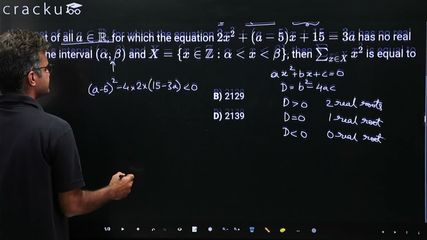
If the set of all $$a \in \mathbb{R}$$, for which the equation $$2x^2 + (a-5)x + 15 = 3a$$ has no real root, is the interval $$(\alpha,\beta)$$ and $$X=\{x \in \mathbb{Z} : \alpha < x < \beta\}$$, then $$\sum_{x \in X}^{}x^{2}$$ is equal to :
We consider the quadratic equation $$2x^2 + (a-5)x + 15 - 3a = 0$$ and require that it have no real roots, which is equivalent to its discriminant satisfying $$D = (a-5)^2 - 4(2)(15-3a) < 0\;.$$
Expanding the discriminant yields $$a^2 - 10a + 25 - 120 + 24a < 0\;,$$ which simplifies to $$a^2 + 14a - 95 < 0\;.$$
To find the critical values of $$a$$, we solve the equation $$a^2 + 14a - 95 = 0$$, giving
$$a = \frac{-14 \pm \sqrt{196 + 380}}{2} = \frac{-14 \pm \sqrt{576}}{2} = \frac{-14 \pm 24}{2}\;,$$
so that $$a = 5$$ or $$a = -19\;.$$
Therefore the quadratic has no real roots precisely when $$a \in (-19, 5)\;.$$
For integer values of $$x$$ in this interval we set
$$X = \{\,x \in \mathbb{Z} : -19 < x < 5\} = \{-18, -17, \dots, 4\}\;.$$
We wish to compute
$$\sum_{x \in X} x^2 = \sum_{x=-18}^{4} x^2 = \sum_{x=1}^{18} x^2 + \sum_{x=1}^{4} x^2\;.$$
Using the formula $$\sum_{k=1}^{n} k^2 = \frac{n(n+1)(2n+1)}{6}\;,$$ we find
$$\sum_{x=1}^{18} x^2 = \frac{18 \times 19 \times 37}{6} = \frac{12654}{6} = 2109$$
and
$$\sum_{x=1}^{4} x^2 = \frac{4 \times 5 \times 9}{6} = 30\;.$$
Hence
$$\sum_{x \in X} x^2 = 2109 + 30 = 2139\;.$$
The correct answer is Option 4: 2139.
Was this solution helpful?
Click on the Email ☝️ to Watch the Video Solution
Create a FREE account and get:
_1.webp)

Educational materials for JEE preparation

Ask our AI anything

AI can make mistakes. Please verify important information.
AI can make mistakes. Please verify important information.
