
Join Our JEE Preparation Group
Prep with like-minded aspirants; Get access to free daily tests and study material.
Sign in
Please select an account to continue using cracku.in
↓ →
Join Our JEE Preparation Group
Prep with like-minded aspirants; Get access to free daily tests and study material.
A cylindrical vessel containing a liquid is rotated about its axis so that the liquid rises at its sides as shown in the figure. The radius of vessel is 5 cm and the angular speed of rotation is $$\omega$$ rad s$$^{-1}$$. The difference in the height, h (in cm) of liquid at the Centre of vessel and at the sides of the vessel will be:
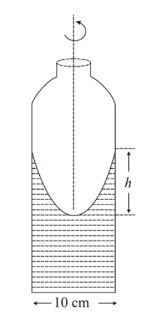
Let us consider an element of the liquid situated at a distance $$r$$ from the axis of the cylindrical vessel which is rotating with a uniform angular speed $$\omega$$ rad s$$^{-1}$$. Because of the rotation, the element experiences a centrifugal acceleration $$\omega^{2}r$$ directed horizontally outward, while the usual gravitational acceleration $$g$$ acts vertically downward.
On the free surface of the liquid the pressure is the same everywhere (equal to the atmospheric pressure). For any two points on that free surface the total change in hydrostatic pressure must therefore be zero. We can write this balance in differential form. If the surface rises by a vertical amount $$dz$$ when we move radially outward by an infinitesimal distance $$dr$$, the pressure change due to gravity is $$\rho g\,dz$$ downward, and the pressure change due to the centrifugal field is $$\rho\,\omega^{2}r\,dr$$ outward. Equating the two (and cancelling the common factor $$\rho$$) we obtain
$$g\,dz \;=\; \omega^{2}r\,dr.$$
We now integrate this differential relation from the axis ($$r=0$$) to any general point on the surface at radius $$r$$. The left-hand side integrates over the corresponding vertical rise $$z$$ (measured from the level at the axis), while the right-hand side integrates over the radial distance:
$$\displaystyle\int_{0}^{z}\! g\,dz \;=\; \int_{0}^{r}\! \omega^{2}r\,dr.$$
Carrying out the integrations term by term, we get
$$g\,z \;=\; \omega^{2}\,\frac{r^{2}}{2}.$$
Solving for the height $$z$$ of the liquid surface above the centre level at a distance $$r$$ gives the well-known parabolic profile
$$z \;=\; \frac{\omega^{2}r^{2}}{2g}.$$
Now we are interested in the difference in height between the surface at the extreme side of the vessel ($$r = R$$) and the surface at the axis ($$r = 0$$). At the centre, $$r = 0$$ so $$z = 0$$. At the wall, $$r = R = 5\;{\rm cm}$$. Substituting this value into the expression for $$z$$, we obtain
$$h \;=\; z(R) - z(0) \;=\; \frac{\omega^{2}R^{2}}{2g} \;=\; \frac{\omega^{2}(5\;{\rm cm})^{2}}{2g}.$$
Evaluating the square of the radius,
$$(5\;{\rm cm})^{2} = 25\;{\rm cm}^{2},$$
and substituting back, we have
$$h \;=\; \frac{25\,\omega^{2}}{2g}\;{\rm cm}.$$
This expression matches Option C in the given list.
Hence, the correct answer is Option C.
Was this solution helpful?
Create a FREE account and get:
_1.webp)

Educational materials for JEE preparation

Ask our AI anything

AI can make mistakes. Please verify important information.
AI can make mistakes. Please verify important information.
