
Join Our JEE Preparation Group
Prep with like-minded aspirants; Get access to free daily tests and study material.
Sign in
Please select an account to continue using cracku.in
↓ →
Join Our JEE Preparation Group
Prep with like-minded aspirants; Get access to free daily tests and study material.
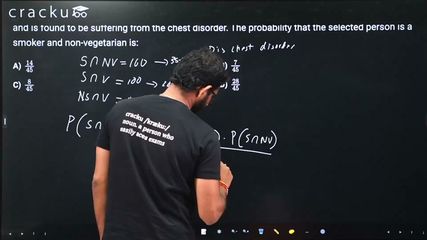
In a group of 400 people, 160 are smokers and non-vegetarian; 100 are smokers and vegetarian and the remaining 140 are non-smokers and vegetarian. Their chances of getting a particular chest disorder are 35%, 20% and 10% respectively. A person is chosen from the group at random and is found to be suffering from the chest disorder. The probability that the selected person is a smoker and non-vegetarian is:
We are given 400 people divided into three groups: 160 smokers and non-vegetarian (group I), 100 smokers and vegetarian (group II), and 140 non-smokers and vegetarian (group III). Their probabilities of getting a chest disorder are 35%, 20%, and 10% respectively.
Using Bayes' theorem, we need $$P(\text{group I} \mid \text{disorder})$$. The total probability of a randomly chosen person having the disorder is $$P(D) = \frac{160}{400} \times 0.35 + \frac{100}{400} \times 0.20 + \frac{140}{400} \times 0.10$$.
Computing each term: $$\frac{160}{400} \times 0.35 = 0.4 \times 0.35 = 0.14$$, $$\frac{100}{400} \times 0.20 = 0.25 \times 0.20 = 0.05$$, and $$\frac{140}{400} \times 0.10 = 0.35 \times 0.10 = 0.035$$.
So $$P(D) = 0.14 + 0.05 + 0.035 = 0.225$$.
By Bayes' theorem, $$P(\text{group I} \mid D) = \frac{0.14}{0.225} = \frac{140}{225} = \frac{28}{45}$$.
Therefore, the probability that the selected person is a smoker and non-vegetarian is $$\dfrac{28}{45}$$.
Was this solution helpful?
Click on the Email ☝️ to Watch the Video Solution
Create a FREE account and get:
_1.webp)

Educational materials for JEE preparation

Ask our AI anything

AI can make mistakes. Please verify important information.
AI can make mistakes. Please verify important information.
