
Join Our JEE Preparation Group
Prep with like-minded aspirants; Get access to free daily tests and study material.
Sign in
Please select an account to continue using cracku.in
↓ →
Join Our JEE Preparation Group
Prep with like-minded aspirants; Get access to free daily tests and study material.
If the shortest distance between the lines $$L_1 : \vec{r} = (2 + \lambda)\hat{i} + (1 - 3\lambda)\hat{j} + (3 + 4\lambda)\hat{k}, \lambda \in \mathbb{R}$$ and $$L_2 : \vec{r} = 2(1 + \mu)\hat{i} + 3(1 + \mu)\hat{j} + (5 + \mu)\hat{k}, \mu \in \mathbb{R}$$ is $$\frac{m}{\sqrt{n}}$$, where $$\gcd(m, n) = 1$$, then the value of $$m + n$$ equals
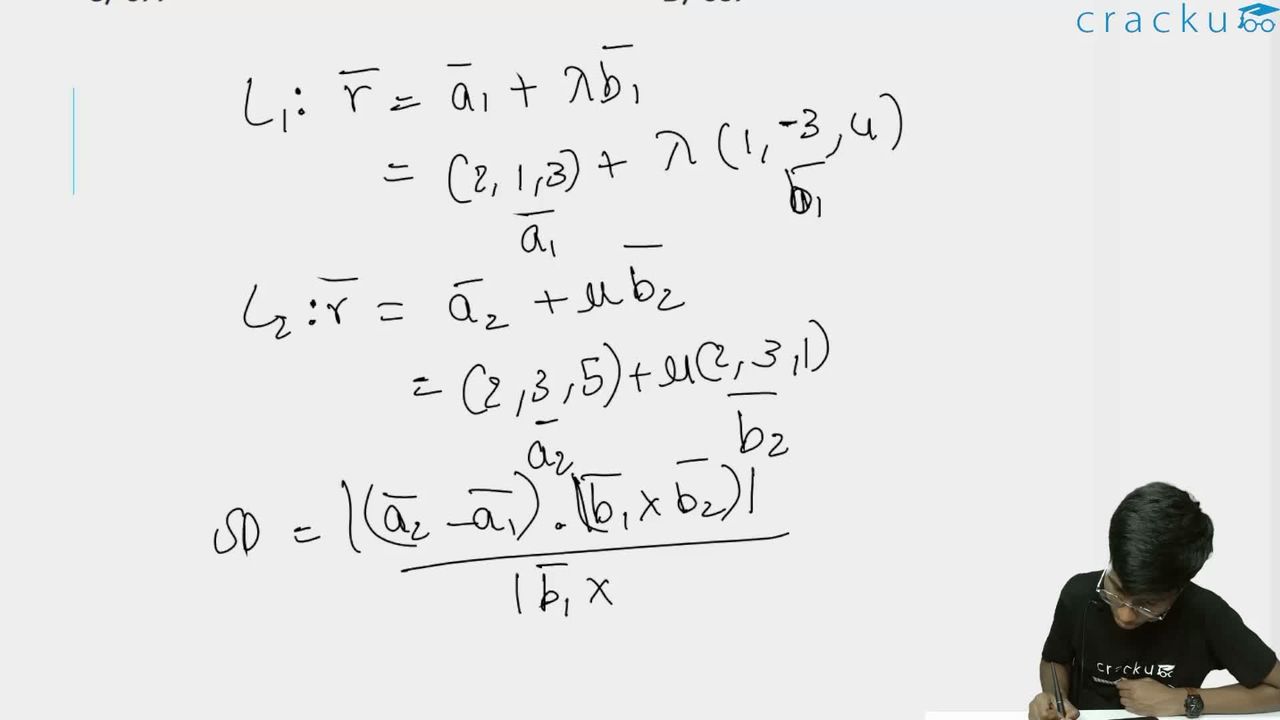
The shortest distance between two skew lines $$L_1: \vec{r} = \vec{a} + \lambda \vec{b}$$ and $$L_2: \vec{r} = \vec{c} + \mu \vec{d}$$ is given by the formula:
$$d = \frac{ | (\vec{b} \times \vec{d}) \cdot (\vec{a} - \vec{c}) | }{ |\vec{b} \times \vec{d}| }$$
First, rewrite the given lines in standard form.
For $$L_1: \vec{r} = (2 + \lambda)\hat{i} + (1 - 3\lambda)\hat{j} + (3 + 4\lambda)\hat{k}$$:
Position vector $$\vec{a} = 2\hat{i} + 1\hat{j} + 3\hat{k}$$
Direction vector $$\vec{b} = 1\hat{i} - 3\hat{j} + 4\hat{k}$$
For $$L_2: \vec{r} = 2(1 + \mu)\hat{i} + 3(1 + \mu)\hat{j} + (5 + \mu)\hat{k} = (2 + 2\mu)\hat{i} + (3 + 3\mu)\hat{j} + (5 + \mu)\hat{k}$$:
Position vector $$\vec{c} = 2\hat{i} + 3\hat{j} + 5\hat{k}$$
Direction vector $$\vec{d} = 2\hat{i} + 3\hat{j} + 1\hat{k}$$
Now, compute $$\vec{a} - \vec{c}$$:
$$\vec{a} - \vec{c} = (2 - 2)\hat{i} + (1 - 3)\hat{j} + (3 - 5)\hat{k} = 0\hat{i} - 2\hat{j} - 2\hat{k}$$
Next, compute the cross product $$\vec{b} \times \vec{d}$$:
$$\vec{b} = \begin{pmatrix} 1 \\ -3 \\ 4 \end{pmatrix}, \vec{d} = \begin{pmatrix} 2 \\ 3 \\ 1 \end{pmatrix}$$
$$\vec{b} \times \vec{d} = \begin{vmatrix} \hat{i} & \hat{j} & \hat{k} \\ 1 & -3 & 4 \\ 2 & 3 & 1 \end{vmatrix} = \hat{i} \left[ (-3)(1) - (4)(3) \right] - \hat{j} \left[ (1)(1) - (4)(2) \right] + \hat{k} \left[ (1)(3) - (-3)(2) \right]$$
Calculate each component:
i-component: $$(-3)(1) - (4)(3) = -3 - 12 = -15$$
j-component: $$- \left[ (1)(1) - (4)(2) \right] = - \left[ 1 - 8 \right] = -(-7) = 7$$
k-component: $$(1)(3) - (-3)(2) = 3 - (-6) = 3 + 6 = 9$$
Thus, $$\vec{b} \times \vec{d} = -15\hat{i} + 7\hat{j} + 9\hat{k}$$
Now, find the magnitude $$|\vec{b} \times \vec{d}|$$:
$$|\vec{b} \times \vec{d}| = \sqrt{(-15)^2 + (7)^2 + (9)^2} = \sqrt{225 + 49 + 81} = \sqrt{355}$$
Compute the scalar triple product $$(\vec{b} \times \vec{d}) \cdot (\vec{a} - \vec{c})$$:
$$\vec{b} \times \vec{d} = -15\hat{i} + 7\hat{j} + 9\hat{k}, \quad \vec{a} - \vec{c} = 0\hat{i} - 2\hat{j} - 2\hat{k}$$
Dot product: $$(-15)(0) + (7)(-2) + (9)(-2) = 0 - 14 - 18 = -32$$
Absolute value: $$| -32 | = 32$$
Therefore, the shortest distance is:
$$d = \frac{32}{\sqrt{355}}$$
The distance is given as $$\frac{m}{\sqrt{n}}$$ with $$\gcd(m, n) = 1$$. Here, $$m = 32$$ and $$n = 355$$.
Check $$\gcd(32, 355)$$:
$$32 = 2^5, \quad 355 = 5 \times 71$$
Since there are no common prime factors, $$\gcd(32, 355) = 1$$.
Thus, $$m = 32$$, $$n = 355$$, and $$m + n = 32 + 355 = 387$$.
Verify that the lines are skew (neither parallel nor intersecting):
Direction vectors $$\vec{b} = \langle 1, -3, 4 \rangle$$, $$\vec{d} = \langle 2, 3, 1 \rangle$$.
Check for parallelism: Is there $$k$$ such that $$\langle 1, -3, 4 \rangle = k \langle 2, 3, 1 \rangle$$?
From $$1 = 2k$$, $$k = \frac{1}{2}$$, but $$-3 = 3 \times \frac{1}{2} = 1.5 \neq -3$$, so not parallel.
Check for intersection: Set equations equal:
i-component: $$2 + \lambda = 2 + 2\mu \implies \lambda = 2\mu$$
j-component: $$1 - 3\lambda = 3 + 3\mu$$
Substitute $$\lambda = 2\mu$$: $$1 - 3(2\mu) = 3 + 3\mu \implies 1 - 6\mu = 3 + 3\mu \implies -6\mu - 3\mu = 3 - 1 \implies -9\mu = 2 \implies \mu = -\frac{2}{9}$$
Then $$\lambda = 2 \times -\frac{2}{9} = -\frac{4}{9}$$
k-component: Left side: $$3 + 4\lambda = 3 + 4(-\frac{4}{9}) = 3 - \frac{16}{9} = \frac{27}{9} - \frac{16}{9} = \frac{11}{9}$$
Right side: $$5 + \mu = 5 - \frac{2}{9} = \frac{45}{9} - \frac{2}{9} = \frac{43}{9}$$
$$\frac{11}{9} \neq \frac{43}{9}$$, so no intersection. Thus, lines are skew.
The value of $$m + n$$ is 387, which corresponds to option D.
Was this solution helpful?
Click on the Email ☝️ to Watch the Video Solution
Create a FREE account and get:
_1.webp)

Educational materials for JEE preparation

Ask our AI anything

AI can make mistakes. Please verify important information.
AI can make mistakes. Please verify important information.
