
Join Our JEE Preparation Group
Prep with like-minded aspirants; Get access to free daily tests and study material.
Sign in
Please select an account to continue using cracku.in
↓ →
Join Our JEE Preparation Group
Prep with like-minded aspirants; Get access to free daily tests and study material.
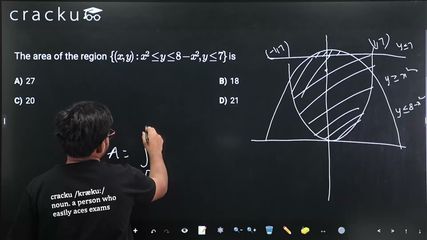
To determine the area of the region $$\{(x,y): x^2 \le y \le 8 - x^2,\; y \le 7\}$$ we first locate the intersection of the parabolas $$y = x^2$$ and $$y = 8 - x^2$$. Solving $$x^2 = 8 - x^2$$ gives $$2x^2 = 8$$, hence $$x = \pm 2$$, and at these points $$y = 4$$.
Next, we observe where $$8 - x^2$$ exceeds the line $$y = 7$$ by solving $$8 - x^2 = 7$$, which yields $$x^2 = 1$$ and thus $$x = \pm 1$$. On the interval $$|x| < 1$$ the upper curve is above $$y = 7$$, so the actual upper boundary becomes $$y = 7$$ for those $$x$$-values.
Therefore the upper limit on $$y$$ is the minimum of $$8 - x^2$$ and $$7$$. Exploiting symmetry about the $$y$$-axis, the total area can be computed as
$$A = 2\biggl[\int_{0}^{1}(7 - x^2)\,dx + \int_{1}^{2}\bigl((8 - x^2) - x^2\bigr)\,dx\biggr] = 2\Bigl[\int_{0}^{1}(7 - x^2)\,dx + \int_{1}^{2}(8 - 2x^2)\,dx\Bigr].$$
Evaluating these integrals gives
$$\int_{0}^{1}(7 - x^2)\,dx = \Bigl[7x - \tfrac{x^3}{3}\Bigr]_{0}^{1} = 7 - \tfrac{1}{3} = \tfrac{20}{3},$$
and
$$\int_{1}^{2}(8 - 2x^2)\,dx = \Bigl[8x - \tfrac{2x^3}{3}\Bigr]_{1}^{2} = \Bigl(16 - \tfrac{16}{3}\Bigr) - \Bigl(8 - \tfrac{2}{3}\Bigr) = \tfrac{32}{3} - \tfrac{22}{3} = \tfrac{10}{3}.$$
Substituting into the expression for $$A$$ yields
$$A = 2\Bigl(\tfrac{20}{3} + \tfrac{10}{3}\Bigr) = 2 \times \tfrac{30}{3} = 2 \times 10 = 20.$$
The answer is Option C: 20.
Click on the Email ☝️ to Watch the Video Solution
Create a FREE account and get:
_1.webp)

Educational materials for JEE preparation

Ask our AI anything

AI can make mistakes. Please verify important information.
AI can make mistakes. Please verify important information.


