
Join Our JEE Preparation Group
Prep with like-minded aspirants; Get access to free daily tests and study material.
Sign in
Please select an account to continue using cracku.in
↓ →
Join Our JEE Preparation Group
Prep with like-minded aspirants; Get access to free daily tests and study material.
Let $$y = y(x)$$ be the solution of the differential equation $$(1 + y^2)e^{\tan x} dx + \cos^2 x(1 + e^{2\tan x}) dy = 0, y(0) = 1$$. Then $$y\left(\frac{\pi}{4}\right)$$ is equal to
We solve the differential equation $$(1+y^2)e^{\tan x}dx + \cos^2 x(1+e^{2\tan x})dy = 0$$ with the initial condition $$y(0)=1$$ and aim to find $$y(\pi/4)\,$$.
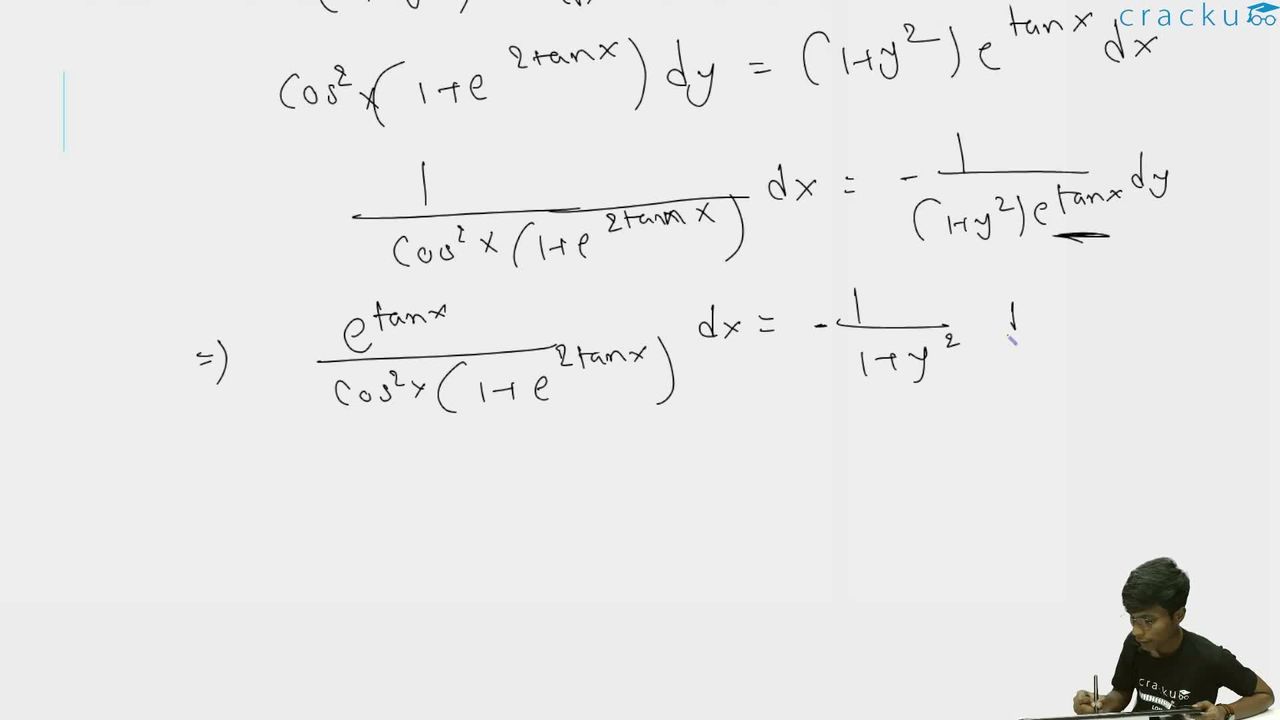
Since the equation can be separated, we rewrite it as $$\frac{e^{\tan x}}{\cos^2 x(1+e^{2\tan x})}\,dx = -\frac{dy}{1+y^2}\,$$. Noting that $$\frac1{\cos^2 x}=\sec^2 x$$ and letting $$u=\tan x\,$$ so that $$du=\sec^2 x\,dx\,$$, we transform the left side into an integral in $$u\,$$.
This gives $$\int \frac{e^u}{1+e^{2u}}\,du\,. $$ Substituting $$v=e^u\,$$ with $$dv=e^u\,du\,$$ changes the integral to $$\int \frac{dv}{1+v^2}=\tan^{-1}(v)=\tan^{-1}(e^u)=\tan^{-1}(e^{\tan x})\,. $$
On the right side, we have $$-\int\frac{dy}{1+y^2}=-\tan^{-1}y\,. $$
Combining both results, the general solution is $$\tan^{-1}(e^{\tan x})+\tan^{-1}(y)=C\,. $$
From the condition $$y(0)=1\,$$ we get $$\tan^{-1}(e^0)+\tan^{-1}(1)=\tan^{-1}(1)+\frac\pi4=\frac\pi4+\frac\pi4=\frac\pi2=C\,. $$
At $$x=\pi/4\,$$ we have $$\tan(\pi/4)=1$$ so that $$e^{\tan x}=e\,$$ and the relation becomes $$\tan^{-1}(e)+\tan^{-1}(y)=\frac\pi2\,. $$ This gives $$\tan^{-1}(y)=\frac\pi2-\tan^{-1}(e)=\tan^{-1}\!\bigl(\tfrac1e\bigr)\,, $$ and hence $$y=\frac1e\,. $$
The correct answer is Option (3): $$\frac{1}{e}$$.
Was this solution helpful?
Click on the Email ☝️ to Watch the Video Solution
Create a FREE account and get:
_1.webp)

Educational materials for JEE preparation

Ask our AI anything

AI can make mistakes. Please verify important information.
AI can make mistakes. Please verify important information.
