
Join Our JEE Preparation Group
Prep with like-minded aspirants; Get access to free daily tests and study material.
Sign in
Please select an account to continue using cracku.in
↓ →
Join Our JEE Preparation Group
Prep with like-minded aspirants; Get access to free daily tests and study material.
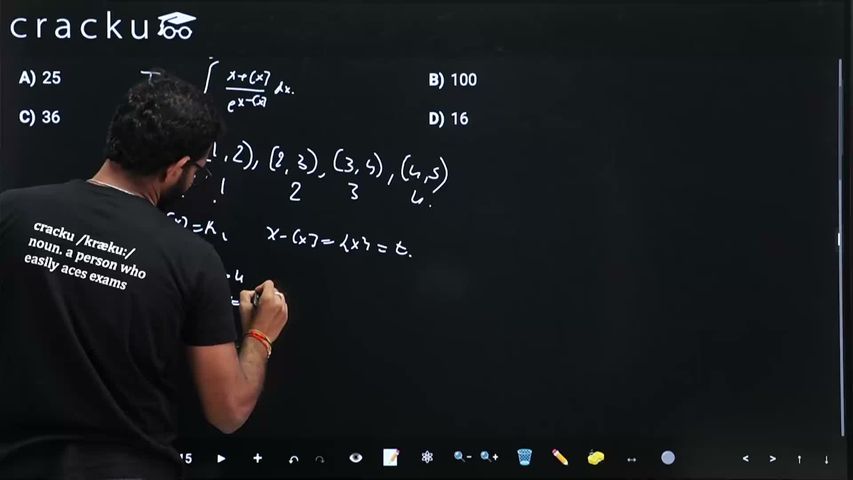
If the value of the integral $$\int_0^5 \frac{x + [x]}{e^{x-[x]}} dx = \alpha e^{-1} + \beta$$, where $$\alpha, \beta \in R$$, $$5\alpha + 6\beta = 0$$, and $$[x]$$ denotes the greatest integer less than or equal to $$x$$; then the value of $$(\alpha + \beta)^2$$ is equal to:
We wish to evaluate the integral
$$I=\int_{0}^{5}\dfrac{x+[x]}{e^{\,x-[x]}}\;dx,$$
where $$[x]$$ denotes the greatest integer less than or equal to $$x$$. Between any two consecutive integers the quantity $$[x]$$ is constant, so we split the whole interval $$[0,5]$$ into the five sub-intervals $$[0,1),[1,2),[2,3),[3,4),[4,5).$$
On the generic sub-interval $$k\le x<k+1$$ (with the integer $$k=0,1,2,3,4$$) we set
$$x=k+t,\qquad 0\le t<1.$$
Then we have
$$[x]=k,\qquad x-[x]=t,$$
and therefore
$$x+[x]=(k+t)+k=2k+t,\qquad e^{\,x-[x]}=e^{\,t}.$$
So the integrand becomes
$$\dfrac{x+[x]}{e^{\,x-[x]}}=\dfrac{2k+t}{e^{\,t}}=(2k+t)\,e^{-t}.$$
Thus, on each sub-interval,
$$\int_{k}^{k+1}\dfrac{x+[x]}{e^{\,x-[x]}}\;dx=\int_{0}^{1}(2k+t)\,e^{-t}\;dt.$$
Summing over all five integers $$k=0$$ to $$4$$, we obtain
$$I=\sum_{k=0}^{4}\int_{0}^{1}(2k+t)\,e^{-t}\;dt.$$
We now separate the terms containing $$k$$ and the term containing $$t$$:
$$I=\sum_{k=0}^{4}\Bigl[\,2k\int_{0}^{1}e^{-t}\,dt+\int_{0}^{1}t\,e^{-t}\,dt\Bigr].$$
The two needed definite integrals are
1. $$\displaystyle \int_{0}^{1}e^{-t}\,dt=\bigl[-e^{-t}\bigr]_{0}^{1}=1-e^{-1}.$$
2. For $$\displaystyle\int_{0}^{1}t\,e^{-t}\,dt$$ we use integration by parts. Taking $$u=t$$ and $$dv=e^{-t}dt$$ we get $$du=dt,\,v=-e^{-t}$$, hence
$$\int_{0}^{1}t\,e^{-t}\,dt=\Bigl[-t\,e^{-t}\Bigr]_{0}^{1}+\int_{0}^{1}e^{-t}\,dt =-e^{-1}+1-e^{-1}=1-2e^{-1}.$$
Denote
$$A=\int_{0}^{1}e^{-t}\,dt=1-e^{-1},\qquad B=\int_{0}^{1}t\,e^{-t}\,dt=1-2e^{-1}.$$
Substituting these values we have
$$I=\sum_{k=0}^{4}\bigl(2kA+B\bigr)=A\sum_{k=0}^{4}2k+5B.$$
The sum of the first five non-negative integers is $$0+1+2+3+4=10,$$ so
$$\sum_{k=0}^{4}2k=2\times10=20.$$
Thus
$$I=20A+5B=20(1-e^{-1})+5(1-2e^{-1}) =(20+5)-(20+10)e^{-1}=25-30e^{-1}.$$
We are told that $$I=\alpha\,e^{-1}+\beta,$$ so comparing gives
$$\alpha=-30,\qquad\beta=25.$$
The condition $$5\alpha+6\beta=0$$ is satisfied, as indeed $$5(-30)+6(25)=-150+150=0.$$
Finally, we need $$\bigl(\alpha+\beta\bigr)^2$$:
$$\alpha+\beta=-30+25=-5\quad\Longrightarrow\quad(\alpha+\beta)^2=(-5)^2=25.$$
Hence, the correct answer is Option A.
Was this solution helpful?
Click on the Email ☝️ to Watch the Video Solution
Create a FREE account and get:
_1.webp)

Educational materials for JEE preparation

Ask our AI anything

AI can make mistakes. Please verify important information.
AI can make mistakes. Please verify important information.
