
Join Our JEE Preparation Group
Prep with like-minded aspirants; Get access to free daily tests and study material.
Sign in
Please select an account to continue using cracku.in
↓ →
Join Our JEE Preparation Group
Prep with like-minded aspirants; Get access to free daily tests and study material.
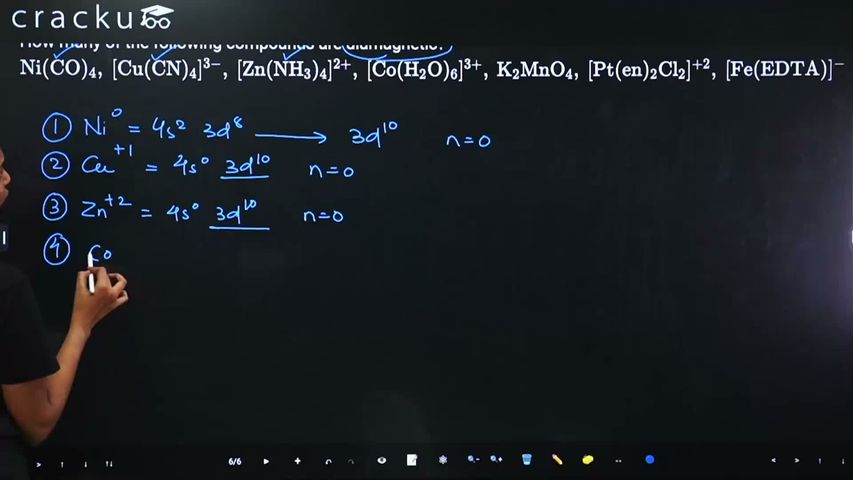
How many of the following compounds are diamagnetic?
$$\mathrm{Ni(CO)_4,\ [Cu(CN)_4]^{3-},\ [Zn(NH_3)_4]^{2+},\ [Co(H_2O)_6]^{3+},\ K_2MnO_4,\ [Pt(en)_2Cl_2]^{+2},\ [Fe(EDTA)]^-}$$
Correct Answer: 5
A compound is diamagnetic when all the electrons are paired.
1. $$Ni(CO)_4$$
CO is a neutral ligand, so Ni is in the $$0$$ oxidation state.
$$Ni^0: 3d^{10}$$
All electrons are paired. Hence, it is diamagnetic.
2. $$[Cu(CN)_4]^{3-}$$
Let the oxidation state of Cu be $$x$$.
$$x+4(-1)=-3$$
$$x=+1$$
Thus,
$$Cu^+:3d^{10}$$
All electrons are paired. Hence, it is diamagnetic.
3. $$[Zn(NH_3)_4]^{2+}$$
NH3 is a neutral ligand.
$$Zn^{2+}:3d^{10}$$
All electrons are paired. Hence, it is diamagnetic.
4. $$[Co(H_2O)_6]^{3+}$$
$$Co^{3+}:3d^6$$
Co(III) has a large octahedral splitting, and the hexaaqua complex is treated as low spin:
$$t_{2g}^6e_g^0$$
There are no unpaired electrons. Hence, it is diamagnetic.
5. $$K_2MnO_4$$
The oxidation state of Mn is:
$$2(+1)+x+4(-2)=0$$
$$x=+6$$
Thus,
$$Mn^{6+}:3d^1$$
There is one unpaired electron. Hence, it is paramagnetic.
6. $$[Pt(en)_2Cl_2]^{2+}$$
For the complex ion:
$$x+2(0)+2(-1)=+2$$
$$x=+4$$
Thus,
$$Pt^{4+}:5d^6$$
Pt(IV) is a 5d metal ion and forms a low-spin octahedral complex:
$$t_{2g}^6e_g^0$$
All electrons are paired. Hence, it is diamagnetic.
7. $$[Fe(EDTA)]^-$$
EDTA has a charge of $$-4$$.
$$x+(-4)=-1$$
$$x=+3$$
Thus,
$$Fe^{3+}:3d^5$$
The complex is high spin with five unpaired electrons. Hence, it is paramagnetic.
Therefore, the diamagnetic compounds are:
$$Ni(CO)_4,\ [Cu(CN)_4]^{3-},\ [Zn(NH_3)_4]^{2+},\ [Co(H_2O)_6]^{3+},\ [Pt(en)_2Cl_2]^{2+}$$
Hence, the number of diamagnetic compounds is:
$$\boxed{5}$$
Therefore, the answer will be 5.
Was this solution helpful?
Click on the Email ☝️ to Watch the Video Solution
Create a FREE account and get:
_1.webp)

Educational materials for JEE preparation

Ask our AI anything

AI can make mistakes. Please verify important information.
AI can make mistakes. Please verify important information.
