
Join Our JEE Preparation Group
Prep with like-minded aspirants; Get access to free daily tests and study material.
Sign in
Please select an account to continue using cracku.in
↓ →
Join Our JEE Preparation Group
Prep with like-minded aspirants; Get access to free daily tests and study material.
Let $$f$$ be any continuous function on $$[0, 2]$$ and twice differentiable on $$(0, 2)$$. If $$f(0) = 0$$, $$f(1) = 1$$ and $$f(2) = 2$$, then:
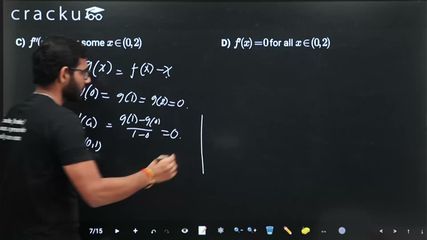
We have a function $$f$$ that is continuous on $$[0,2]$$ and twice differentiable on $$(0,2)$$ with the data $$f(0)=0,\;f(1)=1,\;f(2)=2$$. In order to bring the three equal end-values required by Rolle’s Theorem into the problem, let us introduce a new auxiliary function
$$g(x)=f(x)-x.$$
This simple subtraction is motivated by the desire to “cancel’’ the given values of $$f$$ at the three integer points. Indeed, substituting $$x=0,1,2$$ we obtain
$$\begin{aligned} g(0)&=f(0)-0 =0,\\ g(1)&=f(1)-1 =0,\\ g(2)&=f(2)-2 =0. \end{aligned}$$
Thus $$g$$ is continuous on $$[0,2]$$, differentiable (in fact twice differentiable) on $$(0,2)$$, and it satisfies $$g(0)=g(1)=g(2)=0$$.
Now recall the statement of Rolle’s Theorem: “If a function is continuous on $$[a,b]$$, differentiable on $$(a,b)$$ and $$h(a)=h(b)$$, then there exists some $$c\in(a,b)$$ such that $$h'(c)=0.$$”
We apply Rolle’s Theorem first to the interval $$[0,1]$$ for the function $$g$$. Because $$g(0)=g(1)=0$$, there is a point $$c_{1}\in(0,1)$$ with
$$g'(c_{1})=0.$$
We repeat the same reasoning on the interval $$[1,2]$$. Since $$g(1)=g(2)=0$$, there is another point $$c_{2}\in(1,2)$$ satisfying
$$g'(c_{2})=0.$$
At this stage we know that $$g'$$ vanishes at two distinct points $$c_{1}$$ and $$c_{2}$$ lying strictly inside $$(0,2)$$. Because $$g'$$ is continuous on $$[c_{1},c_{2}]$$ and differentiable on $$(c_{1},c_{2})$$ (again a consequence of the differentiability properties of $$f$$), we can apply Rolle’s Theorem once more—but now to the derivative $$g'$$ itself—on the interval $$[c_{1},c_{2}]$$. Since $$g'(c_{1})=g'(c_{2})=0$$, there exists some point $$c\in(c_{1},c_{2})\subset(0,2)$$ such that
$$g''(c)=0.$$
But $$g(x)=f(x)-x$$, so differentiating twice gives $$g''(x)=f''(x)-0=f''(x).$$ Therefore
$$f''(c)=0\quad\text{for some }c\in(0,2).$$
This conclusion matches exactly Option C, which states “$$f''(x)=0$$ for some $$x\in(0,2).$$”
Observe furthermore that
• Option A (“$$f''(x)>0$$ for all $$x$$”) is impossible because we have just found a point where $$f''$$ equals zero.
• Option B (“$$f'(x)=0$$ for some $$x$$”) is not guaranteed; the example $$f(x)=x$$ satisfies all given conditions yet has $$f'(x)=1$$ everywhere.
• Option D (“$$f'(x)=0$$ for all $$x$$”) is certainly false for the same linear example.
Hence, the correct answer is Option C.
Was this solution helpful?
Click on the Email ☝️ to Watch the Video Solution
Create a FREE account and get:
_1.webp)

Educational materials for JEE preparation

Ask our AI anything

AI can make mistakes. Please verify important information.
AI can make mistakes. Please verify important information.
