
Join Our JEE Preparation Group
Prep with like-minded aspirants; Get access to free daily tests and study material.
Sign in
Please select an account to continue using cracku.in
↓ →
Join Our JEE Preparation Group
Prep with like-minded aspirants; Get access to free daily tests and study material.
Consider all the structural isomers with molecular formula $$C_{5}H_{11}Br$$ are separately treated with KOH(aq) to give respective substitution products, without any rearrangement. The number of products which can exhibit optical isomerism from these is ______.
Correct Answer: 3
We need to find all structural isomers of $$C_5H_{11}Br$$, treat each with aqueous KOH (SN2/SN1 substitution, no rearrangement), and count how many products exhibit optical isomerism.
The structural isomers of $$C_5H_{11}Br$$ (monobromopentanes) are:
1. $$CH_3CH_2CH_2CH_2CH_2Br$$ (1-bromopentane)
2. $$CH_3CH_2CH_2CHBrCH_3$$ (2-bromopentane)
3. $$CH_3CH_2CHBrCH_2CH_3$$ (3-bromopentane)
4. $$(CH_3)_2CHCH_2CH_2Br$$ (1-bromo-3-methylbutane)
5. $$(CH_3)_2CHCHBrCH_3$$ (2-bromo-3-methylbutane)
6. $$(CH_3)_2CBrCH_2CH_3$$ (2-bromo-2-methylbutane)
7. $$(CH_3)_3CCH_2Br$$ (1-bromo-2,2-dimethylpropane / neopentyl bromide)
8. $$CH_3CH_2CH(CH_3)CH_2Br$$ (1-bromo-2-methylbutane)
Now, substitution with KOH(aq) replaces Br with OH. The product is the corresponding alcohol. For optical isomerism, the product must have a chiral center (asymmetric carbon).
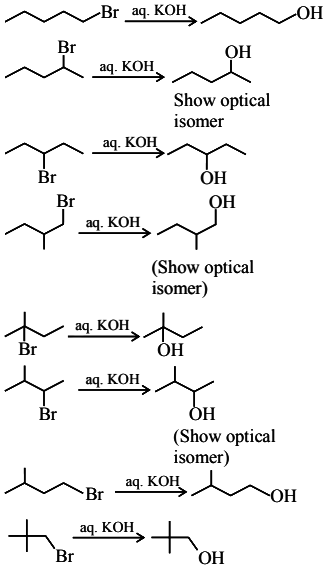
The products that can exhibit optical isomerism are: 2-pentanol (from isomer 2), 3-methyl-2-butanol (from isomer 5), and 2-methyl-1-butanol (from isomer 8).
The answer is 3.
Was this solution helpful?
Click on the Email ☝️ to Watch the Video Solution
Create a FREE account and get:
_1.webp)

Educational materials for JEE preparation

Ask our AI anything

AI can make mistakes. Please verify important information.
AI can make mistakes. Please verify important information.
